Yaquina Head Lighthouse – Birds

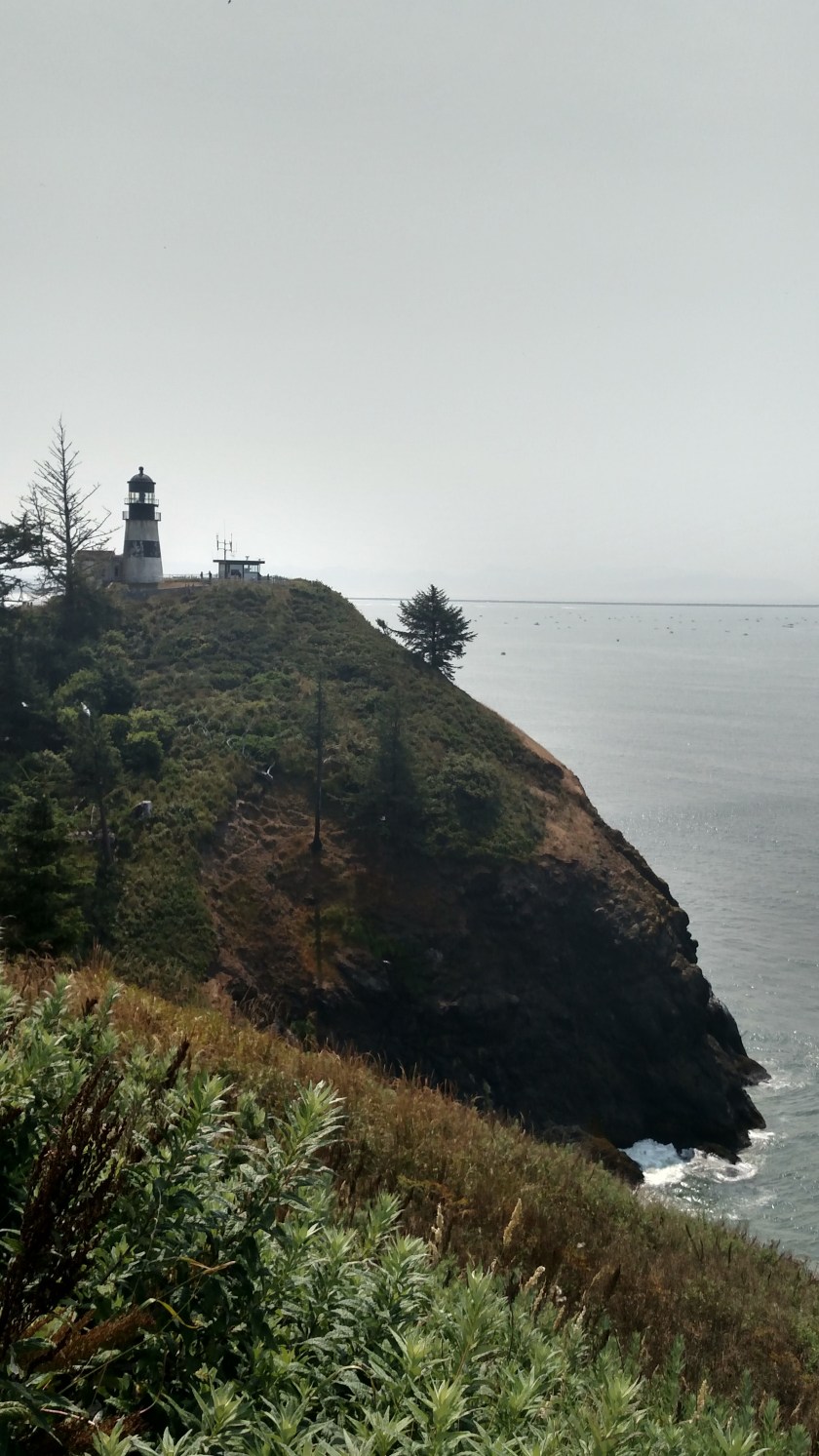
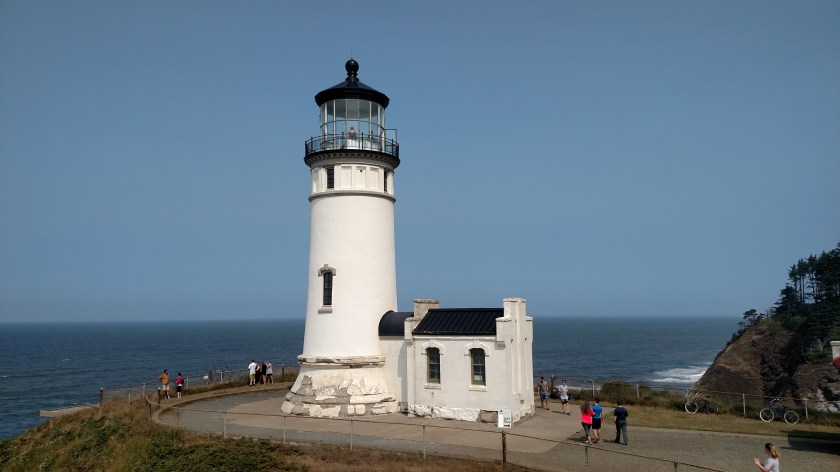
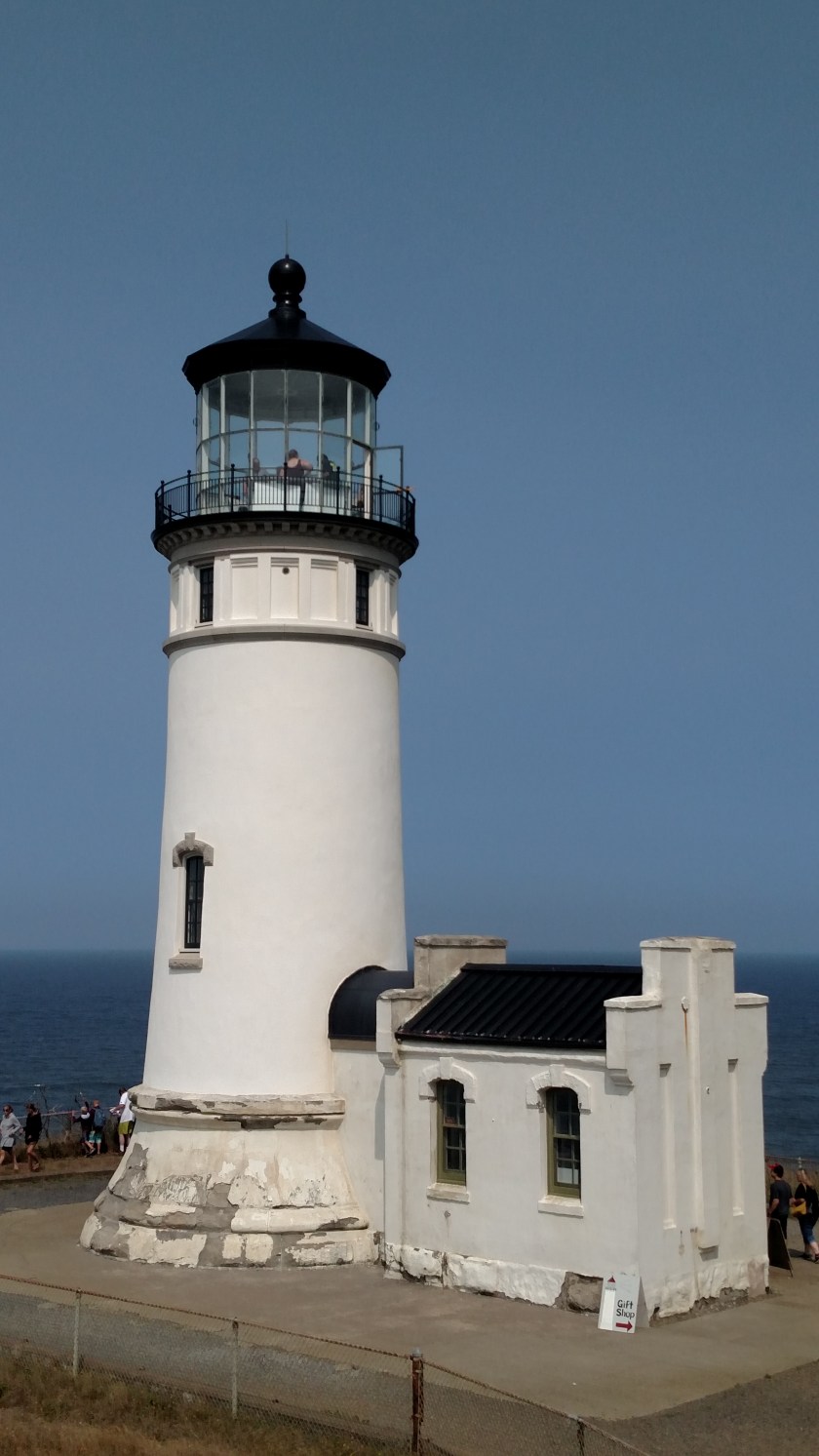
Saturday I went to see both lighthouses which are near Newport, Oregon. The larger one, located north of town, sits right out by the ocean and has some large rocks sitting just offshore which is a great spot to see birds.

On the south side of the lighthouse:

IMG_20180804_115146634

IMG_20180804_115155838

And standing near the late-morning shadow of the lighthouse, looking west-northwest:

IMG_20180804_120132677

The two biggest rocks as seen from those two vantage points held the largest number of birds. The tops of each were literally covered with Common Murres:

DSCN5560

DSCN5610

This area has one of the largest populations of these little penguin-like birds on the west coast. I had seen some down in California but they were too far away to get a good picture of them. And where they gather, they gather en masse. They do not make nests but lay their eggs on flat, bare rock, near a cliff. The eggs have an unusual shape, like a pear, so while they may move around a bit, they won’t roll off the cliff because they roll in a circle. These birds are similar to the Pigeon Guillemot (with the red feet and having bright red inside their mouths) but these are your basic black and white. Unlike penguins, common murres can fly (although they evidently aren’t very agile). Their biggest feature is the ability to dive underwater, often to great depths. And young chicks know how to dive as soon as they hit the water for the first time.
Another bird I saw lots of were cormorants. I have seen many of these in many different places but rarely get blogworthy photos. The ones I saw on Saturday were on rocks which were rather close and with the angle of the sun I was able to get some decent pictures.

DSCN5599

DSCN5602

DSCN5897

These birds have very long necks and when they fly they look sort of like geese (though they are sleeker). They like to hang out on rocks, and often nest in holes on the sides of cliffs. I most often see them floating on the water and they frequently dive underwater, sometimes for over a minute, looking for food. When they get up on land they often stand with their wings spread out – literally to air-dry! They don’t have very efficient water-shedding feathers like ducks.

DSCN3255

Generally when I’ve seen cormorants they appear to be black, but like the ibis I finally saw up close when I was near Klamath Falls, these can have colorful feathers and with a cooperating sun angle I actually captured some shots showing this.

DSCN5842

DSCN5868

This group of cormorants appear to be having a good laugh over something:

DSCN5849

Perhaps the silly man with the red camera, over by the lighthouse.

I also spotted some brown birds which I thought were something I hadn’t seen before but later learned they were just young Western Seagulls.

DSCN5615

And although this post is mostly about birds, when I was reviewing my pictures from the day I found I had this interest sequence of a seal on the rocks:

DSCN5569

Then he fanned out his tail (kind of like he was stretching his legs)…

DSCN5570

And rolled on his side to take a nap…

DSCN5573

Depoe Bay, Oregon

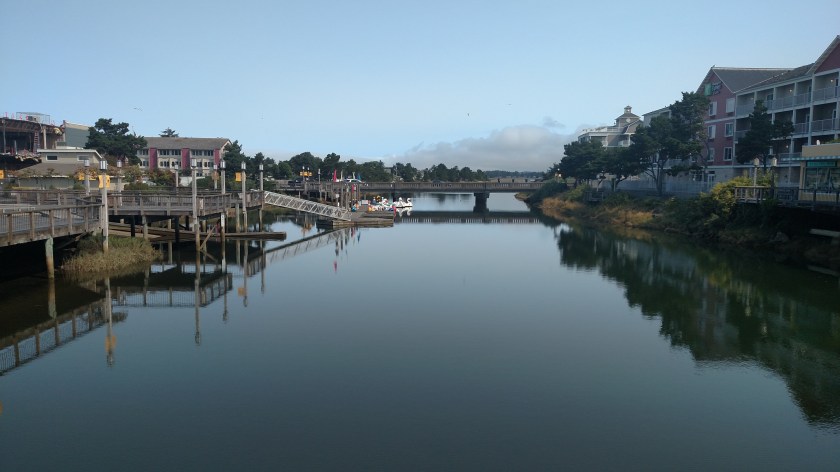
Saturday afternoon, after getting my tire issue resolved in Newport, I drove further north to this little town which sits right along the ocean.  While Depoe (pronounced d-po) Bay is small, it has two big things which bring people here.  Actually one big thing and one small thing.  Depoe Bay has the distinction of having the smallest navigable harbor in the world:

IMG_20180804_133239811_HDR

Trust me, that’s it.  I took two more photos, one slightly left and one slightly right but they each show just a tad more water.

The Bay sits just on the land side of the concrete bridge which takes busy Highway 101 over it:

IMG_20180804_133251147

That photo was taken from the pedestrian walkway which people can use to cross under the highway.  Here is a view looking towards the ocean from under the bridge:

IMG_20180804_133350779_HDR

And looking from the outside in:

IMG_20180804_133452129_HDR

And there is a reason why so many people park on the land side of the highway but want to be on the ocean side – and it isn’t to go to the beach.

The big thing Depoe Bay has going for it is REALLY big.  Whales.

The west coast of the United States is a great place to see whales migrate north for the winter and south for the summer.  Several of the places I have already been to in California and southern Oregon have places which are specifically designed to help people whale watch.  The signs I read in those places seemed to indicate that I was “between seasons” and I figured I wouldn’t see any.  Well, it turns out that there is a small population of, maybe 60, gray whales that live in this area year-round and Depoe Bay seems to be their favorite hangout.  There are numerous whale watching companies based here which ferry people out to sea to look for whales.  As I would learn on Sunday when I returned here, you don’t have to be out at sea to see whales.  Several came right into the Bay and I’ll post pictures of them tomorrow.

Here is a 3-shot panorama of the Bay as seen from the pedestrian bridge on the west side of Highway 101:

IMG_20180804_133457028_HDR

IMG_20180804_133504541_HDR

IMG_20180804_133508424_HDR


Florence to Yachats, Oregon

Friday I drove north on Highway 101 from where I had been staying near Florence to the little town of Yachats.  Here are some of the things I saw along the way:

This is the town of Florence as I approached before crossing the bridge you see on the left.

IMG_20180803_083339126_HDR

I had stopped in Florence the day before (when it was overcast) and got this sign in the “Old Town” area which shows the distances to other towns in North America named Florence.

IMG_20180802_120248373

This is from the hill which Highway 101 climbed (to about 450 feet) before descending to the Heceta Head lighthouse.  This is looking at the beach and ocean southward, towards Florence.  This is beyond the Oregon Dunes National Recreation Area so this is mostly just flat, sandy beach.

IMG_20180803_093017949_HDR

IMG_20180803_093035974_HDR

Here is another picture of the beach area about 15 minutes later with different areas getting sunlight (it was mostly overcast over the inland area but mostly clear at the beach itself)

IMG_20180803_094634830

From the other side of the 450 foot hill this is the first overlook from which you can see the Heceta Head lighthouse in the distance.  I took similar pictures when I was here before but it was overcast and now it was mostly sunny.

IMG_20180803_100147699_HDR

And here is a zoomed-in shot of the lighthouse:

DSCN5513

This is a 3-shot panorama, left to right, of another beach a little further up the road (from back down at beach level).

IMG_20180803_101822986

IMG_20180803_101818075

IMG_20180803_101809997


Cape Perpetua Area

Friday I spent some time at various parts of this area just south of Yachats, Oregon.  One of the most popular spots seemed to be Cooks Chasm, a long area with rough rocks and narrow inlets.  This is a VERY popular place at high tide as the water crashing against the rocks puts on quite a show.

IMG_20180803_104620758

IMG_20180803_104626212

One of the spots near the bridge which carries Highway 101 over the deep inlet (seen below) has a naturally developed hole which, under the right conditions, shoots a geyser of water high in the air at high tide.

IMG_20180803_104754142

Another area just north from Cooks Chasm is called Devil’s Churn, and it also puts on a show at high tide.  Look closely at the bottom of the photo and you’ll see some people.

IMG_20180803_110712973_HDR

I just enjoyed the incredible beauty of this area because I was there at low tide (of course).  While it turns out to be just down the road from where I am staying in Yachats, the small parking areas were already full at low tide and I imagine it gets incredibly crowded at high tide so I never came back.  I’m sure there are videos on YouTube.

After looking at things from highway-level I took a two-mile road up a mountain to around 850 feet above sea level which gave me a very different view:

When I first got there I was a little nervous about the view:

IMG_20180803_111730409_HDR

But all I had to do was take a dirt path a short ways out towards the ocean.  Friday was the exact opposite of coastal weather I have experienced during this trip.  Today there was a heavy cloud deck inland but the coast was clear.  (Hmmm… “the coast was clear”… that seems to be a neat phrase – maybe I’ll trademark it).

IMG_20180803_111909977

IMG_20180803_112013423_HDR

IMG_20180803_112241720_HDR

Much better.

I soon came to a little rock cabin, which had an amazing view of the ocean:

IMG_20180803_112822053_HDR

IMG_20180803_112833490_HDR

IMG_20180803_112848138_HDR

Before I went back down to the highway I took one last look south:

IMG_20180803_112908201

And north, towards Yachats:

IMG_20180803_105649248_HDR

And when I got back down to the highway I stopped at the Visitor Center and had this view of the ocean from their deck:

IMG_20180803_114745508


The Little Log Church

This little church and museum is in the oceanside town of Yachats, Oregon.  It was built in 1930 in the shape of a cross.

IMG_20180803_141206328_HDR

IMG_20180803_141227990_HDR

IMG_20180803_141318691

As the size of the congregation grew it outgrew the building (the sanctuary only holds about 60 people) and a new church was constructed nearby.  This building was converted to a museum, which underwent a complete restoration in 1993, still has an operating 100 year-old pump organ, and there is a very nice garden area behind the building.  The property may be rented for weddings or other events.

IMG_20180803_141510066_HDR

IMG_20180803_141530186_HDR

I walked through the building looking at old photographs and memorabilia but was most interested in a large cabinet displaying a variety of colorful shells and other items:

IMG_20180803_141623866

IMG_20180803_141630185_HDR

IMG_20180803_141636618_HDR

IMG_20180803_141652436_HDR

IMG_20180803_141703573_HDR

IMG_20180803_141713288_HDR

IMG_20180803_141718211_HDR


Yachats, Oregon

Friday I drove north from Florence and my next stop which was in this little town by the ocean.  It is spelled like yachts but with an extra ‘a’ near the end.  When you say it the ‘c’ is silent (like the ‘p’ in urine).  Put the emphasis on the first syllable and people will think you’ve lived here all your life…     YA-hots.

This was the view of the beach and part of the oceanfront from the Yachats State Park, about a half mile from where my Airbnb for the next two nights was located.  These were taken early afternoon, at low tide:

IMG_20180803_125909005

IMG_20180803_125914751

IMG_20180803_125922895

IMG_20180803_125937725

After walking around town a bit I drove about 9 miles inland to see one of the many covered bridges in Oregon.  I was surprised to learn that there are actually still quite a few such bridges in the southwest part of the state.

IMG_20180803_134907791

IMG_20180803_135008027

IMG_20180803_135016481

IMG_20180803_135042533

I drove back in to town to see some other sites (and had to tend to a car repair issue which ended up taking the bulk of the afternoon).

At high tide, a little before 6pm, I walked back out to the little park to take pictures of the beach area and that part of the oceanfront again:

IMG_20180803_174111378

IMG_20180803_174115436

IMG_20180803_174119397


Dean Creek Elk Viewing Area

I am pleased to report that I have FINALLY seen a fairly large number of elk in the wild.  I had stopped at this area a few miles east of Reedsport, Oregon on Wednesday as I drove up to Florence, which features a lengthy parking area parallel to the main road (but separated from it) where people can safely watch the fields for elk which have come out of the wooded area behind it.  These are free range elk but evidently choose to hang out in this area on a fairly regular basis.

When I stopped by on Wednesday I saw, of course, zero elk.  Par for the course for me.  I have been to a huge elk preserve outside of Jackson, Wyoming on two different trips there and didn’t see any there either.  Nor did I see any in central Pennsylvania (a state I’ve lived in most of my life and didn’t even KNOW there were elk there).  A few years ago I was driving through rural northern Wisconsin at night (I had put myself “on the clock” and arrived later than expected at my Airbnb there).  That night I saw signs warning of elk crossing the road for the next 20 miles.  I’ve wanted to see an elk in the wild but was glad that I DIDN’T see any that night!

But I digress…

Thursday afternoon I returned to this area near Reedsport and, sure enough, there were maybe 30 elk out grazing in the fields.  There were quite a few adult females (called cows) and their offspring, which were obviously smaller in size but were getting pretty big.  I did not see any adult males (called bulls).

DSCN5419

DSCN5420

DSCN5426

DSCN5429

DSCN5439

I returned Thursday in the late afternoon and spotted one huge bull – although he wasn’t in the “viewing area” but in a field about a half mile before it (where there wasn’t anywhere to safely park).  I went and got pictures of the other elk (maybe twice as many as I had seen earlier in the day) then parked back towards town and walked back along the main road to get some pictures of the bull.  This group of cows was evidently his “harem” – that’s really what they call it.  Adult males will amass a loyal following of females which he breeds with and that group is, in fact, called a harem.

DSCN5442

DSCN5443

DSCN5446

DSCN5456

DSCN5457

DSCN5460

DSCN5462

DSCN5463

DSCN5465

DSCN5466

Darling’s RV Campground & Marina

This was my Airbnb home for two nights while staying near Florence, Oregon.  I was in a one-room apartment without any scenic view (which I knew when I made the reservation) but I was there mainly to sleep, shower and post my blog.  The other features of the facility more than made up for it.  The campground sits a short ways off busy Highway 101 so there was virtually no traffic other than people coming to the campground itself and a handful of neighbors.  The campground sits just across a small road from the north shore of Sitcoos Lake, and they have a few docks where you may rent boats, jetskis and kayaks or put your own in the water and enjoy the lake.
IMG_20180802_190546047_HDR

IMG_20180802_190551349_HDR

IMG_20180802_190556511_HDR

The current owners bought the dormant 100-year old resort about 4 years ago and have breathed new life into it by putting in a lot of hard work and long hours.  They have a small, friendly staff who help maintain the grounds and cook 3-meals a day in their restaurant/pub.  It is a wholesome, family environment and reminded me very much of a husband/wife operated resort in the Pocono Mountains of Pennsylvania which was a client of mine when I lived and worked up there.  Most of the guests here have their own motorhomes or large pull-behind trailers but there were also some more primitive campsites and rental units like the one I stayed in.

Thursday evening, my final night there, I caught these scenes in the early evening as the sun was setting out over the ocean:

IMG_20180802_202404676_HDR

IMG_20180802_202438476_HDR

IMG_20180802_202652780

IMG_20180802_202811071

IMG_20180802_202917486_HDR

IMG_20180802_203255423

IMG_20180802_203337907

IMG_20180802_203745593_HDR

Oregon Dunes National Recreation Area

Wednesday I traveled about 40 miles north of where I had been staying in Glasgow (North Bend), Oregon to the town of Florence.  In that distance I only saw the ocean twice, briefly.  Not because of coastal fog.  Because of sand.

That 40 mile stretch comprises most of the Oregon Dunes National Recreation Area, part of the Siuslaw National Forest.  Huge sand dunes, some as high as 500 feet, stretch along the coast as far as the eye can see – and they block the view of the ocean from Highway 101.  I saw the ocean when I stopped to visit the Umpqua River Lighthouse and I saw it again when I climbed a wooden staircase to a viewing platform at the Oregon Dunes Day Use Observation Area.  After that I didn’t see it until I was well north of Florence at the Heceta Head Lighthouse.

Here is a 4-part view of a map covering the 40-mile stretch.

IMG_20180801_140603970

IMG_20180801_140608167

IMG_20180801_140614348

IMG_20180801_140618496

Some areas of the dunes are for people only – no OHV’s (Off Highway Vehicles) are permitted, but there are several large areas (with red dots) where people (with recreation permits) can take their own OHV’s, or they can rent them from several vendors in the area.  There are also companies which will take you on a ride, or will take large groups in huge dune buggy-type vehicles.

IMG_20180803_082413308_HDR

IMG_20180803_082452879_HDR

Parts of the dunes are temporarily off-limits to everyone to help protect the Snowy Plover while it is nesting:

Snowy_Plover audubon.org mike baird

(Photo credit: Mike Baird  audubon.org)

Here was what I saw from the Ocean Dunes Day Use Area.  This is a 3-shot panorama, looking left to right.  The people in the second photo are two adults running down the hill.  In the third photo there are several people of all ages.

IMG_20180801_141137353

IMG_20180801_141044028_HDR

IMG_20180801_141143329_HDR

DSCN5358

When I left the Airbnb I was staying at on Thursday I noticed that there was a huge sand dune where the road I was on met Highway 101:

DSCN5478

And here are two photos I found online:

Alottasand DinaPavlis

(Photo credit: Dina Pavlis  alottasand.com)

Oregon Sand thewandererschuckandkate blogspot

(Photo credit: thewandererschuckandkate.blogspot.com)


Umpqua River Lighthouse

Can you spot the lighthouse in this photo?

IMG_20180801_111358437_HDR

It isn’t where you’d expect it to be.  Need help?  About a third of the way in from the right, look straight down from the end of the rock jetty which extends out into the ocean.  There you’ll see the top of the Umpqua River Lighthouse.  And by the way, inside the “triangle” in the ocean at the center of the photo they farm mussels and oysters.

IMG_20180801_114017104_HDR

This lighthouse stands 61 feet tall and is located at a Coast Guard housing complex about a mile inland near the mouth of Winchester Bay, Oregon.  It is 165 feet above sea level. This is actually the second lighthouse near this location.  The first was built in 1857 but was destroyed by a flood in 1864, hence the decision to built the replacement further inland and on higher ground.  This one was commissioned in 1894 and is still operational.

A unique feature of this lighthouse is the light it emits.  Instead of a standard white beacon it has a partially colored lens and emits two white bursts of light, followed by a red one.

IMG_20180801_113713380_HDR

DSCN5348

DSCN5351

Here are photos I found online:

umpqua_rb lighthousefriends

(Photo credit:  lighthousefriends.com)

Here is the inside of the lens:

Umpqua-Lighthouse DennisSkogsbergh

(Photo credit & copyright: Dennis Skogsbergh)