Photos and stories of my journey across the US and Canada
I am back in Durham after my big 2025 road trip. I am working on getting all the photos I took organized on my computer to expedite posting and hope to resume posts very soon.
I will eventually be creating a number of pdf files which list all my previous posts, enabling visitors to find specific posts from earlier trips (over 1,300 and counting). I know how to do it, I just need the time. Lord knows I had plenty of that at home in the weeks leading up to my departure, but it was consumed with other projects, prepping and packing. I will let everyone know when they are completed and will email them to anyone interested.
If you use the calendar grid to the right, go back to May, 2025. Then click on May 13th. There you will find a post I made which contains 100 links to some older posts from 2018 (San Diego)/2019 (Eastern Canada) to give you an idea what I’m talking about. You may also use the calendar grid on the right side of this page to go to any other month the blog existed. I started the blog in the Spring of 2016. I traveled and took photos for two years prior to that but have only posted a select few, and some of my early posts only included 1 photo (I was a blog newbie) and I need to post more from the tens of thousands of photos I’ve taken.
FOR THOSE OF YOU NEW TO THE BLOG:
Welcome to my travel blog, where I post photos of my trips throughout the United States and Canada. For details on my intent for this project please click on “About” in the upper right hand corner. If you have comments or requests please feel free to contact me by clicking on “Contact” in the upper right hand corner.
If you are new to the blog please note that you are seeing the most recent posts first. As you scroll down you are going back in time. You may read statements which may not make much sense right at the moment because they may refer to a discussion earlier in the blog. If you want to find posts for a specific place (e.g. Grand Canyon) enter it in the search box. You may also use the calendar grid to use the “way-back” function to time travel back to a particular day’s posts.
Enjoy, and PLEASE feel free to share the blog address with others. Also feel free to copy and save any photos I’ve taken. You should be able to right-click on them and save them to your device (but if you sell them and make a gazillion dollars, please slip me a zillion or two. We’ll just keep that between us). The photos are best viewed on a computer or tablet, not a phone. The larger the screen the better.
They say everything’s bigger in Texas. That may be true until you start talking about Alaska , which in land mass alone, is 2.19 times larger. It’s a big place. And I have only been traveling in a small portion of it. The main roads are all in the southeast corner of the state and there is much, much more land to the north and west.
This is a sign I saw in Earthquake Park, north of Anchorage, a few days ago.
It talks about comparable areas of wetlands between the two. which is a whole nother matter.
There are 4 major highways in Alaska, not surprisingly numbered 1, 2, 3 and 4. Yes, there are other, smaller ones I’ll talk about in a minute.
1 – Runs from Tok, southwest through Glennallen, west through Anchorage and south to Homer. 538 miles, 9 hrs 38 min (per Google).
2 – Runs from the Canadian border with Yukon, northwest through Tok, Delta Junction, and Fairbanks plus a few more miles to Livengood. 624 miles, 7 hrs 34 min.
3 – Runs from Palmer north to Fairbanks. 327 miles, 5 hrs 36 min.
4 – Runs from Delta Junction, south through Glennallen to Valdez. 268 miles, 4 hrs 37 min.
Yes, there are shorter stretches of highway with different numbers:
11 – The “Dalton Highway” north from Livengood to Prudhoe Bay, a dangerous stretch of road not for the faint of heart, and not considered a major highway.
9 – Which branches off from 1 to run south to Seward.
5 – Which branches off from 2 to run northeast to Chicken.
7 & 98, in the Alaskan Panhandle which run south to Haines and Skagway respectively, though I will drive through much more of the Yukon Territory and extreme northwest British Columbia to actually get to them than I will while I am in Alaska.
This is part of the reason I am so far behind posting photos here on the blog. It takes me a long time to get from Point A to Point B, plus the time to stop and take photos. My 2 hr 22 min trip to Valdez took over 6 hours because I stopped every 4 minutes to take pictures! So please be patient with me. Believe me, I am seeing many amazing things EVERY DAY and I am banking lots of photos. I will get caught up eventually.
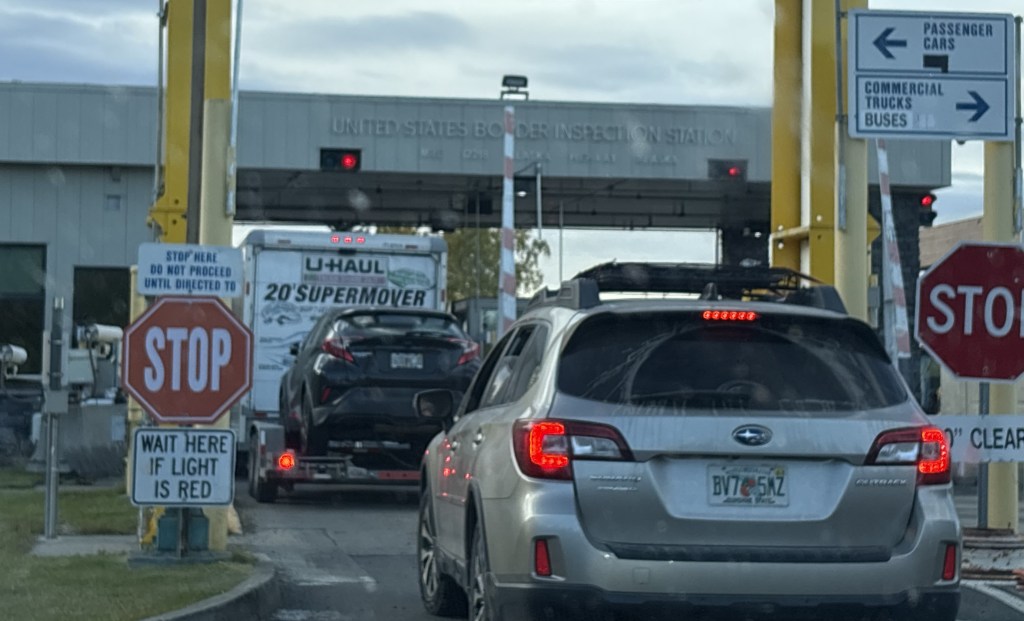
Real time post – A week ago today I crossed the border from the Yukon Territory into the United States near Beaver Creek, YT. It was around 6pm PDT, which then became 5pm AKDT when I crossed the line. As big as Alaska is, most of it is in one time zone – except the extreme southern Aleutian Islands which are on Hawaii Time. And Alaska only has one Area Code – 907.
Actually, I was already in the US – I had crossed the line about 30 miles earlier but the Customs Inspection Station wasn’t until later. I guess they really want to nab you before you can slink back into Canada.
When it got to be my turn it was pretty straightforward until we got to the subject of fruit. The agent was only interested in my 1 1/3 bags of mandarin oranges which I had purchased at a Walmart in Prince George, BC. He didn’t seem to care about the one banana I had left, or the two partial bags of apples I was packing.
He confiscated them. (He took two large potted plants from the woman in the car ahead of me. Lord knows what was in the U-Haul her traveling companion was driving).
Maybe he was hungry and was outfitting his apartment.
Anyway – I was cleared to go shortly thereafter and on my way to Tok (pronounced toke), AK.
And I just talked about road conditions in my last post. The first 10 miles or so of the highway in the US were pristine. Newly paved and without blemishes. (Take THAT, Canada… we know how to do roads over here!)
Then things started to go south. Same issues as in Canada except little or no warning at offending spots, and POTHOLES! Lots of POTHOLES! I honestly don’t think I saw a single pothole on the Alaska Highway in the Yukon. I swear they must go out every morning and patch them before they get worse. Not so on the US side.
Guess AKDOT needs to tuck it’s tail between it’s legs….
In their defense, I will give AKDOT kudos for repairing the road near Anchorage after a major earthquake many years ago. I remember seeing news stories about how they removed and replaced entire sections of the badly damaged roadway in record time. They apparently had all the materials ready to go, and moved in as soon as it was safe to do the rebuild.
I should have posted this earlier after I had driven across the southern edge of British Columbia the second week I was in Canada. During that leg of my trip I had to drive across a few small mountains (fortunately I drive around most of the big ones) and in lots of places the speed limit would drop as I approached turns, not uncommon on mountain roads. Now I will admit I sometimes channel my inner Shane van Gisbergen (* see footnote at end of post) and take some of these turns at speed, going wide on entry, hitting the apex, and going wide on exit. I am an experienced driver (though not on the proverbial closed course, so don’t start emulating me – I will plead the fifth) and only do this when I am well aware of the lack of traffic around me. In fact, when I was on Vancouver Island and drove north to Port Hardy my Airbnb host told me – “You will enjoy the road going up there. It is in good shape and you may not even need to slow down, just hold onto the wheel with both hands”. He was right!
I have learned, however, that when you see this sign:
that you need to SLOW DOWN. In Canada, when they say slow down they mean it! This also rang true in the Canadian Rockies. In the Canadian National Parks their roads are wide, sometimes multi-lane affairs (with passing lanes in some areas) and with a 90/kph speed limit in most places, but on tight turns you still need to slow down.
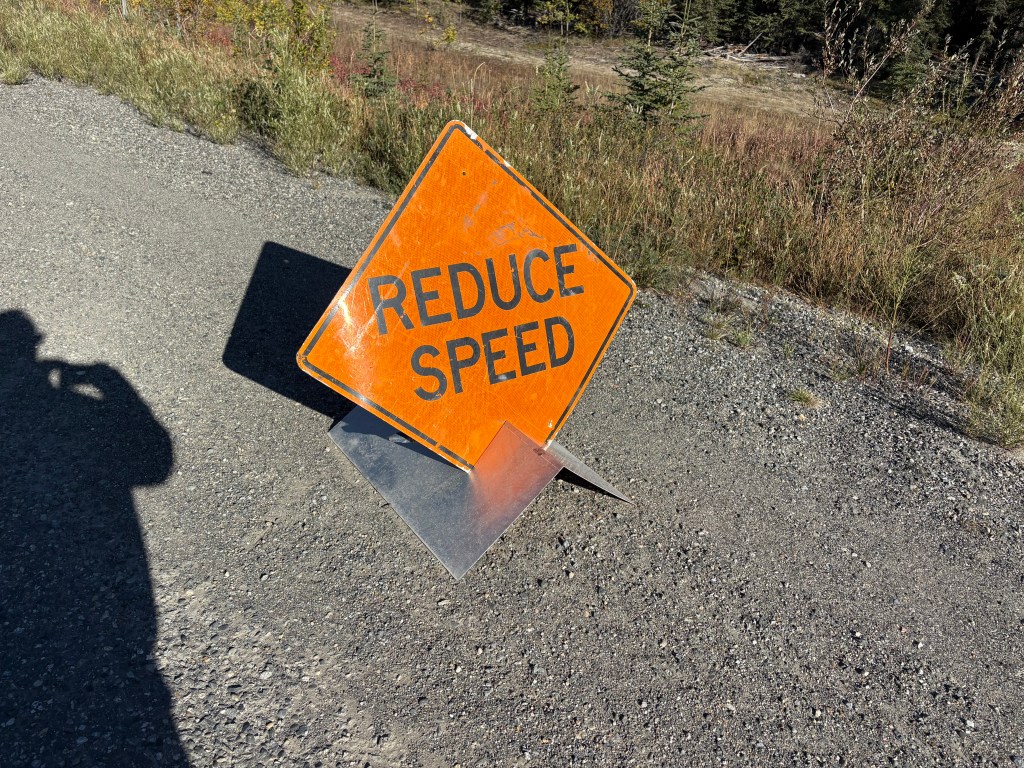
Even further evidence of this is when I crossed the southern edge of the Yukon Territory on my way west to Alaska. I was traveling on the Alaska Highway, what would be known as the Trans Canada Highway in other parts of Canada, is still referred to by its former name once one gets close to the US state. Because of the extreme cold this far north, parts of the Alaska Highway deteriorate rather quickly as potholes develop and/or the roadway “heaves,” creating undulations which, if repeated over a short distance, cause your vehicle to “porpoise” as if you were a dolphin swimming in front of a cruise ship. At full speed the result of these, usually unexpected, undulations can become catastrophic, hence the need to SLOW DOWN. These conditions can develop very quickly and randomly so instead of permanent signs, as was shown above, the Canadian Department of Transportation (probably called Transportation Canada) puts out temporary signs at each bad spot in the road.
And there are many.
Sometimes you only get the second sign, indicating a bump or dip in the road (which you can also see in the photo above. This one didn’t require any patches but can still catch the driver off guard), but the two signs generally travel in pairs. And God forbid you see an orange flag next to the Slow Down sign, as it means a severe undulation or road heave, which is sometimes like driving over a speed bump (or as Peter Sellers called it in the Inspector Clouseau movies, a “bimp”). Remember it – Orange Flag means SLOW DOWN, and big yellow sign saying SLOW means SLOW DOWN.
Now in addition to the signs, during the day the driver can often see major patches made on the road in advance, as they are all black of an otherwise gray roadway, and with black tire marks from the heavy equipment used to make the repairs. And often, if the repairs were major, they result in a very uneven surface, again necessitating a reduction in speed. I wouldn’t want to drive these roads at night – not only because of the risk of animals in the road, but also the inability to see the defects before arriving at them.
When I got in the extreme western part of the Yukon, “Transportation Canada” evidently ran out of small signs as there were NUMEROUS, major patches which were not marked (except an occasional orange flag). So in addition to worrying about animals in the road I also had to be on my toes for road conditions. I would sometimes cross to the opposite lane if the damage was confined to my side, again, well aware of other traffic around me.
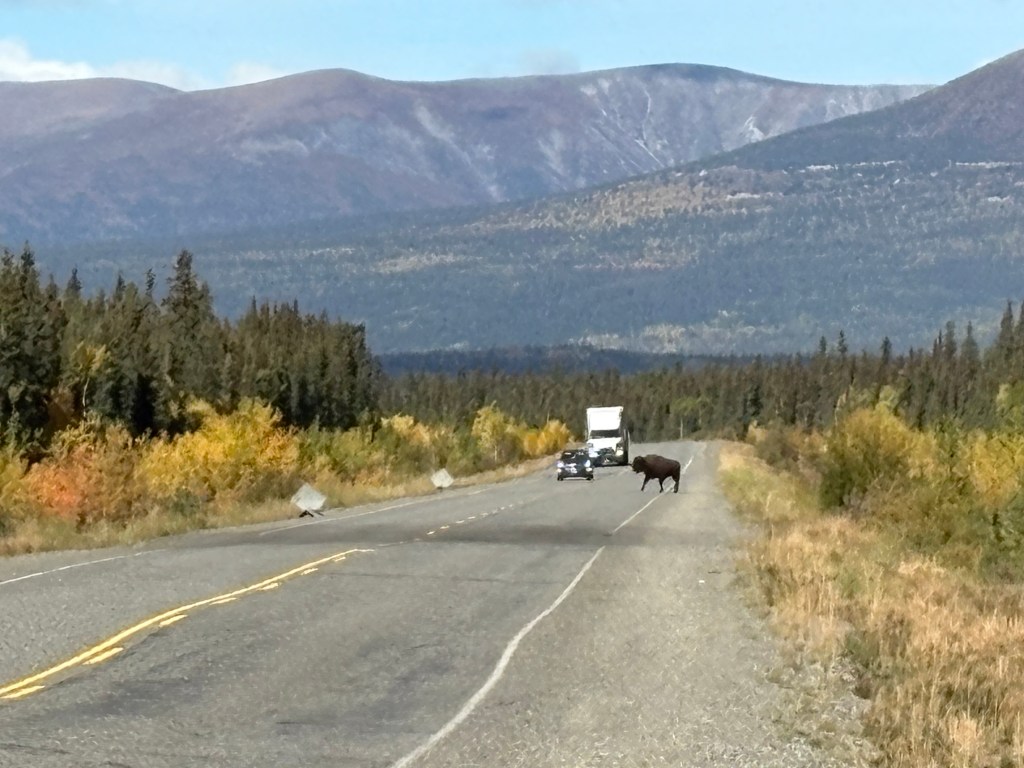
And speaking of animals in the road – as I was taking the two orange sign photos above I saw two bison casually cross the road well ahead of me:
If I hadn’t stopped to take my pictures I would have missed it. One of the FEW wildlife sightings I have had during this entire trip.
And I will also note that the car which had stopped to let the bison cross the road also stopped when she got up to my car to ask if I had broken down. I assured her, no, I was just out of the car taking pictures but thanked her for her concern and for stopping to inquire. Before she drove off, she observed “They’re not tame” and I said “No ma’am, they’re not.”
Shane van Gisbergen is race car driver from New Zealand. He used to race in the Australian “Supercar” series but came to America to compete in the inaugural NASCAR Cup Series street race in Chicago three years ago. He won. His first ever race in a Cup car, which some full time NASCAR drivers can’t even drive, AND he is used to steering from the right side of the car! Trackhouse Racing team owner Justin Marks, himself a very successful road course driver, had provided a car for him to use in the race and immediately signed him to a full-time contract. He now competes full time in the Cup Series and wins most of the road course and street races he participates in, including the Xfinity “minor league” Series. Experienced NASCAR drivers openly marvel at his ability. He still struggles on the ovals, but he’s a damn good driver and loves his NASCAR!
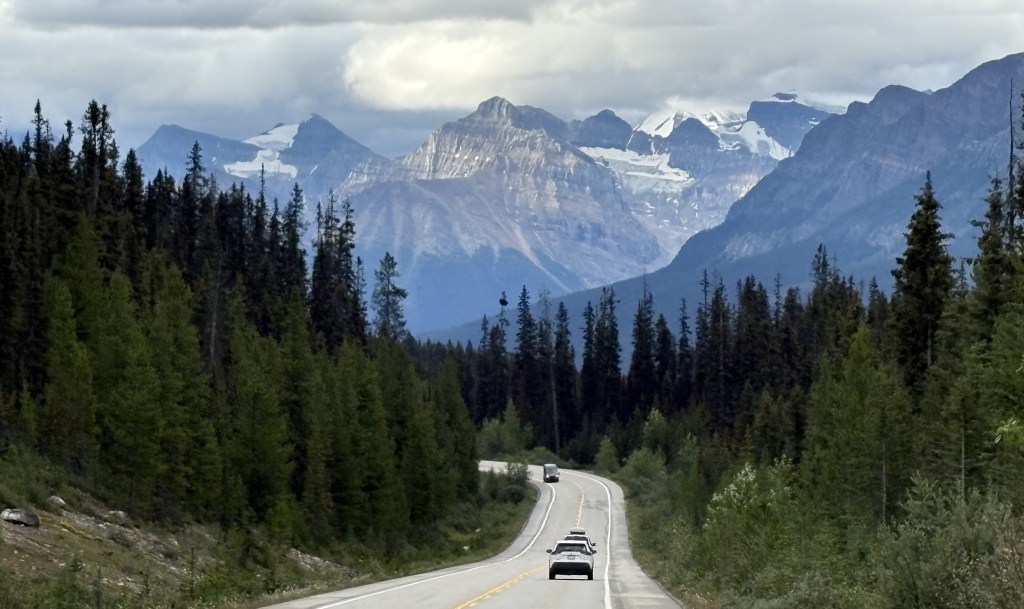
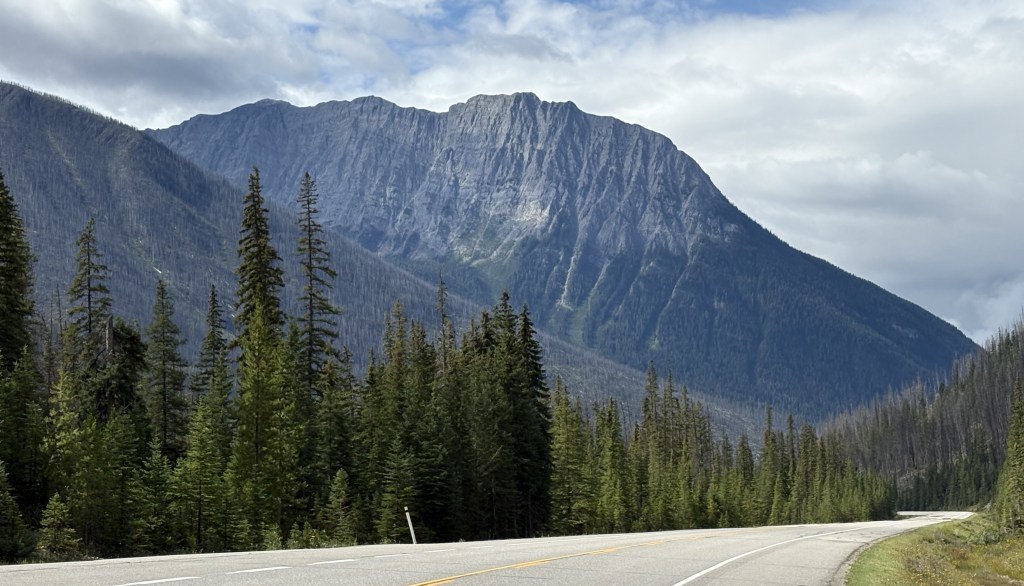
Almost all of my drive northward to Jasper National Park involved driving on British Columbia Highway 93N, which I turned left onto after having driven northeast through Yoho National Park when I left Thursday morning from where I was staying in Golden. The photos I posted previously of several lakes (Herbert, Bow and Peyto) and mountains were actually taken in Banff National Park, a large section of which I would drive through to get to the Parkway. As I post this next set of photos I realize I am STILL in Banff National Park and am still making my way north towards Jasper NP and the town of Jasper. Once I cross the line into Jasper National Park the road will become what is called the Icefields Parkway, so named because of the many mountains which have snow and ice packs (glaciers, or ice fields) on their higher elevations year-round, including these mountains which are still in Banff NP.
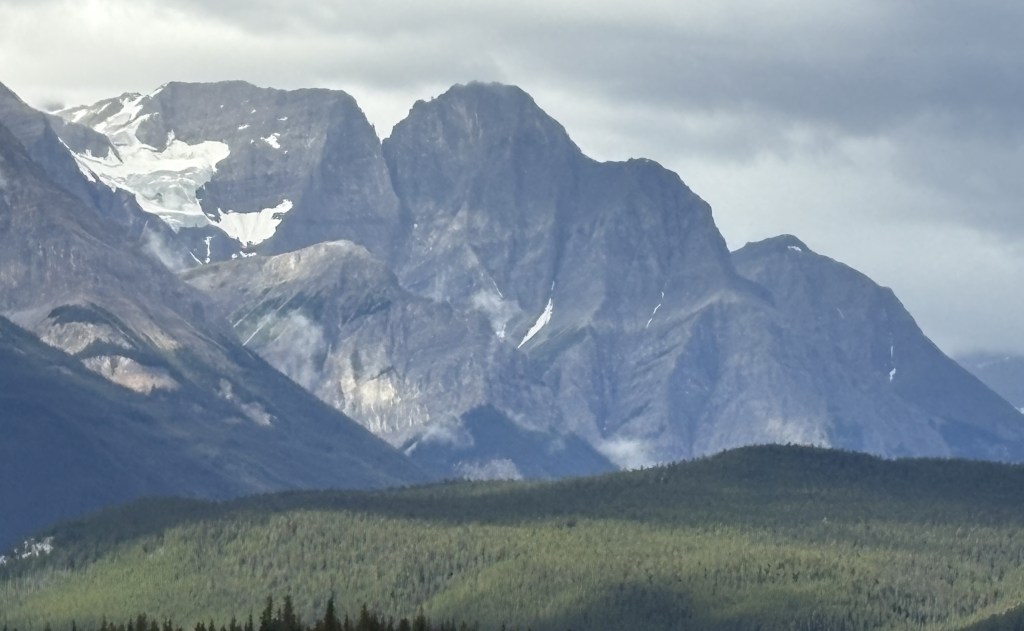
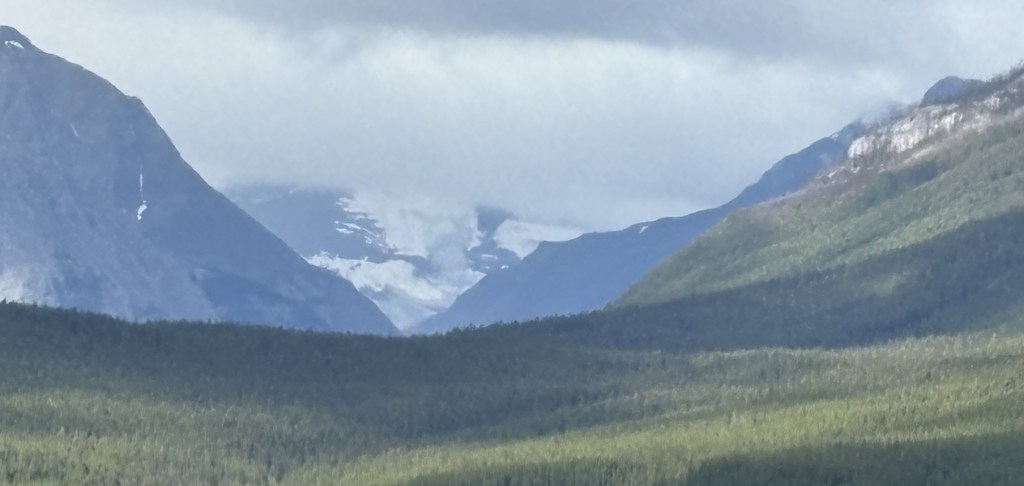
The day started out cloudy, and with some low clouds near the mountains. It was rather cold and windy which made it feel quite raw. Here are some of the many glaciers I saw as I drove north.
A closer look at two of the peaks in the photo above from a slightly different angle:
Again with these mountains, it is hard to name names and give elevations because there are rarely signs identifying them. There are two very large icefields I will come to that definitely have names and are the main focus of specific tours which take paying customers directly to them, or to an exclusive observations platform which allow them to take photos. I will point them out when I get to them in the next post.
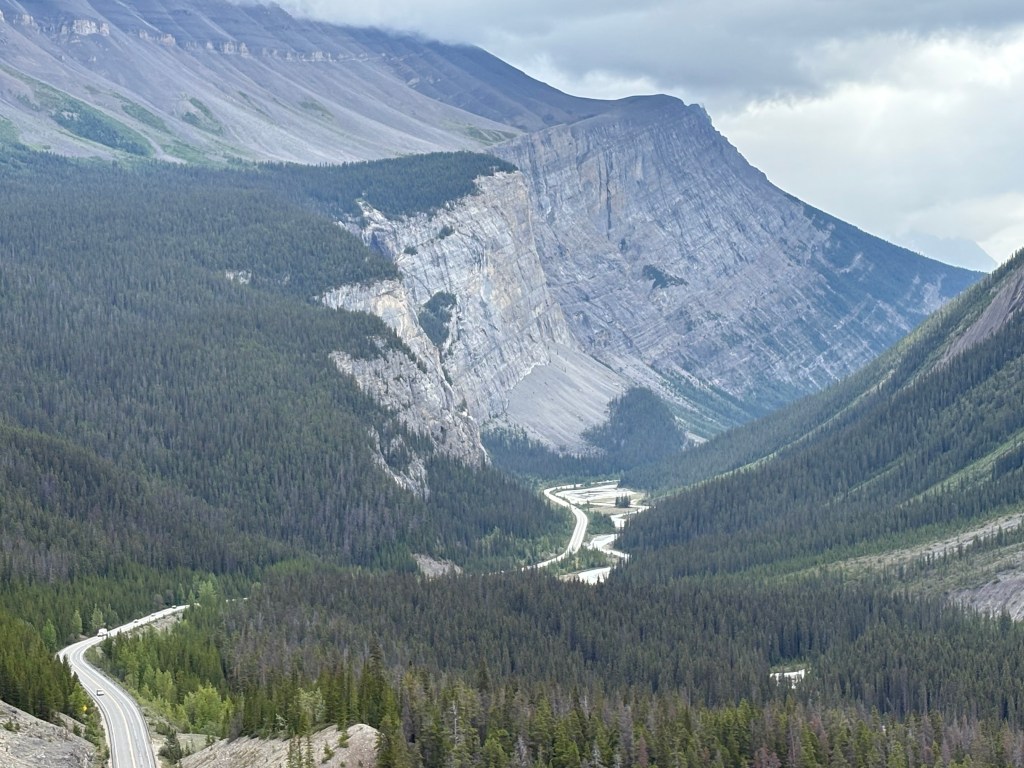
This is looking back after I started climbing the road through Wilcox Pass:
Driving north through Sunwapta Pass and Wilcox Pass will result in an overall altitude change and will also signify the transition from Banff NP to Jasper NP, and the official start of the Icefields Parkway.
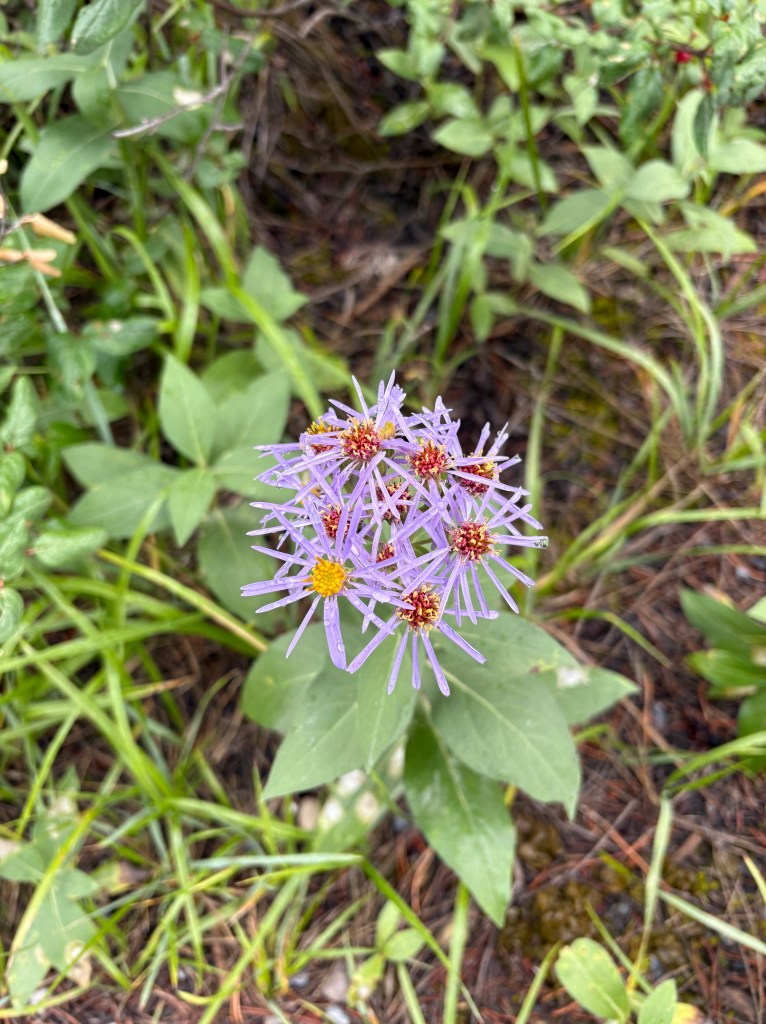
A little color at the viewpoint from which I took the preceding photo:
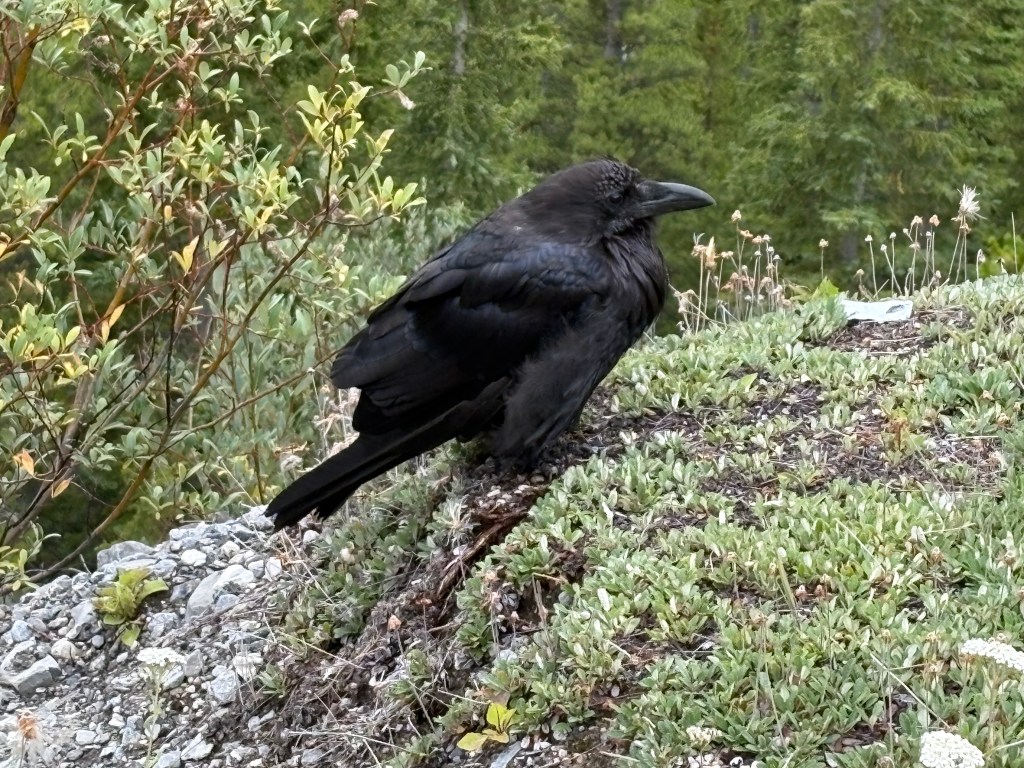
And a big fat crow, sitting on the ground watching all the tourists getting out of their cars and taking photos of the view looking back at the lower elevation we had just come from.
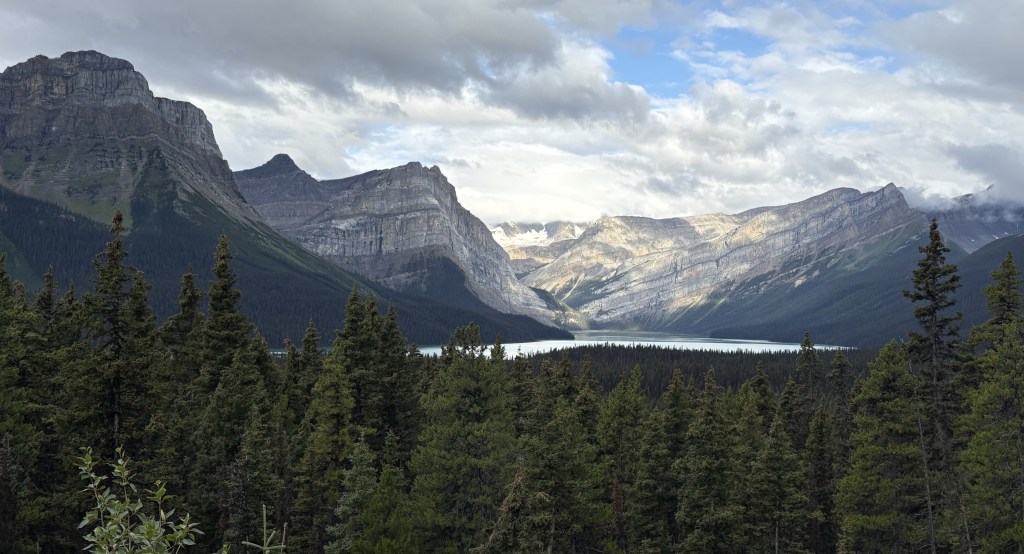
And a wider view looking back. These photos were all taken August 8, about a month ago as I actually post this. As you can see it was an overcast, albeit clear (air-wise) day. I drove through this same area a few days ago in slightly less ideal conditions due to wildfire smoke which is now being thrust into British Columbia and the Candian Rockies from other parts of Canada, and took more photos which, when it comes time to post them, will show a slightly different look.
Even in the less than ideal conditions cloud-wise, I was glad I got here in early August when I did.
A real-time JohnBoy travel update. I arrived in Grande Prairie, Alberta yesterday afternoon having driven up from Valemount, British Columbia which is located northwest of the town of Jasper. There were only two routes to get here from there and I chose the shorter, but more circuitous one. It involved going right back to the town of Jasper, which is in the northern part of Jasper National Park (where I filled my tank with gas), driving through the Park from west to east, something I haven’t done yet other than getting to Valemount two days earlier, and after exiting the Park on the east side I proceeded north, west, and then further north on Alberta Highway 40, a two lane road which ended up being a very pleasant drive through rolling hills and mainly open land, and with very little traffic. I was at about 3,100 feet elevation the whole time. I am only now starting to see some color in the trees. Of course 99% of the trees I see up here are pine trees, which don’t change color, but there are others mixed in and they are starting to show some traces of yellow. The nights are starting to get colder and the days will soon follow.
I added a new “big animal” warning sign to my growing list – caribou! I didn’t see any, and when I stopped at a Visitor Center a short time later in a small, local town I was told the area I had just driven through contains a herd of about 150, but they are considered endangered in this area and people are supposed to report sightings, and/or unfortunate road incidents where they are injured or killed, to the Game & Wildlife authorities. I’m glad they told me that because no one else had, and there were no signs to that effect anywhere.
Visibility has improved somewhat from when I was in Red Deer but there is still wildfire smoke in the area, and even as far south as Vancouver there are now sporadic dangerous Air Quality alerts. I am getting ready to review the British Columbia wildfire map as soon as I post this, as the smoke forecast for western Canada now shows smoke moving east from a series several wildfires in the middle section of British Columbia! If I hadn’t changed my travel schedule to head north towards Alaska next week I would have soon been in the British Columbia town of Kamloops, which is getting the brunt of the smoke from these fires this weekend. I suspect these may be new fires, but will verify that shortly. Nevertheless, Prince George, where I will be going tomorrow morning after I spend a second night here, is in the Moderate risk class for air quality as of today and I will probably stay indoors there, too.
I have to go out after the rain passes to get some last minute things at Walmart and do two loads of laundry at a laundromat (the washing machine here at the Airbnb isn’t working). Just as well, as I am now packing my warm weather gear in the trunk and getting out the warmer layers which I will be using very soon. Wednesday, when I start heading north in earnest, the day temperatures will only be in the 60’s in the afternoon and down around 40 at night. Once in Alaska it may not get out of the upper 50’s during the day but the nights will stay in the upper 40’s. I believe the weather in and around Anchorage is a little more moderate than it is inland because of their proximity to water. I will have to be more mindful to the weather as I travel to other areas of the state.
The “Safety Sam” emergency-wear (bright colored tuques, as they call them in Canada, and gloves, and a reflective vest if out of the car for an extended period) will now be close at hand, along with my bear spray, of course. That is one of the additional purchases I must make today at Walmart or a local hunting outfitter.
Lastly, there are now thunderstorms in the area which may be a double-edged sword. Any rain will be welcome as it will help clear the smoke out of the air, and will reduce the fire risk. The danger is lightning, which could trigger more fires in the already dry conditions. This isn’t a very big system so it won’t be a soaking rain, but every little bit helps. I will have to keep a close eye on this whole area in the next few days. I think once I head north the middle of next week I should be out of the wildfire and smoke situation based on the information I have right now.
The first full day based in Golden I decided to drive to up to Jasper National Park to see how the recovery from the devastating wildfire last year is coming along, and to see the extent of damage for myself. To get there I would first have to go back through Yoho National Park to get to Hwy 93. I then drove quite a while in Banff NP before actually getting to Jasper NP at the start of the “Icefields Parkway,” which is considered by some to be the most scenic drive in Canada. So I will break this first Jasper post up into 4 parts – Going through Banff NP, driving up the Icefields Parkway, Jasper NP and, finally, the town of Jasper.
After driving north through Yoho NP I turned left on Route 93 to head towards the town of Jasper. Mapquest says the total drive time from Golden to the town of Jasper is 3 1/2 hours. It will take considerably longer than that because it seemed like I was stopping every 10 minutes to take photos of something.
As soon as I got on Rte 93 I started taking pictures. This is Herbert Lake. Looking left:
And looking right:
It’s all on one side of the highway, it’s just a big lake! Seemingly everywhere you look up here there are mountains.
And this is just getting from Point A to Point B!
A closer look at the mountain on the right, and the more of many glaciers you will see.
One of the amusing trailhead and campsite signs I saw.
I wonder if this mosquito attracts many humans? I suspect so….
Rivers and streams come in two types up here – glacier fed and normal rain runoff. This is an example of the latter:
Crystal clear, and very cold, water
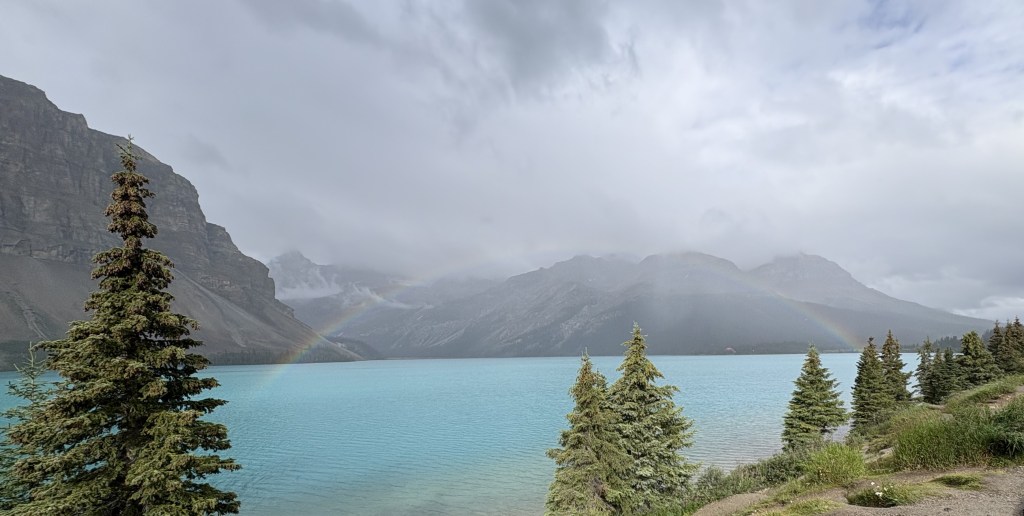
This is my first look at Bow Lake, fed by the Bow Glacier. Remember that name, as it will be a recurring theme once I get further down the road to the town of Banff.
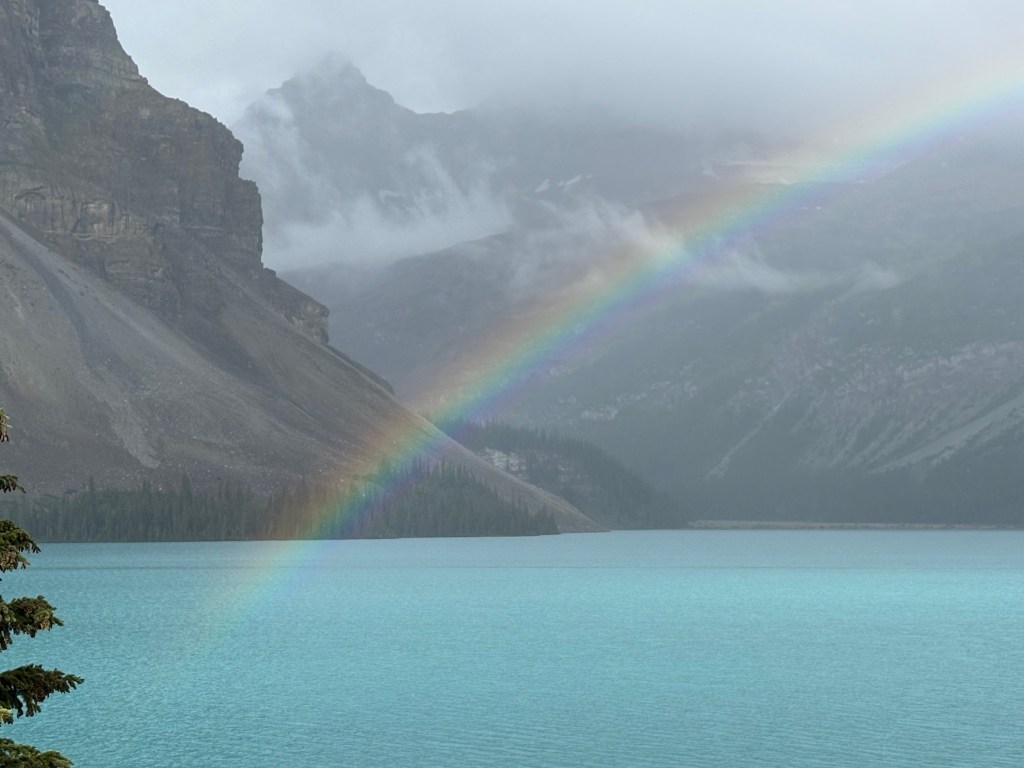
Glacier fed lakes and rivers have various tints, depending on the minerals released when the ice pack (glacier) on top of the mountain melts. This one is a very pretty turquoise color. As you can tell from the photos it was overcast this morning so the color of the water isn’t as rich as it would be if there was a bright blue sky overhead. Bow Lake is quite large. This is a little further up the road where there was a pullout for cars and tour buses to stop.
Sometimes the reward for taking pictures is being in the right place at precicely the right time. As I was walking back to the pullout area where I had parked my car the sun came out behind me VERY briefly. Just long enough to create a rainbow over the lake.
The photos don’t really do it justice. Because I was so close to it the colors in the rainbow were very vivid, especially the blues, indigos and violets.
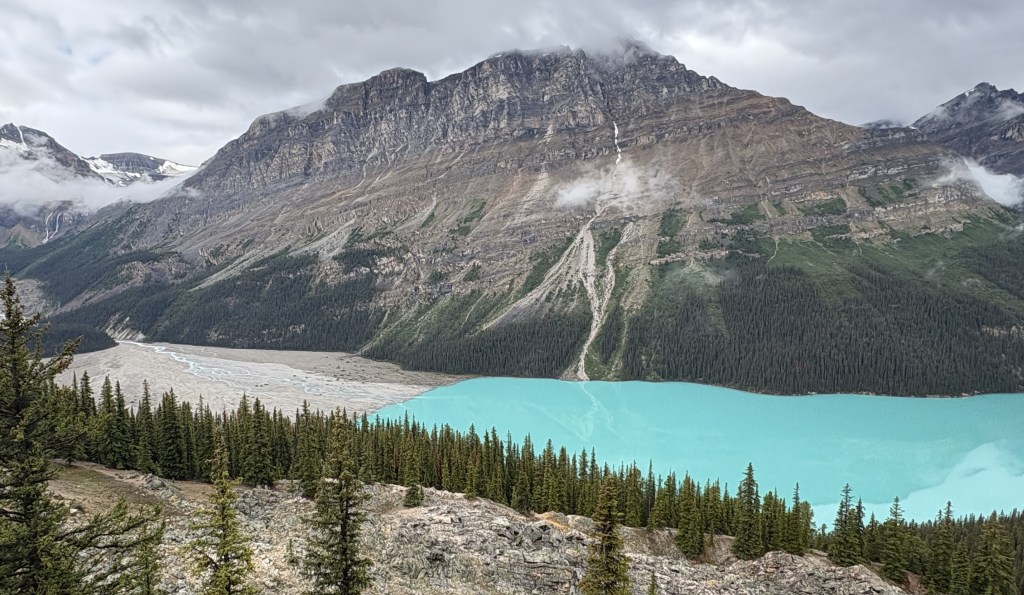
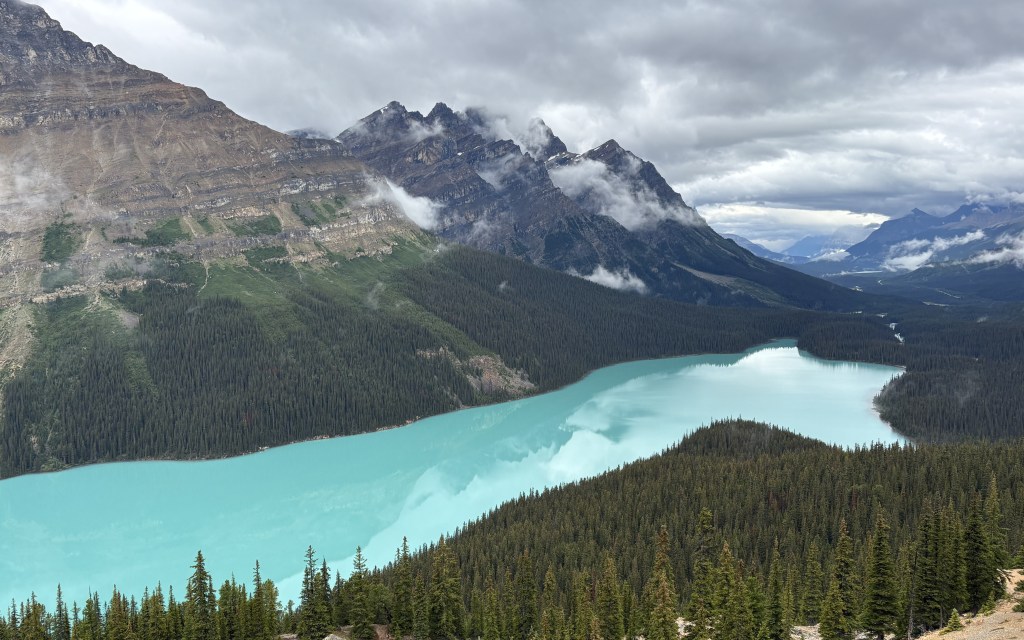
This was walking up the hill to another lake just up the road. Peyto Lake is also glacier fed, from the, you guessed it, Peyto Glacier.
There was a sign indicating we were at 2,078 meters elevation (6,817 feet), the highest point on the Icefields Parkway. I presume they were talking about the roadway getting here, as we were still walking up a VERY steep, albeit paved, trail to get to a scenic viewpoint for the lake below. I was huffing and puffing, and exclaimed to another person walking near me that I didn’t expect to have to climb a mountain to see a lake. I found him when we got to the observation platform and told him it was SO worth it.
The glacier, which you can’t really see because of the clouds, is in the upper far left corner of both photos above. If you look closely you can see how the water drains down through the brownish gray area to get to the lake itself.
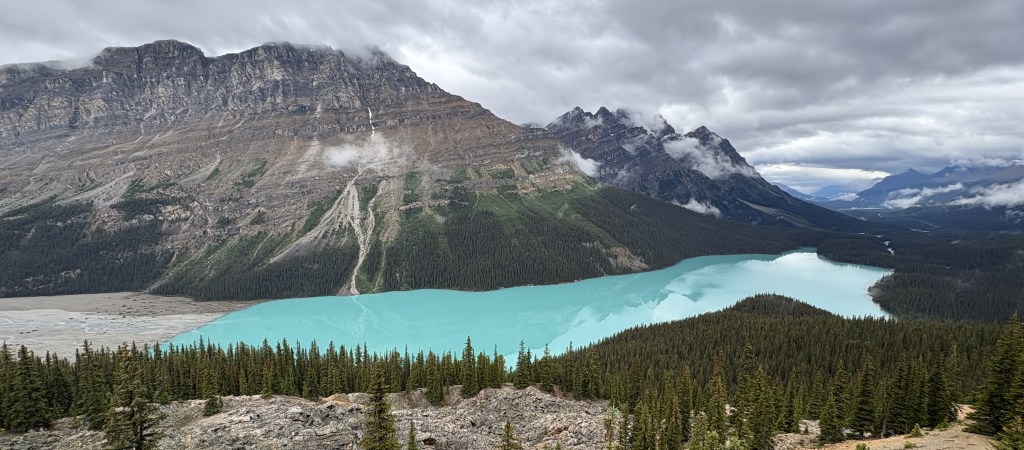
Here’s the whole lake in one photo:
The next section of my journey to the town of Jasper would take me through the Icefields Parkway. If you think you’ve seen some glaciers so far, you ain’t seen nothin’ yet!
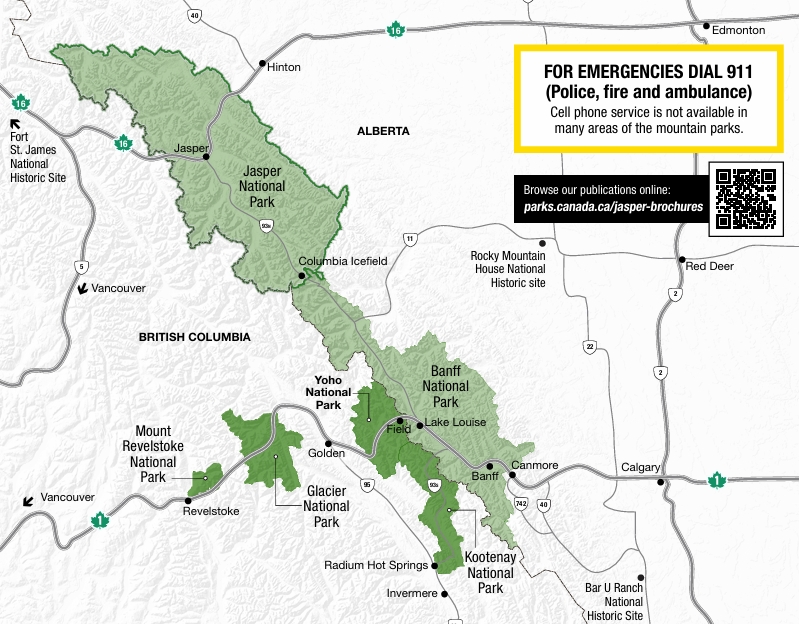
Before I post any more Park pictures let me show part of the Jasper National Park Visitor Guide, published and distributed to Park guests by Parks Canada.
(Photo credit: Parks Canada)
This will give you the “lay of the land” as I describe the Parks I went through while I was based in the town of Golden (bottom center of map, above the words Glacier National Park). The two biggest Parks are Jasper and Banff, both in light green on the map above. They hug the peaks of the Canadian Rockies.
Jasper is the largest, at 4,335 square miles. This makes it larger than Yellowstone, one of the best known American National Parks in northwest Wyoming, which covers 3,472 square miles. It is hard to visualize the comparison because Yellowstone is basically rectangular whereas Jasper is elongated as it spreads down the Canadian Rockies. Believe me, it covers a lot of territory.
Banff, perhaps the best known Canadian National Park, covers 2,564 square miles. That makes it a little less than half the size of Jasper. It stretches out to about the same length in the Rockies but isn’t as wide in the northwest portion.
Kootenay, which I already made one post about, is the next largest. The map above is a little deceiving with regard to Kootenay and Yoho, which are shown in the same color. It appears that a highway separates them, but there is more of Yoho on the south side of the Trans Canada Highway than the map above indicates. The map in the Yoho Visitor Guide gives a much more accurate depiction:
(Photo credit: Parks Canada)
This second map clearly shows how I drove through Kootenay from Radium Hot Springs at the bottom of the map, out to the Trans Canada Highway (Route 1) in Banff NP, left towards Lake Louise, then curving left again to enter Yoho NP and drive past the town of Field to get to Golden.
The two remaining Parks, Glacier and Mount Revelstoke, are both quite small and I drove west to see both of them the third day I was based in Golden.
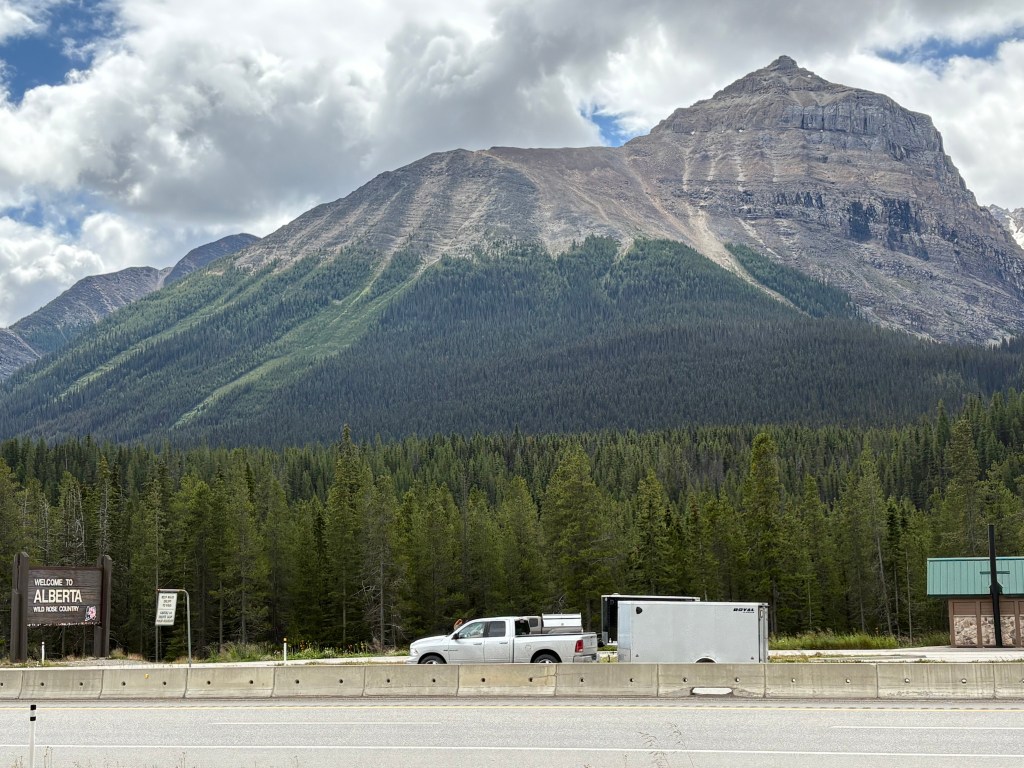
After I had driven through Kootenay National Park the first time (pass #1) I entered Banff National Park and I turned left on the Trans Canada Highway and started heading northwest towards my next stop in Golden, British Columbia. I drove several miles on the TCH (still in Banff NP) and pulled into a rest stop at the border between Banff NP and Yoho NP. That border also represents transitioning from Alberta province (Banff) to British Columbia province (Yoho). One of the more bizarre half-hours I have spent on the road – in three National Parks, two time zones and two provisional border crossings.
And it got even stranger. I ended up parked in that rest stop for almost an hour, which the following photos, all taken there, will help explain.
This shot above is looking across the TCH and the vehicle you see is traveling northeast and about to enter Alberta. If you are paying close attention to what I just described it adds to the bizarre nature of what just happened. Before crossing back into British Columbia the TCH also turned left (for my direction of travel) and whereas I started out driving NW on it I was now heading SW. I’m sure glad my GPS knew what the hell was going on!
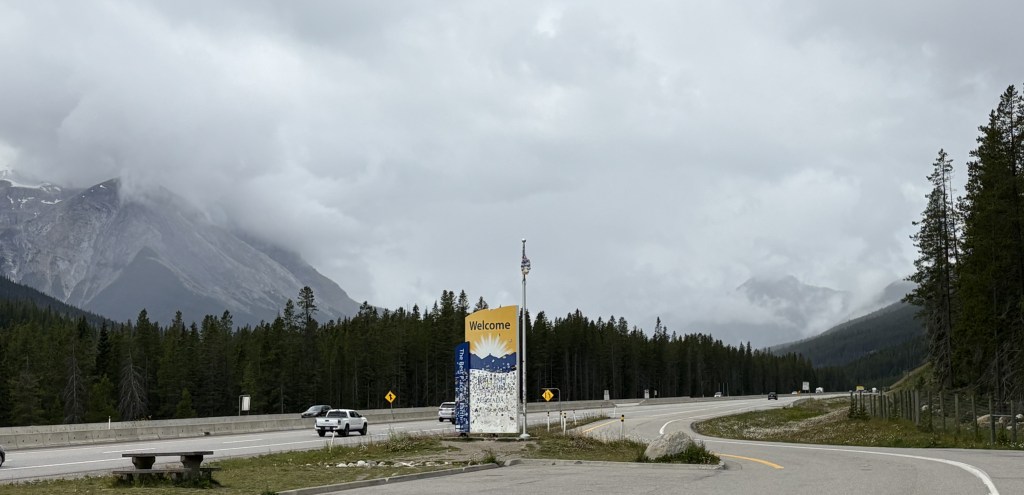
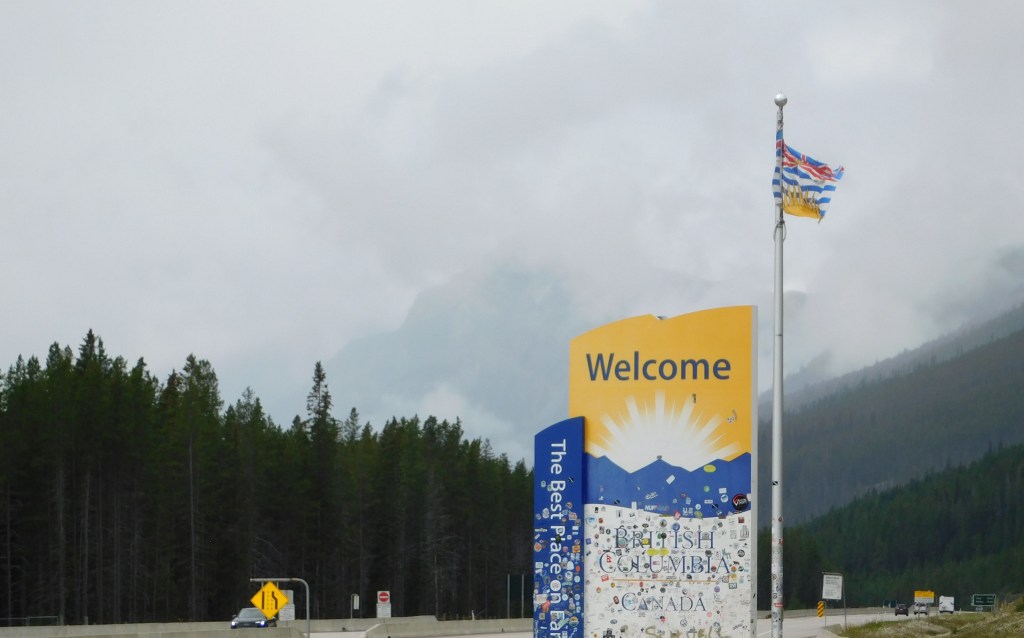
Here is a photo of the exit from the rest stop, with the sign welcoming me to British Columbia.
And further back in the rest stop, where my car was parked, a sign welcoming me to Yoho National Park.
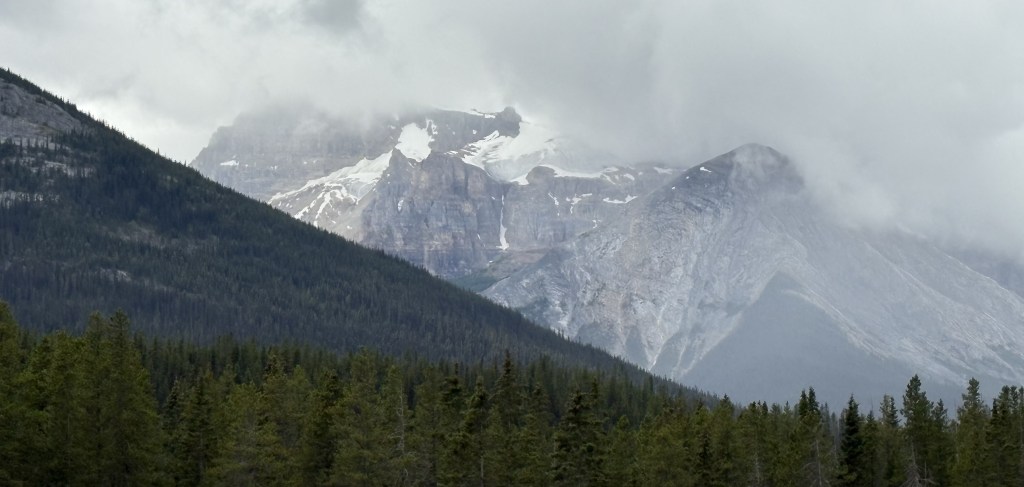
Now, if you look at the middle photo above you will see what was happening that caused me to stay right where I was for a while. The tops of many of the mountains I seen thus far today were partially obscured by clouds. No big deal. Well, and I sat in my car watching, the mountains ahead of me were being overtaken by more clouds, and what appeared to be precipitation falling from them. And whatever it was appeared to be coming towards where I was parked.
I was parked at about 5,400 feet elevation and the air temperature was 56 degrees Fahrenheit. I wasn’t sure if the temperature was going to plummet and snow or sleet might start falling so I opted just to stay right where I was.
Well, it never did anything where I was and the clouds and whatever form of precipitation was falling from them never reached me. Once the clouds dissipated I went on my way and drove through Yoho NP to Golden.
I will make a separate post about what types of things can be found in Yoho, as I passed through it several times over the next few days.
As I post this early on Wednesday, September 3 I have just made my Airbnb reservations which will take me from Prince George, BC on the morning of September 10 to arrive in Anchorage, Alaska in the afternoon of Sunday, September 14. I will share the specifics of that trip in another post, and will start planning my itinerary while I am in Alaska. I’m sure I will spend 2 or 3 days in Anchorage getting acclimated and finding out what things are open full time and what things have adjusted to a seasonal schedule.
After driving north about an hour and a half from Cranbrook I arrived in the little town of Radium Hot Springs. The Visitor Center there doubles as the Visitor Center for Kootenay National Park, the first of six National Parks I would visit while I will be based in the town of Golden, BC for 6 nights. Rather than backtrack I decided to go ahead and drive through the Park on highway 93S. The road starts in Radium Hot Springs (and there are actual hot springs within the Park) and ends at the Trans Canada Highway, in part of Banff National Park. From there I would also drive through another, smaller National Park, Yoho, on my way to Golden. I will find a map showing all of these places so it will be easier to follow along.
Kootenay is the third largest of the six Parks I will visit in the next few days. The road in a normal 2-lane highway with a 90km/hour speed limit and an occasional passing lane as the road rises and falls in elevation throughout the Park. It slows down from that top speed in areas where people are parking for trails and such, or for the few activities scattered throughout the Park. I just stayed on the main road, other than pullouts for viewpoints to take photos, and a parking area for a waterfall and a river. I am not a hiker, especially at elevation, so the highway is fine for me, and there was plenty to see. The highway is only 64 miles long but they say to allow 90 minutes for all the stops you will be making to take photos.
There are LOTS of mountains, and at this point I am unable to identify all of them so I won’t even try. I am calling this post #1 because I will actually be coming back here to do the exact same drive again in a few days when it will be a clearer day. As you will see, some of the mountains were partial obscured by high clouds on this pass.
So for now I will just post photos of what I saw, with a few explanations, and will go into more detail when I get to pass #2. The map they provide doesn’t even list all the mountains you will be seeing, another reason why I won’t even start trying to identify them.
Of the mountains listed on the map, 2 are over 7,000 feet in elevation (near the southern entrance), 6 are over 8,000 feet, 11 are over 9,000 feet and 5 are over 10,000 feet. And they don’t even include the highest peak in Alberta province, Mount Assiniboine, which towers above all of these at 11, 870 feet. It is located in its own Provincial Park, just to the east of Kootenay. I couldn’t even see it because other, smaller mountains, separated us.
So sit back and enjoy the views, as I did:
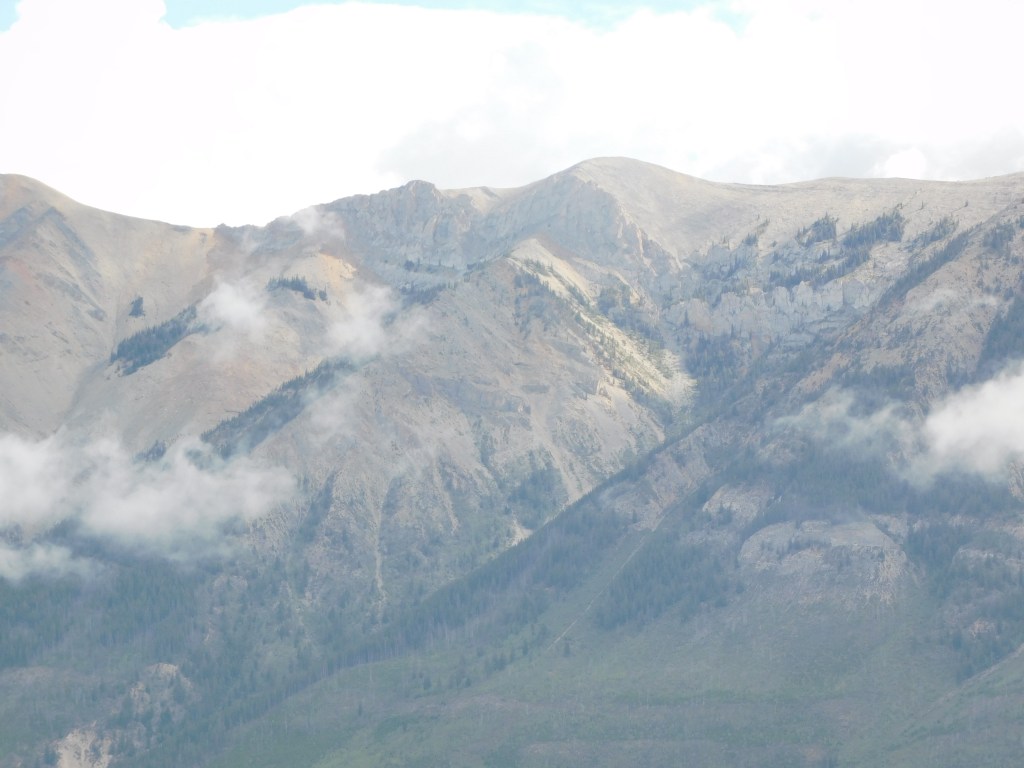
All of the photos in this post were taken with my smartphone except the next two. They were taken with my digital camera, using a zoom lens. I don’t know enough to tinker with the camera settings and when posted together they look rather “washed out”. I include them only to show more detail than is shown on the larger photo, above.
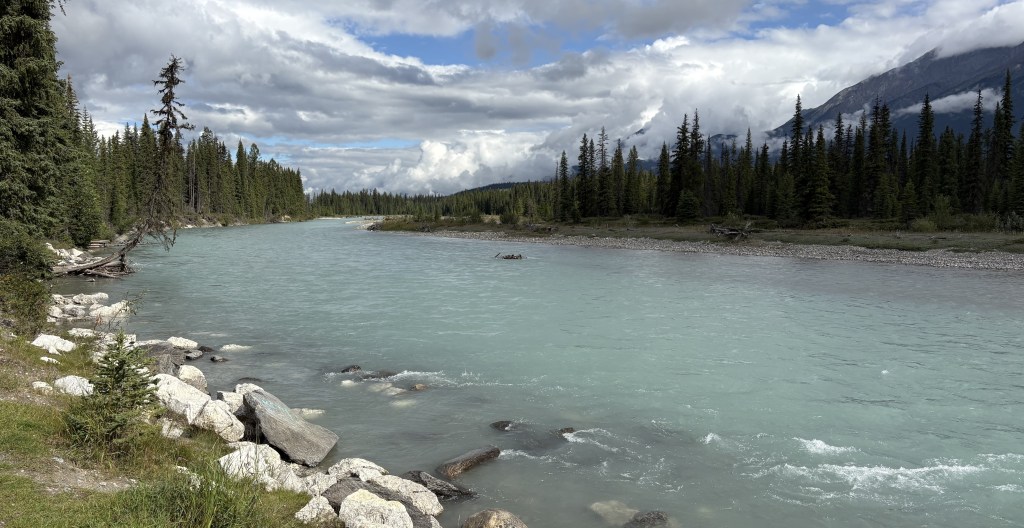
This is the Kootenay River, looking south (the direction I was coming from). The color in many local rivers vary from a pale, chalky white, to a pale blue or turquoise color, as many are fed by melting ice from glaciers – snow and ice packs high atop the tallest mountains which have snow on them year round (and which contribute to the clouds which often appear over mountains on an otherwise cloudless day).
Same place but looking north:
And trust me, the water was VERY cold.
This was part of the Park which burned in a wildfire back in 2017. Canadian National Parks have probably all suffered wildfire damage at one time or another over the years. Some are fortunately very small and can quickly be contained if they threated people or structures. There was a small fire near Dog Lake earlier this year but I didn’t see any evidence of it. The area shown in the photo above is near Simpson Rock and was part of the larger Verdent Creek wildfire in 2017. It consumed 38,300 acres (about 60 square miles) and was believed to have been started by lightning.
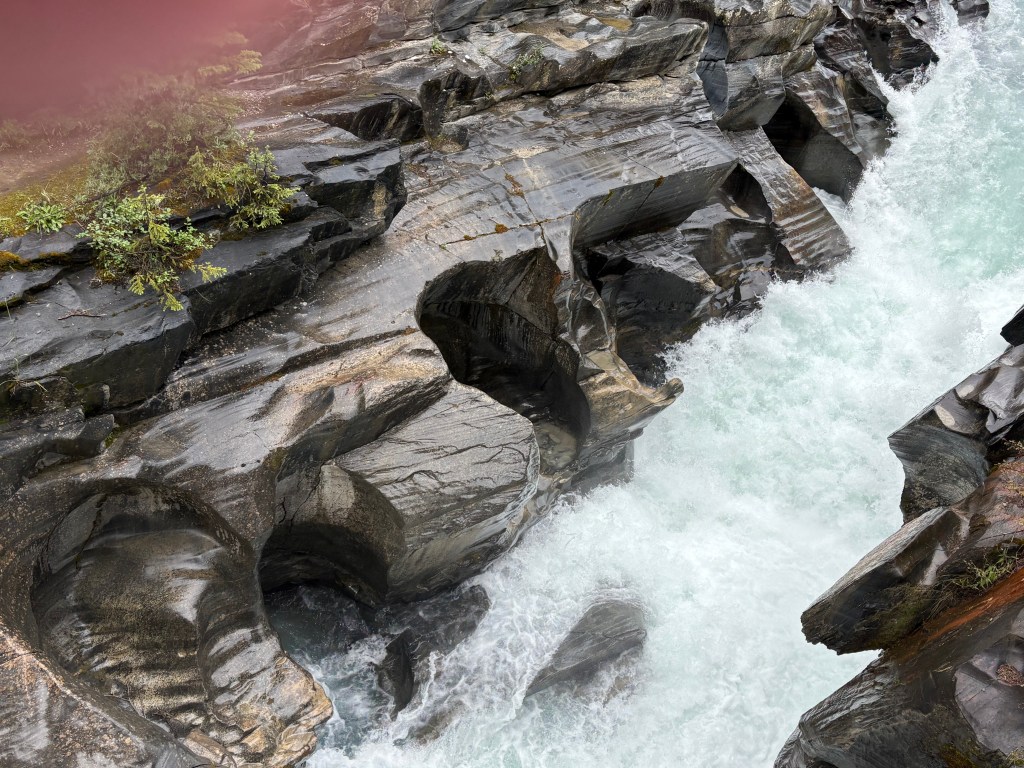
This is a small waterfall, Numa Falls, located near the north end of the Park. Not a very steep drop-off but time has worn some very curious patterns into the rock on either side of the water.
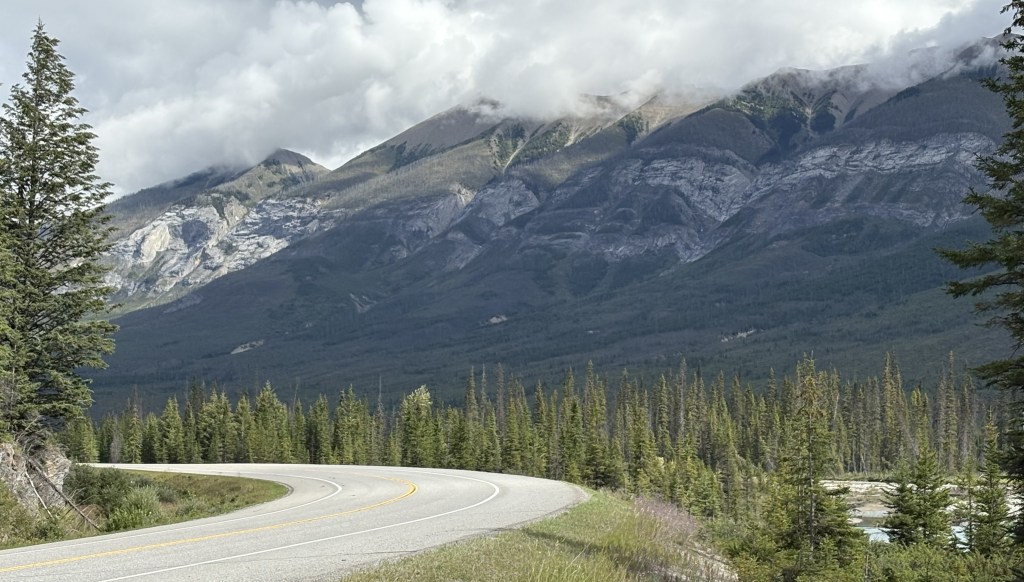
These mountains are actually in Banff National Park but they were in front of me as I left Kootenay. I passed directly from Kootenay to Banff National Park at the Continental Divide (and by doing so entered Alberta Province), turned left on the Trans Canada Highway which would run for several miles (within Banff), and then cross directly into Yoho National Park (which put me back in British Columbia!). It all happens very quickly, so no need to adjust your clocks!
I will cover all of these in separate posts. Banff National Park is enormous and will be covered separately over several days. Yoho, which means “hello” in the native Ktunaxa and Secwepemc dialects, didn’t have that many big mountains but it had other things which I will address in separate posts. I would pass through Yoho several times, in both directions, in the coming days, getting to and from Golden and points east.
And believe me, there were MANY. MANY more mountains than what I’ve shown. This was not a great picture day, and it was my first day in the Parks. I now know that I took better photos a few days later, so be sure to review that post (#2) carefully as it will contains lots more photos.
Sunday, August 31 marked the end of 5 of my planned 8 weeks in western Canada. So far everything is going exceptionally well. I am behind with posting photos which means every day is filled with new adventures. I am prepared to post my photos of the first National Park I visited in the Canadian Rockies but can’t find my Park maps on which I made many notes which I need to reference. The back seat of my car looks like a bomb went off, and I need to root through it and find them. Of course, they aren’t where I thought they were…
As I write this I am in Red Deer, Alberta – finishing the first of 3 nights here. I was in for a shock yesterday morning as I drove up here from High River, AB, south of Calgary. After I bypassed Calgary to the east on Highway 2, a major north/south route, I continued north towards Red Deer (about halfway between Calgary and Edmonton) where I was greeted by a very noticeable low brown cloud of haze. It didn’t smell like smoke, and I wasn’t aware of anything going on in the immediate vicinity, but there it was. I drove a little past Red Deer and it seemed to improve somewhat so I just chalked it up to smog, even though Red Deer only has a population of about 113,000 people.
Overall visibility after I left Castlegar and drove east of the Canadian Rockies Sunday morning was not that great and I thought maybe it was just high pressure keeping whatever was in the air close to the ground. Well, this morning I learned that an air quality alert of over 10 (they call it 10+ on a scale of 1 to 10!) has been issued for little Red Deer. It seems that smoke from a massive wildfire up in the Northwest Territories (a large province due north of Alberta and Saskatchewan) has made its way south. In the last day or two I had read about a big wildfire up in Yellowknife (in the NWT) but didn’t pay much attention because it is 1,000 miles north of here and I wasn’t going much further north than Edmonton. Well, nature works in mysterious ways…
Environment Canada says it is supposed to clear out of here in the next day or two. Today I am planning to drive about 50 miles west to “The Cowboy Highway,” Route 22, the southern part of which I had driven on to get to High River on Sunday. Route 22 has been on my list of scenic roads here and I am sticking with that plan. Other than photo ops I will be in the car with the A/C on “recirculate” so hopefully whatever is in the air won’t bother me. I am tempted to just hunker down and stay inside for the day but I figure one day won’t kill me… If I start out this morning and the haze has gotten any worse I will retreat to my Airbnb and prepare more photos for posting. When I leave Red Deer Thursday morning, I will be driving much further west and should be away from the NWT and the smoke for good. Everything on my route going forward looks fine.
The other travel news is that I am moving my trip to Alaska UP by a week and will start heading north Wednesday of next week! I have decided to hightail it up there and get it in sooner rather than later and then retreat in a more leisurely fashion and finish my time in British Columbia on my way back to the US. I had already booked things through Prince George, BC and will drive north and west from there. I don’t have the itinerary set yet but am hoping to be in Alaska 4 or 5 weeks depending on the weather. I am still on the original overall plan, just rearranging the order in which I’m doing things.
So as of Sunday, 5 weeks in to my original plan, I have driven 6,225 miles in Canada, and a total of 10,825 miles since leaving Durham the morning of July 1.
I just had my oil and filters changed and had the tires rotated so I am all set for the next 10,000 miles! Bring it on!



























 johnboystravelblog