Corn Sex

I never imagined I’d be talking about sex on my blog, although when I entered that word in the Search box on the Homepage several posts appeared which included the word in their content. My mother is probably spinning in her grave… Sorry, Mom, but this is important stuff.

As I drove across several corn producing states on my way out west I noticed something I had never really paid attention to. In one specific field there were alternating, machine-wide rows (maybe 10 to 12 stalks wide), one group with tassels on the top and the next without. That got me thinking – male/female? Not so fast, Skippy. Upon doing a little research all corn stalks are monoecious, meaning they have both male and female “parts”. Yikes!!

(Photo credit: Nature Journals)

The tassel, a flower at the top of all corn stalks, is the male part and produces pollen. The sperm, if you will.

The ear, which grows before fertilization, has lots of silk strands which grow out of the end (and which you remove, along with the husk, when preparing the ear for consumption). Each strand of silk is attached to an individual kernel (the fruit) which will develop once the silk is pollinated. Let the wind do its matchmaking and voila!

So the farmer who planted the field I saw was trying to promote cross-pollination. The hope is that by removing the tassels at the top of one section of corn the silk on that stalk must get pollinated from a neighboring plant that still has a tassel atop it. They don’t want a stalk to “self-pollinate” (bad stalk…).

Who knew???

Only every farmer that grows corn.

Relax Mom, at least I didn’t name this post Corn Porn…


And since we’re talking about corn and not porn, here is a fun fact:

The highest ranking corn producing states in the US in 2024 were:

1 – Iowa – 2,627 million bushels

2 – Illinois – 2,311

3 – Nebraska – 1,803 (take that, Cornhuskers…)

4 – Minnesota – 1,345

5 – Indiana – 1,000

Then South Dakota, Kansas, Missouri, Ohio and North Dakota rounding out the top ten.

(Source: CropProphet.com)

Crop Irrigation

These photos illustrate how modern irrigation techniques are employed on many farms throughout the central and western US. What prompted me to stop driving and start taking photos was this tree in someone’s yard.

As you can see, the lawn in front of the house (lower left of photo) was a gorgeous, thick green mat which you often see in tv ads for fertilizer. Beyond the tree you can see fields with two different types of crops planted. Just to the right of the trunk of the tree I could hear water gurgling and next you will see what prompted me to walk over and check it out.

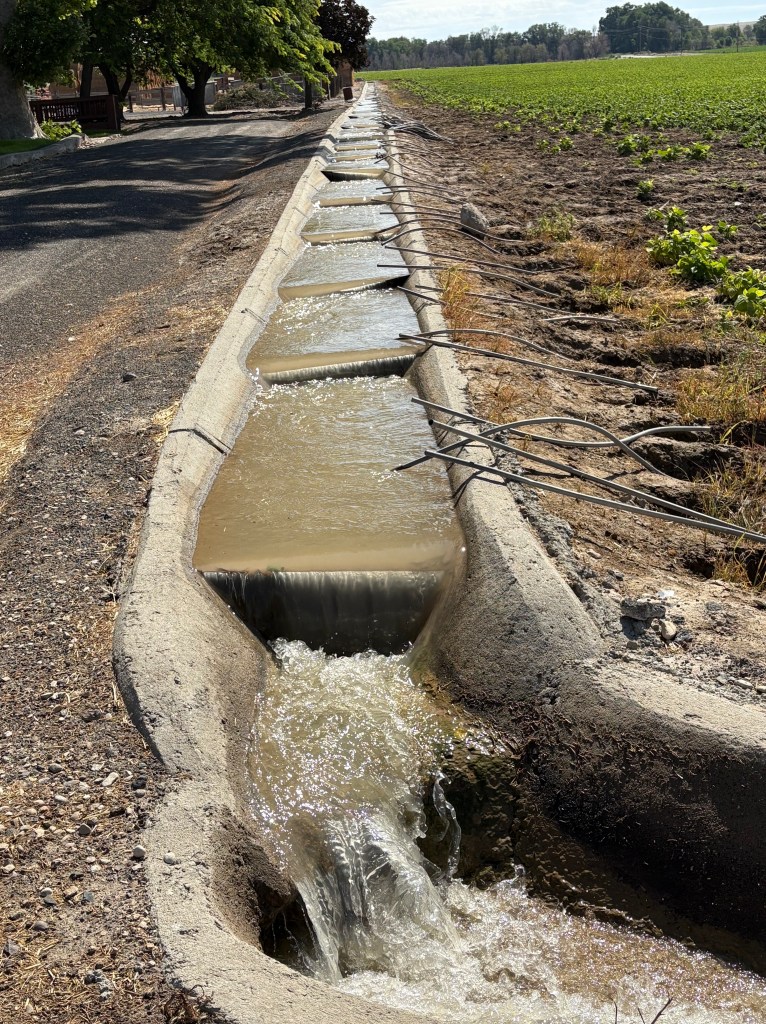
To the right of the driveway as I looked west from the road, was this long cascade of water flowing down from a slightly higher elevation.

It then went down a drain next to the road – it’s destination not obvious at the time, but not a storm sewer I assure you. Water is a precious commodity and farmers use utilize every drop of it they can get access to.

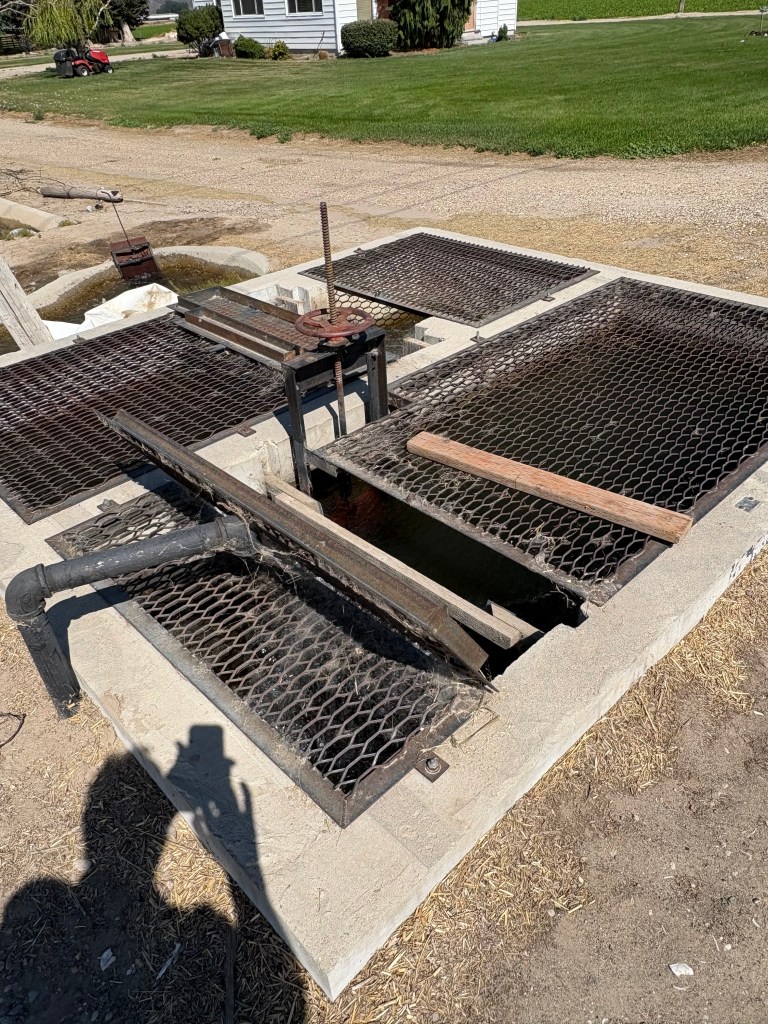
Further up the road I saw what the next step in the process is. At strategic locations, a series of large pumps are located underground to bring the water coming in from elsewhere back up to the surface where it can continue to flow downward, thanks to gravity and water always seeking its lowest point. The surface of the ground raises and lowers as one drives on the roads and at some point the water needs to be boosted back up to the surface to continue its downwards trek.

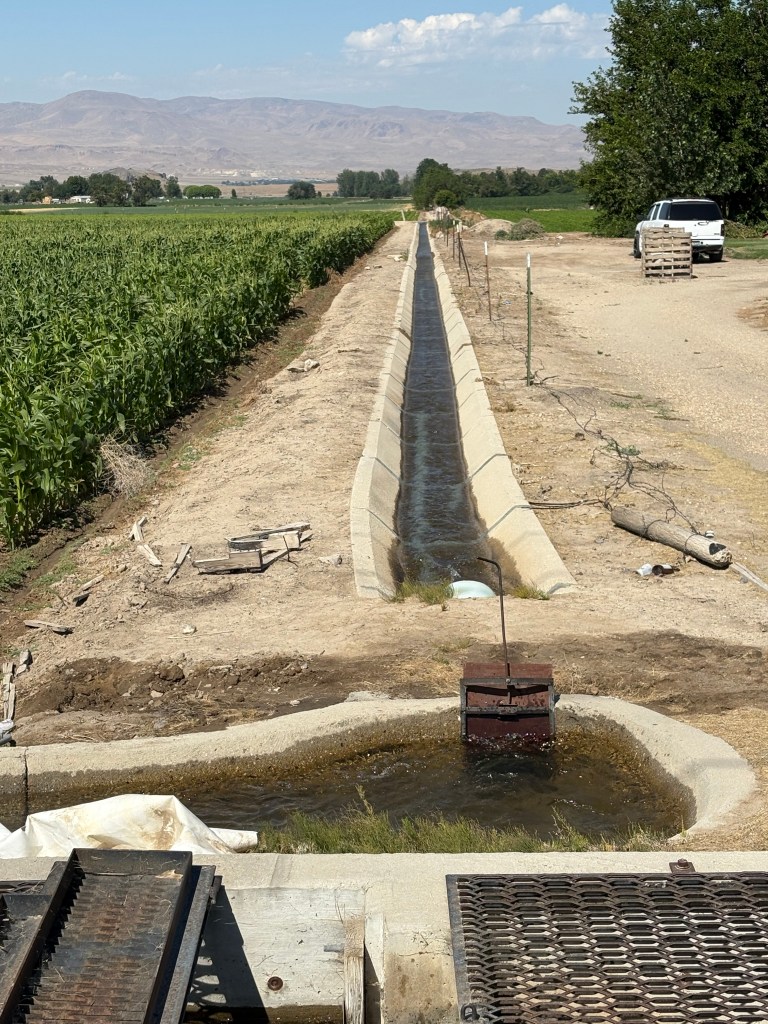
Looking away from the road, after having been pumped up from below, it flows downward, off in the distance:

And looking left, down the road I had just driven up after taking photos of the lush lawn and beautiful tree further down the hill.

And if not from rain, how does the water get into the fields in the first place? It is pumped up through a series of pipes directly to a large sprinkler system (not shown) to move through the fields and spray water from above. It may also be siphoned off the flowing water to go through a series of pipes to be applied directly to the roots of the plants.

Actually, in the photo above you can see a thin white metal wheel (like an oversized bicycle tire rim) which is repeated down the road and rolls slowly through the field to the left, applying water to the roots of the plants. There are also much larger contraptions which pivot from a base to spray water from much higher up (for corn and such). I will take photos the next time I see some and add it to this post later.

I have also seen large holding tanks or collection ponds where water, having reached its lowest useful point, is stored to be pumped out into tanker trucks to be employed elsewhere.

Nothing wasted!