Glacier National Park (Canada!)

August 9, 2025

After returning to Golden from Jasper National Park I had now seen parts of 4 of the 6 Parks I planned to visit while I was based in Golden. Today I would go west, continuing on the Trans Canada Highway which brought me to Golden, to visit Glacier and Mount Revelstoke National Parks. Of course there is a Glacier National Park in the United States (in northwest Montana) which connects to the Canadian border but on the other side of the border the Canadian National Park there is called Waterton. I will visit it later in my trip.

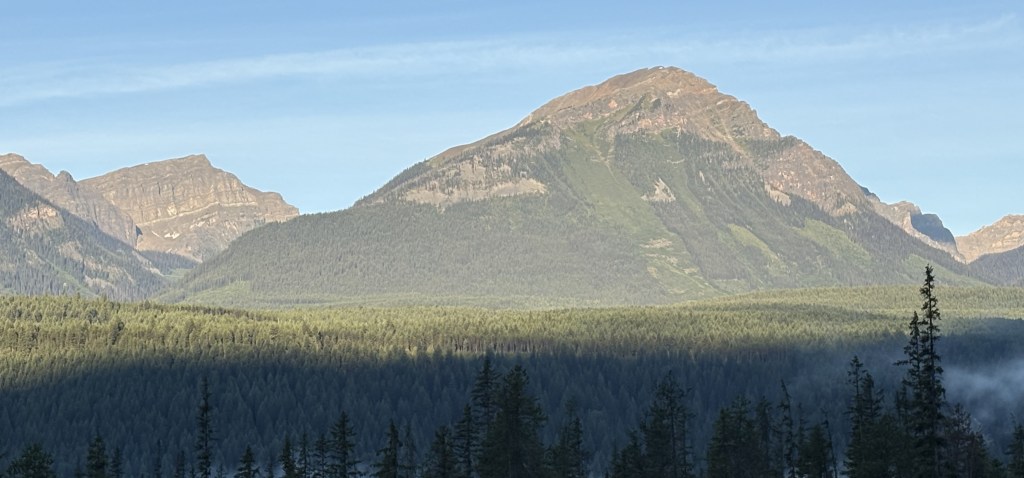
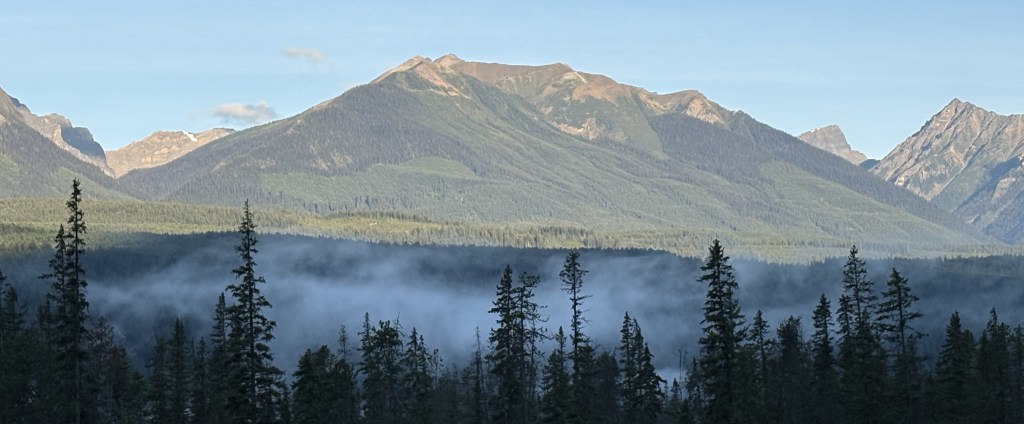
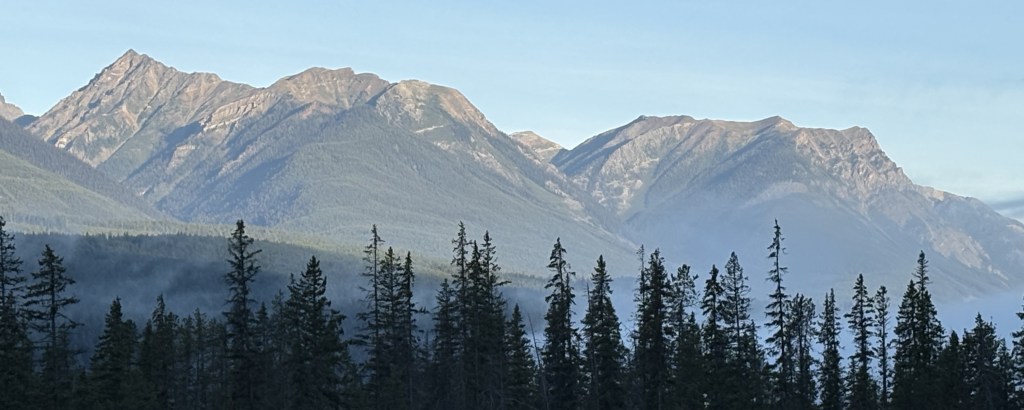
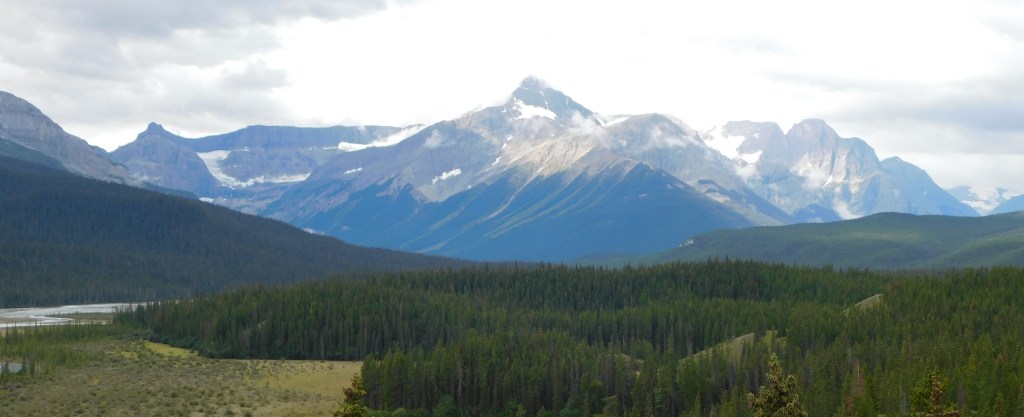
I arrived in Golden towards the end of the day August 7 and left early on the 8th to backtrack and go north to Jasper. As I embarked on my drive west today I had my first good look at some of the mountains around Golden.
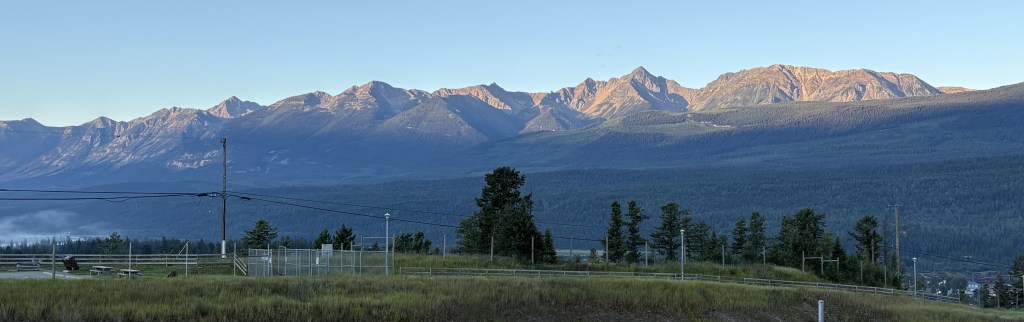
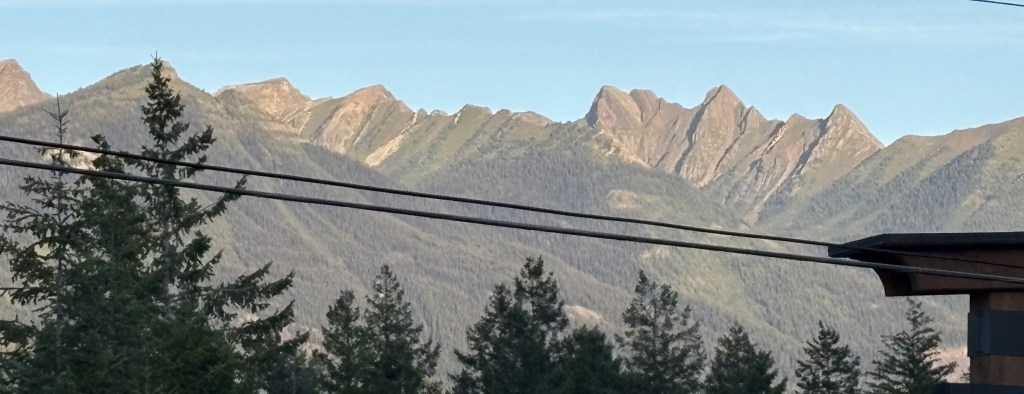
Those are all located west of Hwy 1 (the TCH) and actually sit between Golden and Glacier NP, which is located due west of town. I would have to drive northwest on Hwy 1 to the town of Beaver before turning back south to get to Glacier.
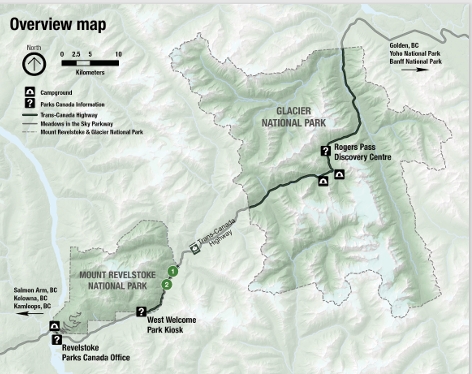
(Photo credit: Parks Canada)

The map above shows the two Parks I would visit today. Compared to the Parks I have seen so far these are quite small. Glacier NP covers 521 square miles and spreads out on both sides of Hwy 1. About 10 miles separate the two Parks, and Mount Revelstoke covers only 100 square miles, all on the north side of the highway.

Here is another map showing some more details:
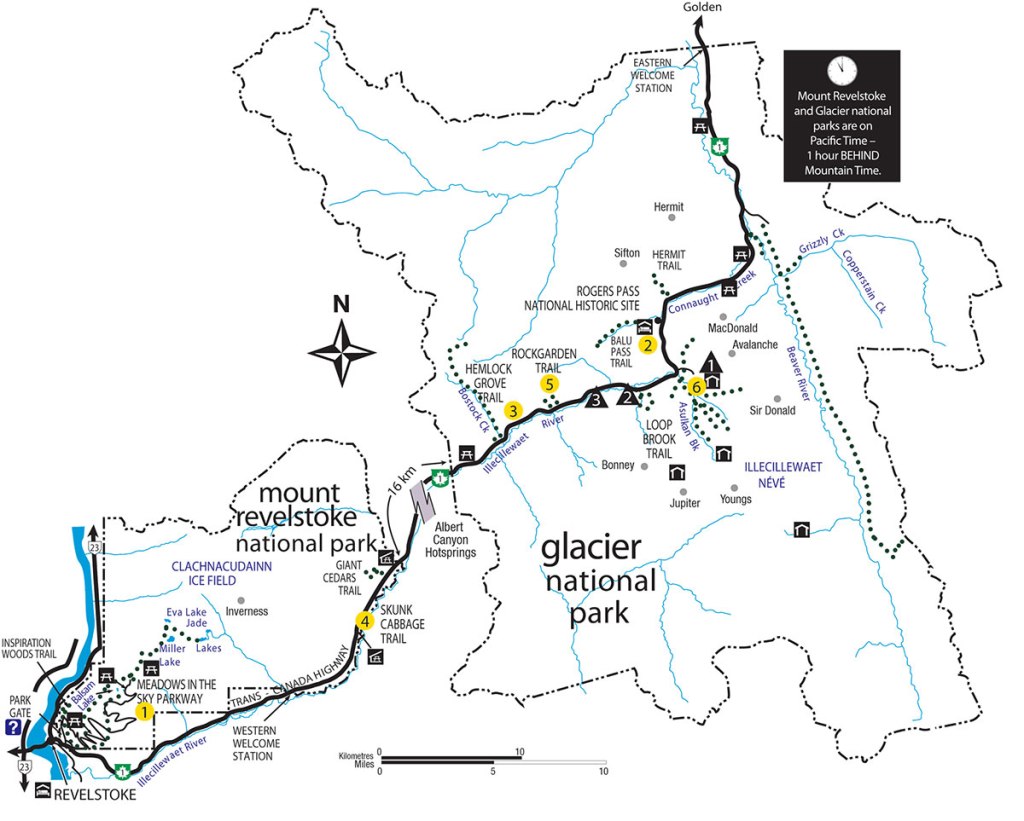
(Photo credit: Parks Canada)

As you can see, the Trans Canada Highway (Hwy 1) is the only road passing through Glacier National Park, although there are several hiking paths which branch off in multiple directions.

I saw this impressive mountain as I approached the Park.
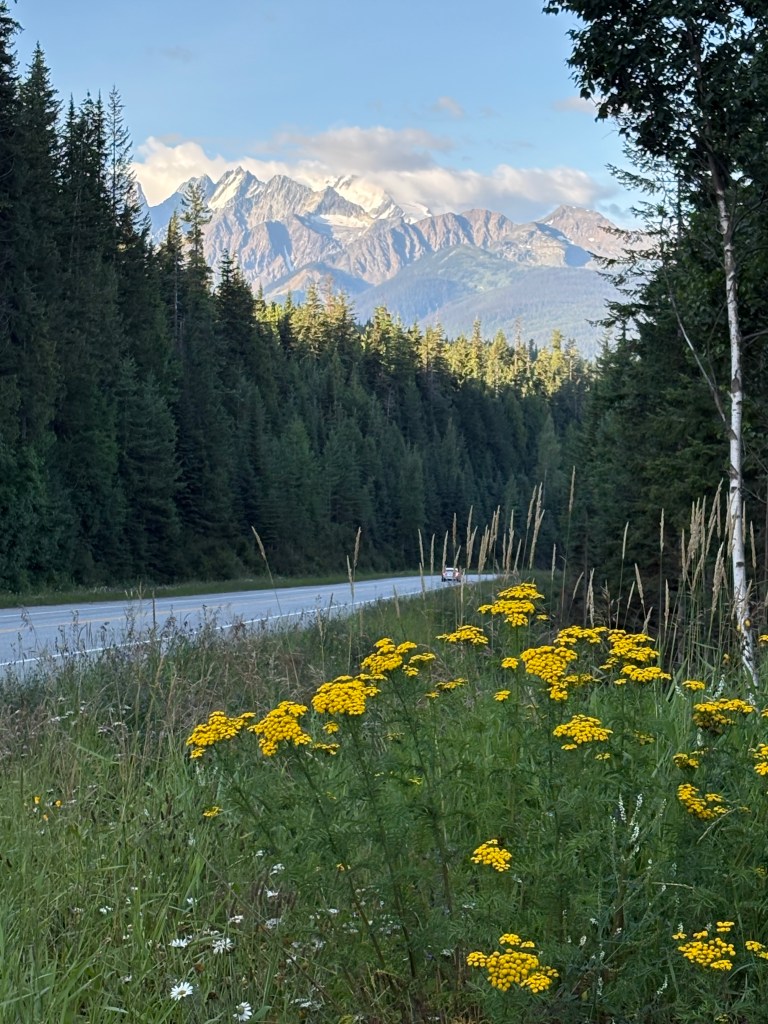
Once again I am faced with the naming problem. I suspect that may be Mount Dawson (because it has snow on it and is over 11,000 feet tall) but it is located pretty far off the highway so I may be mistaken.
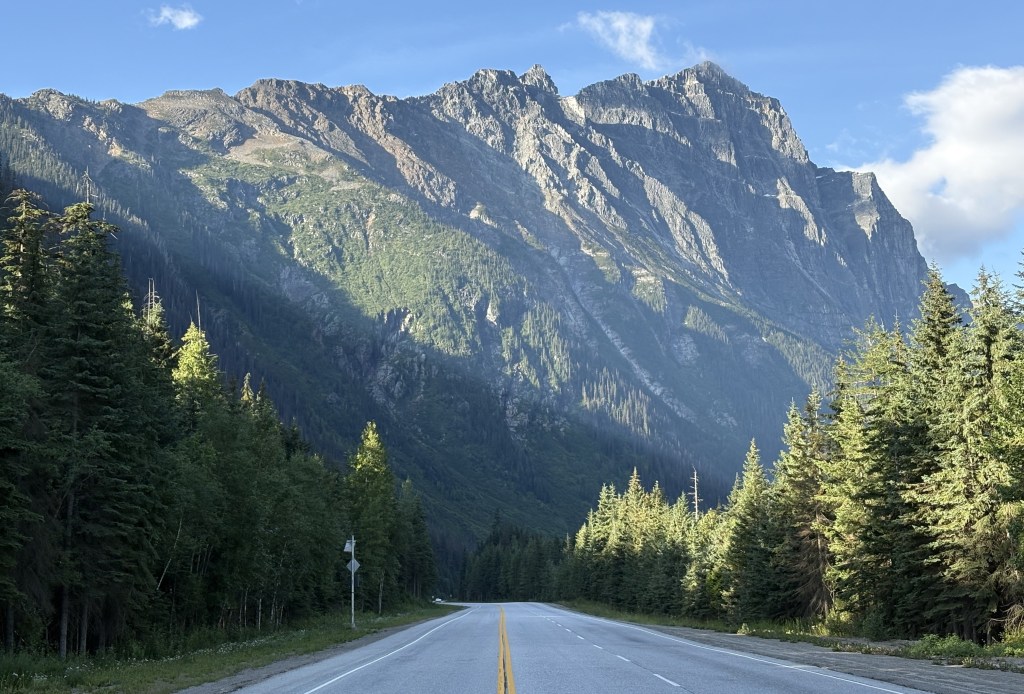
This, I believe, is Mount MacDonald, which is about 9,500 feet tall.

After seeing these two mountains as I approached the Park the area next to the road narrowed as it started to climb up to Rogers Pass. Before getting to the Visitor Centre there I stopped at one of the parking areas for the Hermit hiking trail. Here I found several signs with some stern warnings.

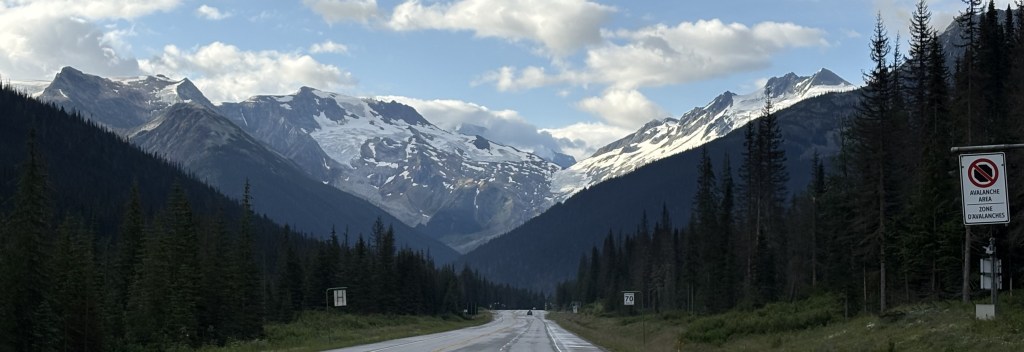
First, I was now in avalanche country.
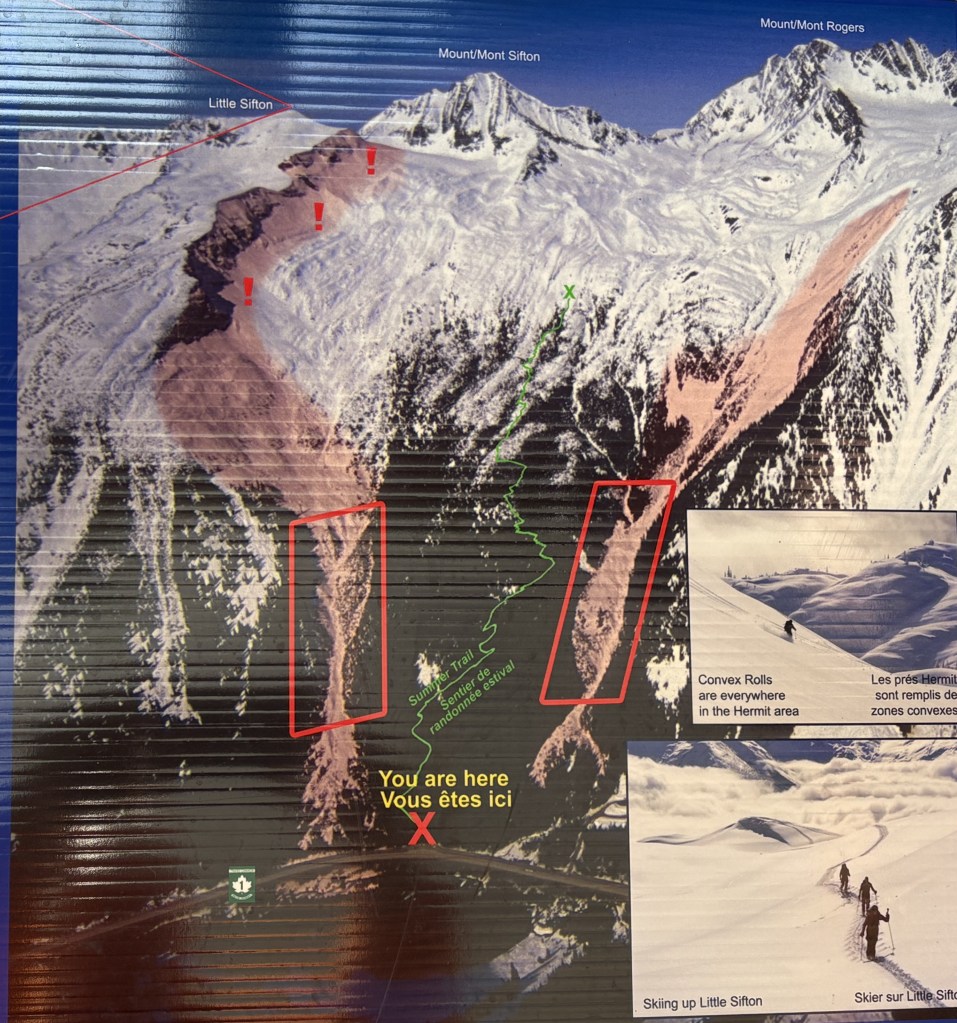
As you can see from the “You are here” X, the road is passing through near the base of these mountains, creating both a significant avalanche risk (though hopefully not on August 9) and also preventing me from seeing other mountains on either side of the highway.

Another sign warned me that I was in Grizzly and Black bear country and that I should take appropriate safety steps (e.g. don’t hike the trails alone, keep your distance from wildlife and carry bear spray). There was also a warning about mountain goats in the area, asking me to report any sightings. Curiously the sign didn’t ask me to Dial 911 for emergencies but, rather, listed a traditional phone number with area code. I presume this is because there generally isn’t cell service in any of the Parks and you would need to send an emergency text IF you could find a satellite signal.

I later read that the number one cause of death among visitors to Glacier National Park is water. People underestimate the power and extreme cold of the water within the Park, and if they should fall into it they are quickly overcome.

I resumed driving and stopped at the Rogers Pass Discovery Centre, only to find it closed, but for the bathrooms (which are called washrooms in Canada). It is being renovated and/or replaced and was not open. I had apparently gained some altitude as when I looked across the parking lot as I was leaving I could see a mountain back from where I had just come.
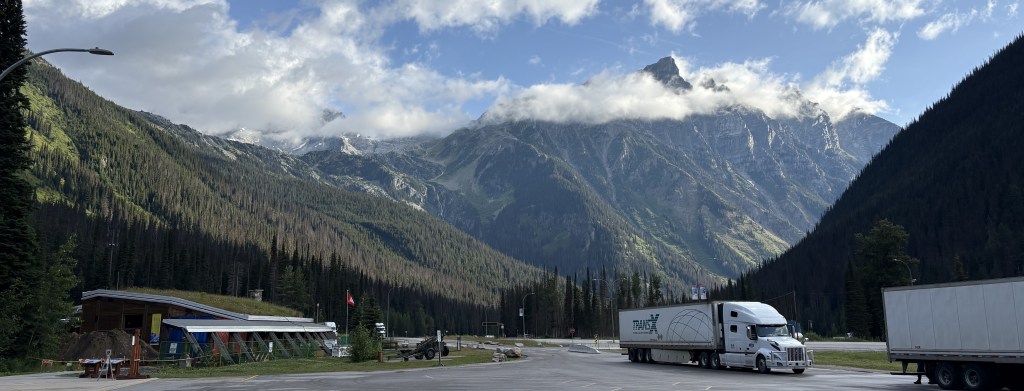
As I was about to pull out onto the highway I could see a few more mountains spread out before me.
Further up the road I came to a spot where they were doing some road work.
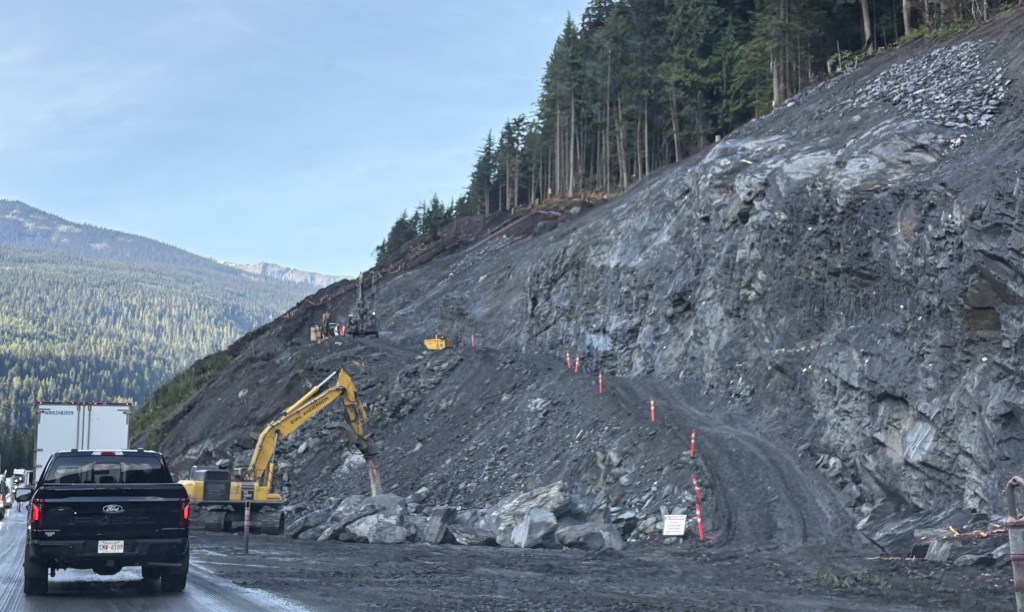
When I mentioned this to my Airbnb host in Golden he said it is a long overdue project to widen the highway from 2-lanes to 4-lanes.

So that was really all I saw of Glacier National Park. There are lots and lots of mountains, and a large number of glaciers, but you can’t see them without getting off the road, and even then you may not see very much.
Jasper, Alberta – Part 2

August 8, 2025

After walking and driving through parts of downtown I drove “around back” to see two lakes located behind town. Once I got back there there was absolutely no indication that anything bad had happened.

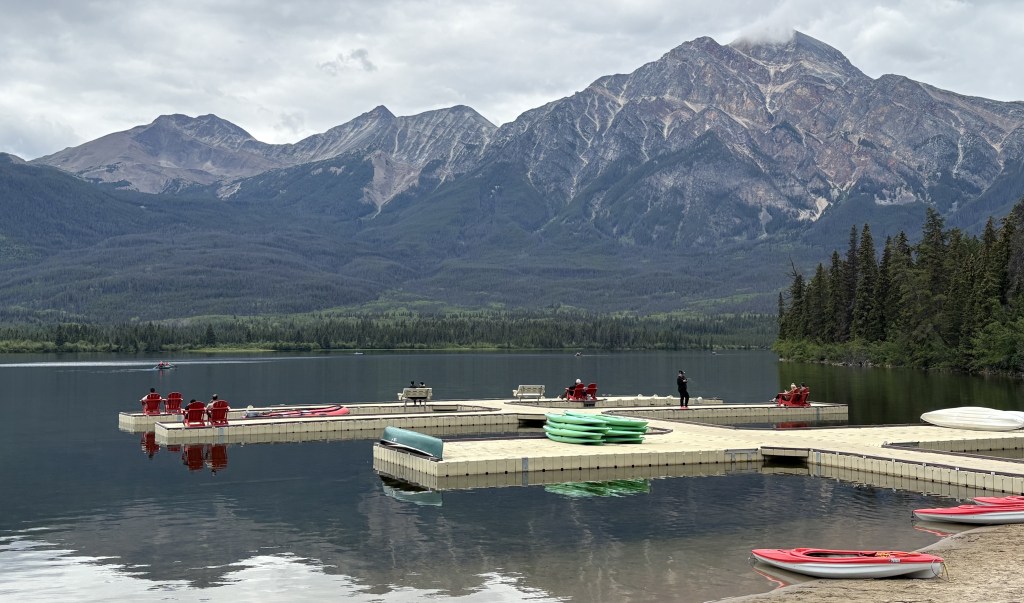
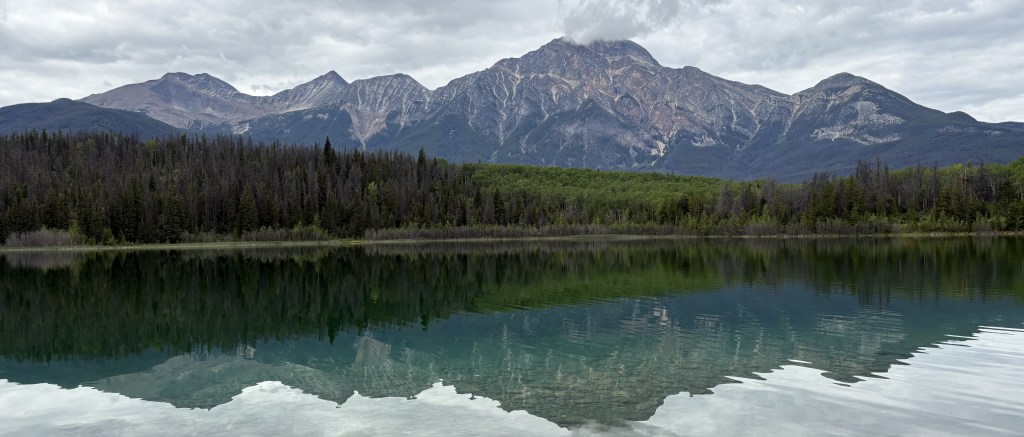
This is Pyramid Lake, and behind it is Pyramid Mountain.

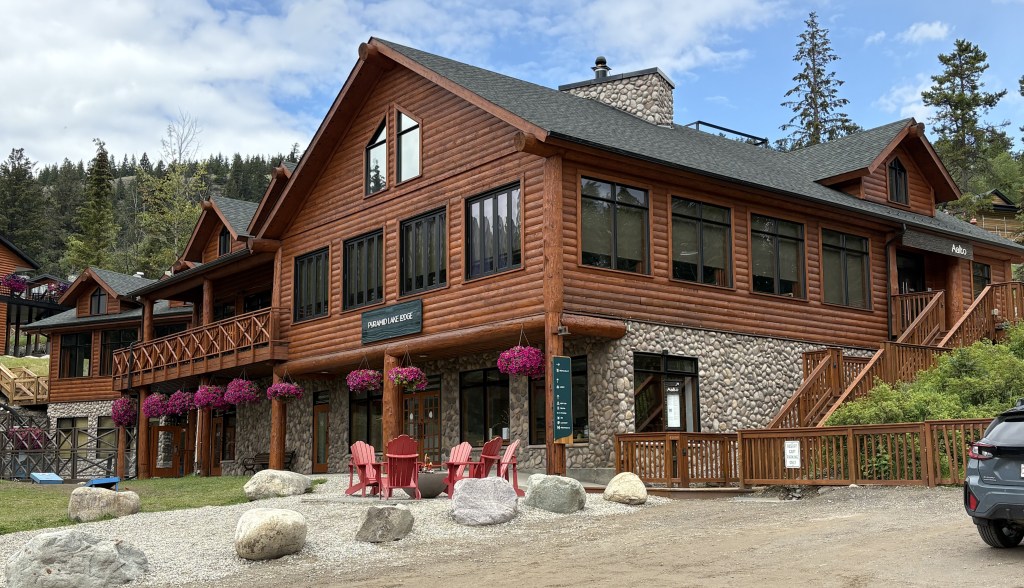
That is the Pyramid Lake Lodge and across the road is another view of the lake with docks and various watercraft for guests to use.

I wasn’t able to get to Patricia Lake, although I don’t think it was technically off limits.

I drove back towards the downtown area and crossed the Athabasca River to take a quick drive through the Fairmont Jasper Park Lodge property, a high-end hotel. It is on the “fire side” of the tracks but was apparently protected by workers and firefighters and only lost a few small buildings. The main lodge and most of the other buildings appeared to be intact.

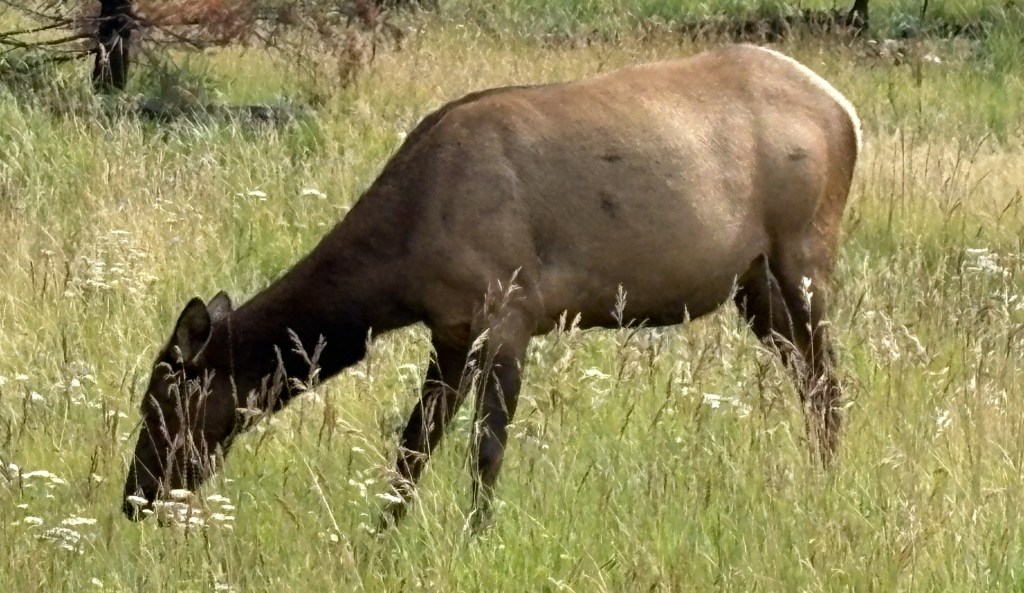
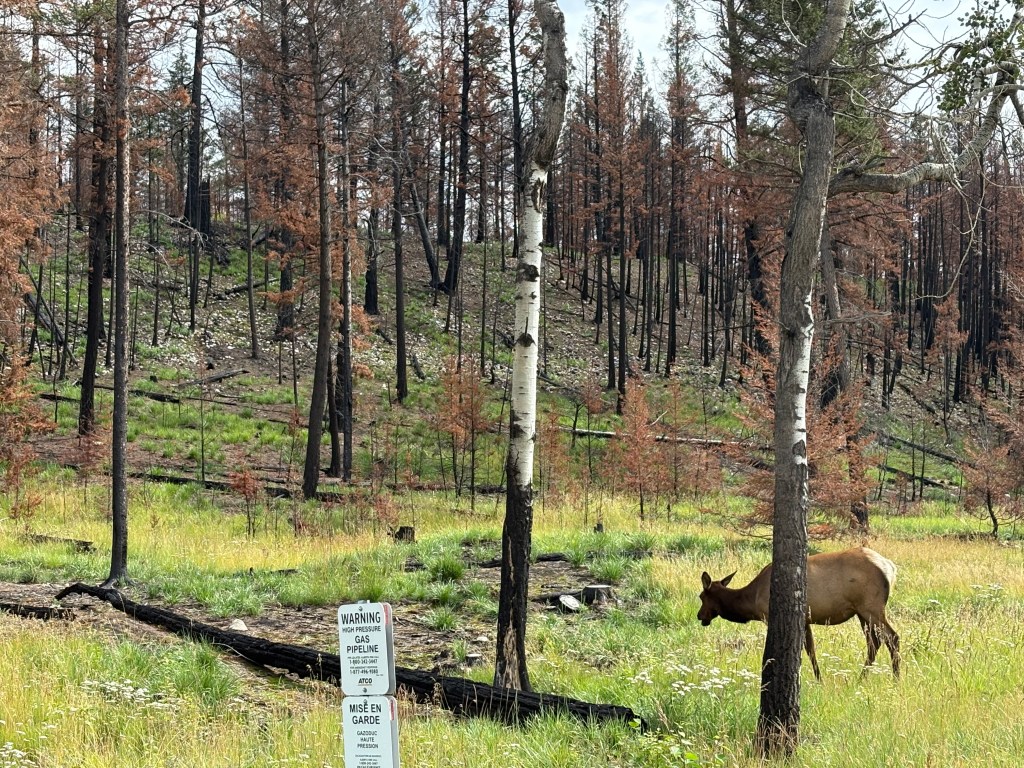
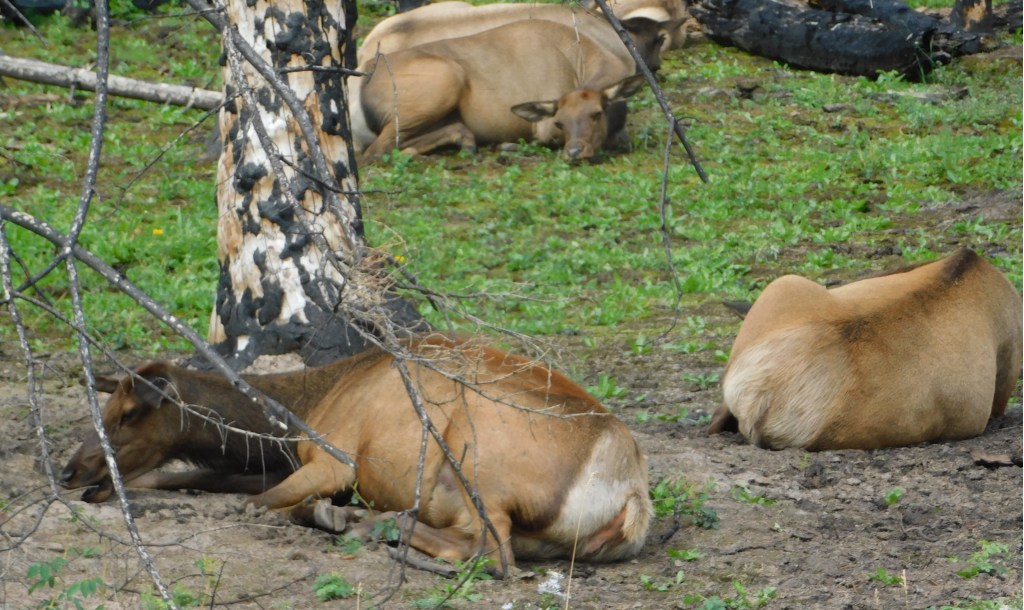
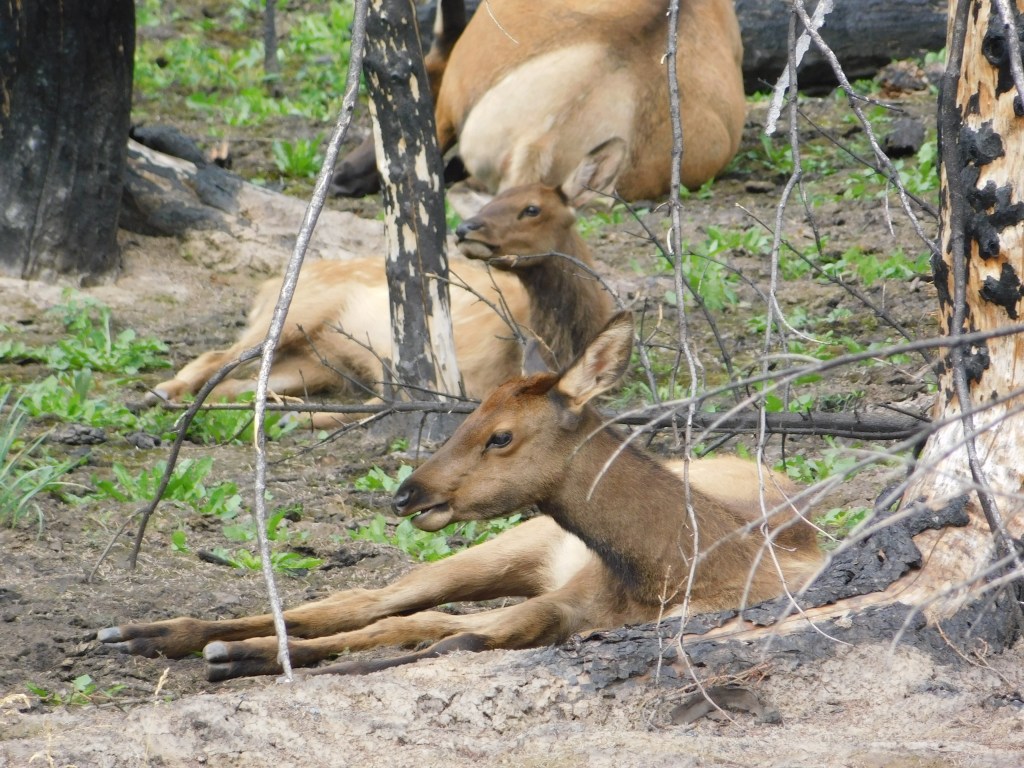
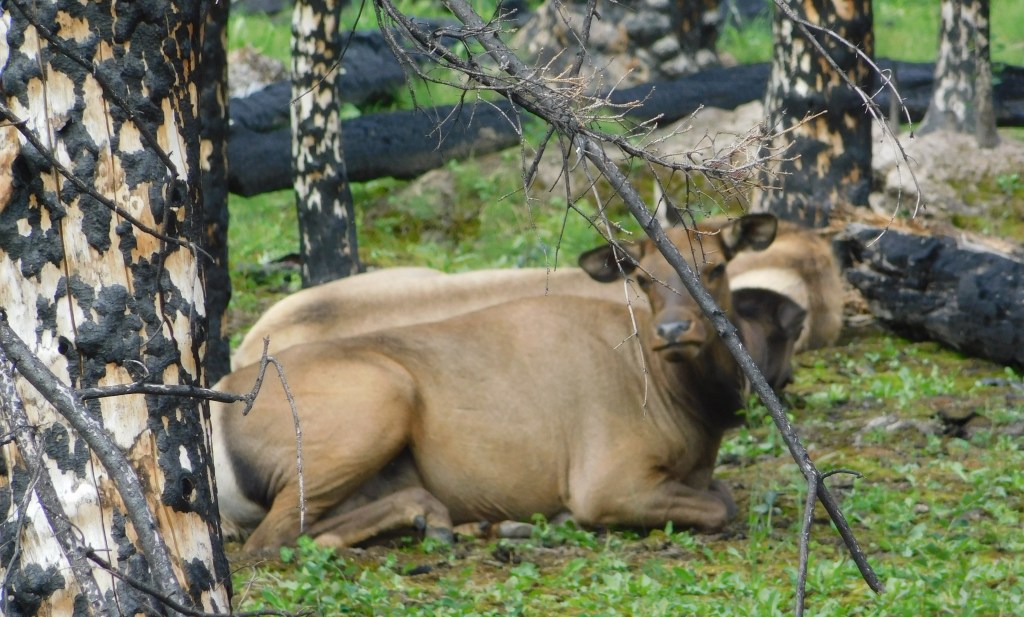
Just off the road to the Fairmont property I did see this animal, eating grass in a burned out area of the forest. I initially thought it was a cow moose but I now believe it was an elk because a few minutes later I saw 30 or so elk as I was leaving Jasper. I sent pictures of them to a few friends called them moose and one of my brothers pointed out that they were elk.

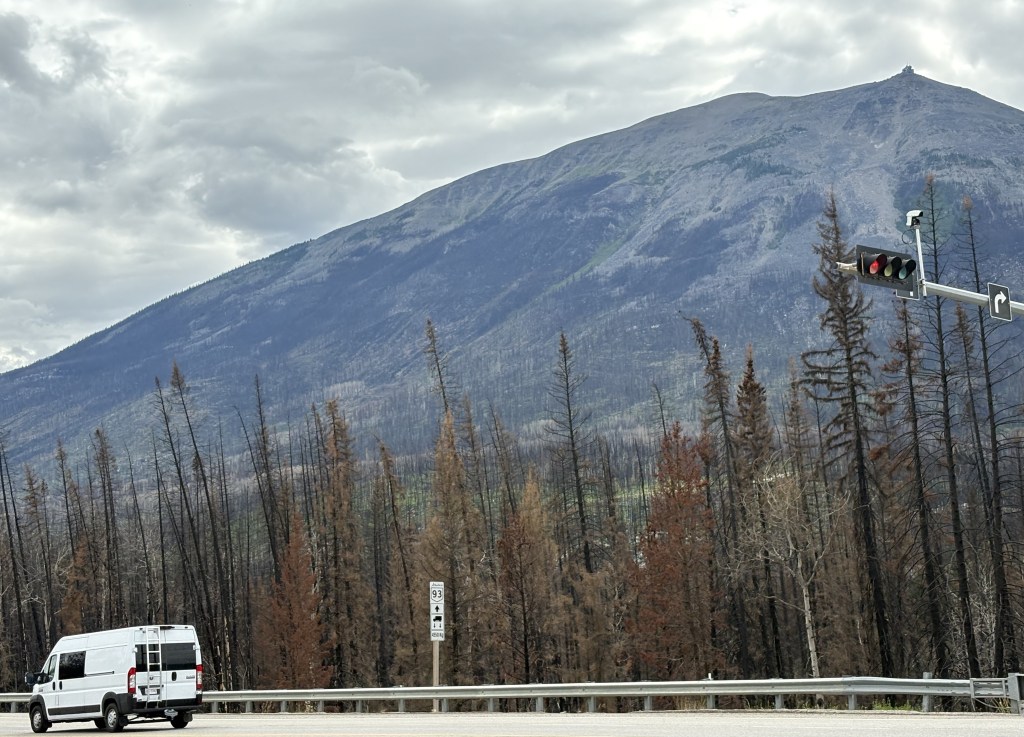
This is the intersection of Hwy 16 (Connaught Drive) and Hwy 93 (the Icefields Parkway) as I was leaving town.

Across the intersection is Whistlers Peak which is where the Jasper Sky Tram goes. It is the highest and longest aerial tram in Canada. As far as I can tell that part of the mountain was not affected by the wildfire. Left of that is Marmot Mountain where the Marmot Basin ski area is located. It, too, was unaffected by the fire.

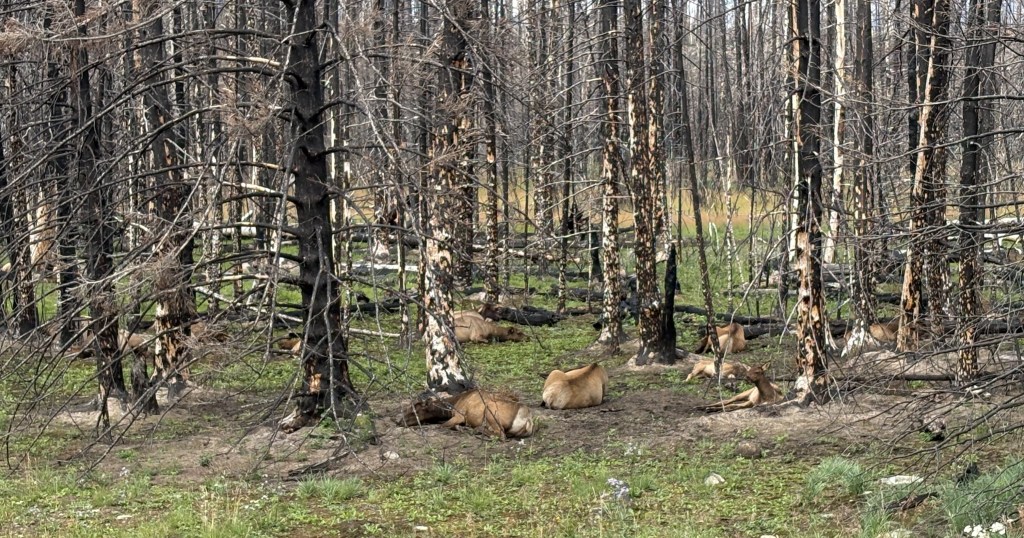
Once I turned south on Hwy 93 there were several vehicles stopped on both sides of the road and people were milling about with their cameras. Of course I stopped and joined them. There were about 30 elk resting on the ground in a grove of burnt out trees. They appeared to be adult females and some younger ones but I didn’t see any antlers so apparently there weren’t any adult males.

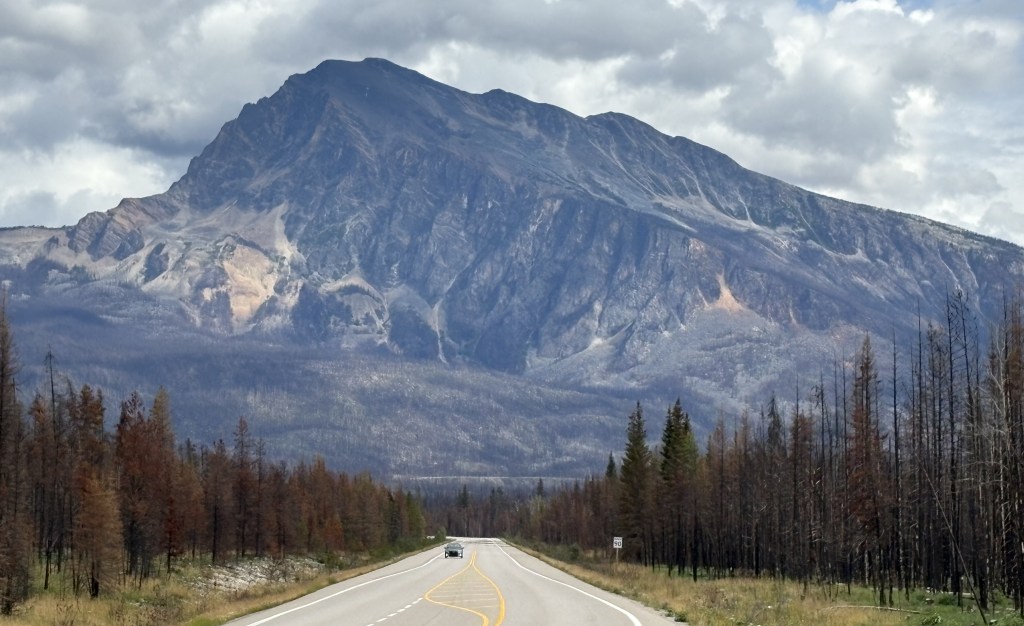
I continued south towards Golden, wanting to get there before dark. This is the view as I approached Mt. Hardisty. You can see the burnt out trees on both sides of the highway.

Jasper (the town), Alberta – Part 1

August 8, 2025

I chose Jasper as my first National Park to visit after arriving in Golden (although I drove through 3 others getting there). I really didn’t know what to expect when I got to the town of Jasper, as I was aware of the wildfire in 2024 but didn’t know the extent of damage. The town of Jasper is about a 3 1/2 hour drive (if done non-stop) from Golden, although I stopped many, many places to take pictures.

As I mentioned in the last post, I started seeing evidence of the fire as I drove around two mountains south of town – about 16 miles away. All the trees on either side of Highway 93 were destroyed by the intense fire. When I finally arrived in town around 1 pm, I stopped to walk the main street in town. I also went to the Parks Canada Visitor Centre, which wasn’t affected by the fire. There I was told where I could and couldn’t go within the Park. While I was there, some parts of the Park were still off limits due to damage caused by the wildfire.

Here are some of the things I saw:

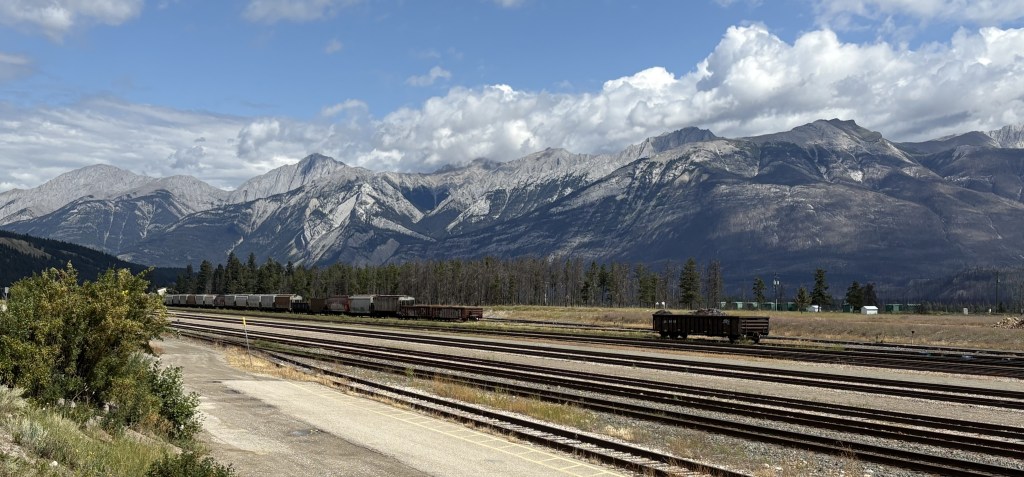
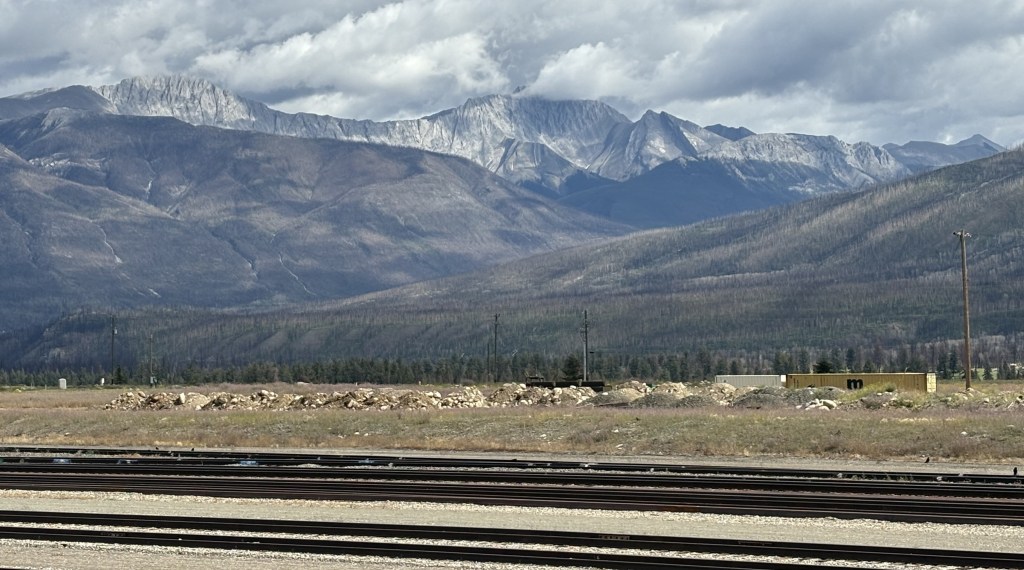
Those are railroad tracks on the south side of town, significant because they are a main transcontinental line operated by CN Rail (The Canadian National Railway). Rail traffic through the Park was suspended the night the fire started, and CN Rail brought in one of their firefighting trains to help fight the growing blaze. Just beyond the tracks is the Athabasca River (out of view), and in the distance are the Colin Range of mountains, located southeast of town.

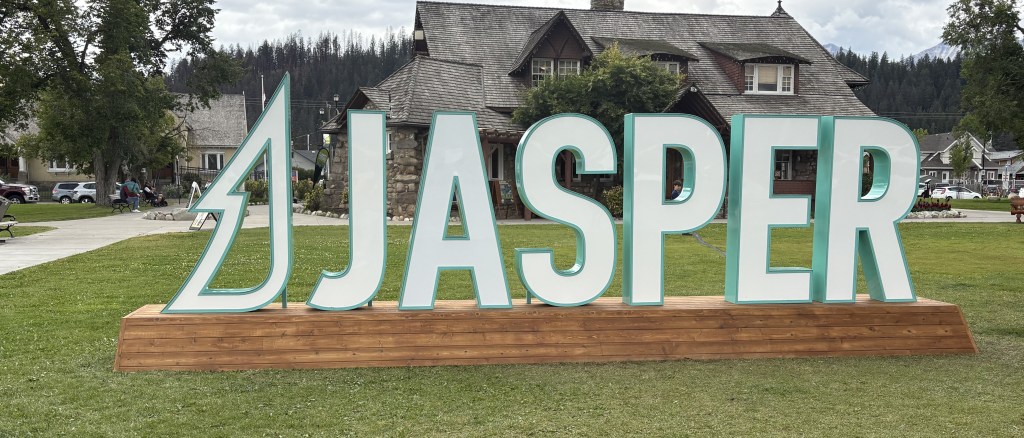
That is the tourist “photo op” sign in Jasper (in a rare moment someone wasn’t having their picture taken in front of it), and behind it is the Parks Canada Visitor Centre.

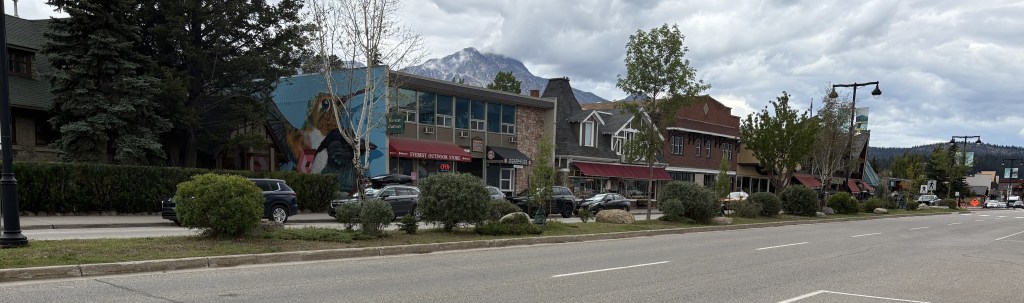
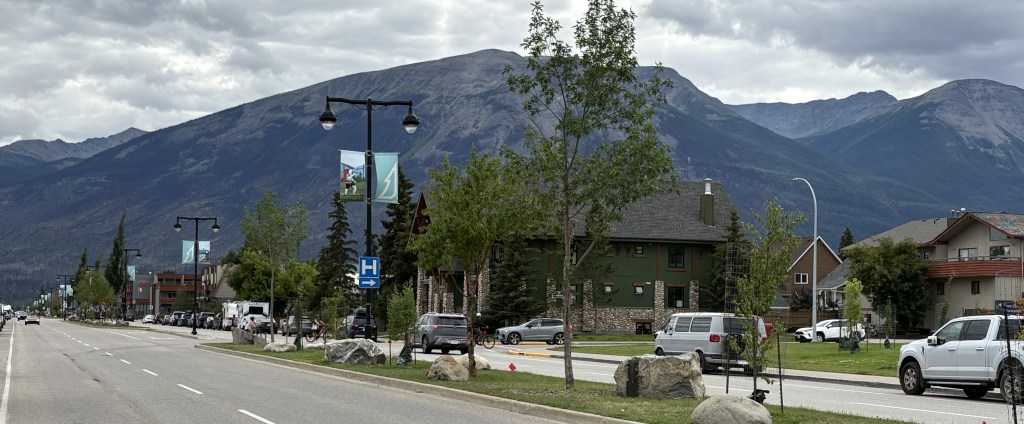
Those are the views of Connaught Drive, the main street in Jasper, looking in from each end.

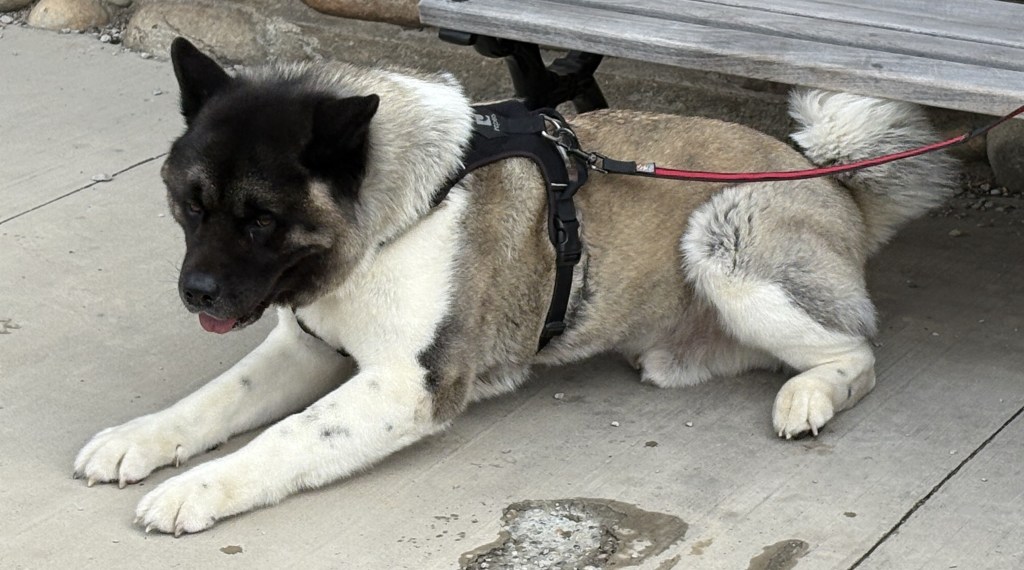
This is an Akita taking a break while his handler was on the phone.

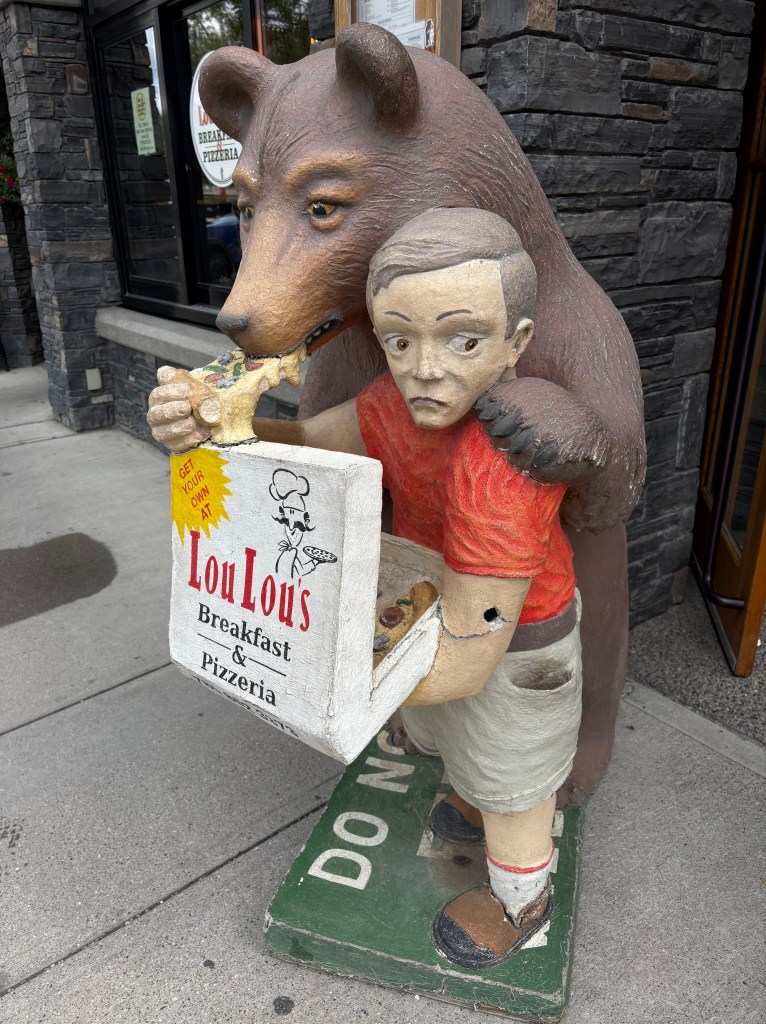
This is a statue outside the pizza place where I had lunch.
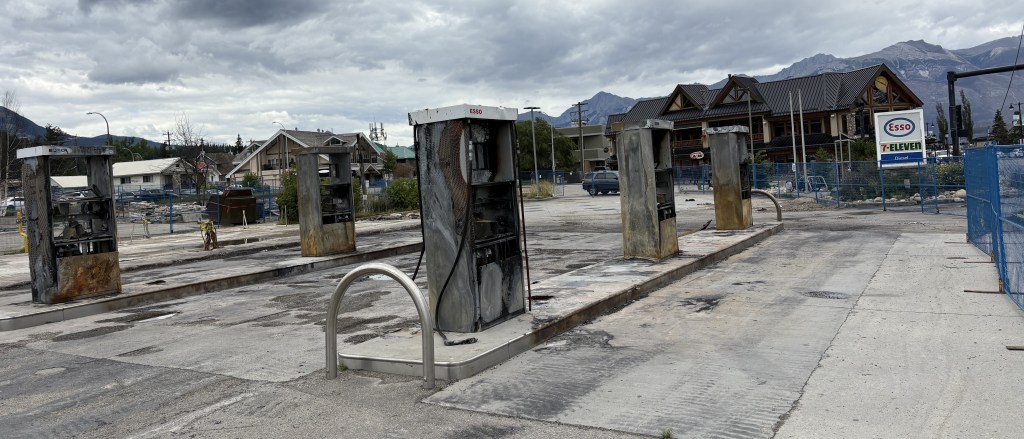
This is one of the few signs of the fire I saw downtown. It is a set of gas pumps on the same side of the street as the main shops.

Another gas station was destroyed on the other side of the street. The structures destroyed in the fire have been razed and the lots cleared. Many of the businesses which were affected indicate online that they are only “Temporarily Closed”.

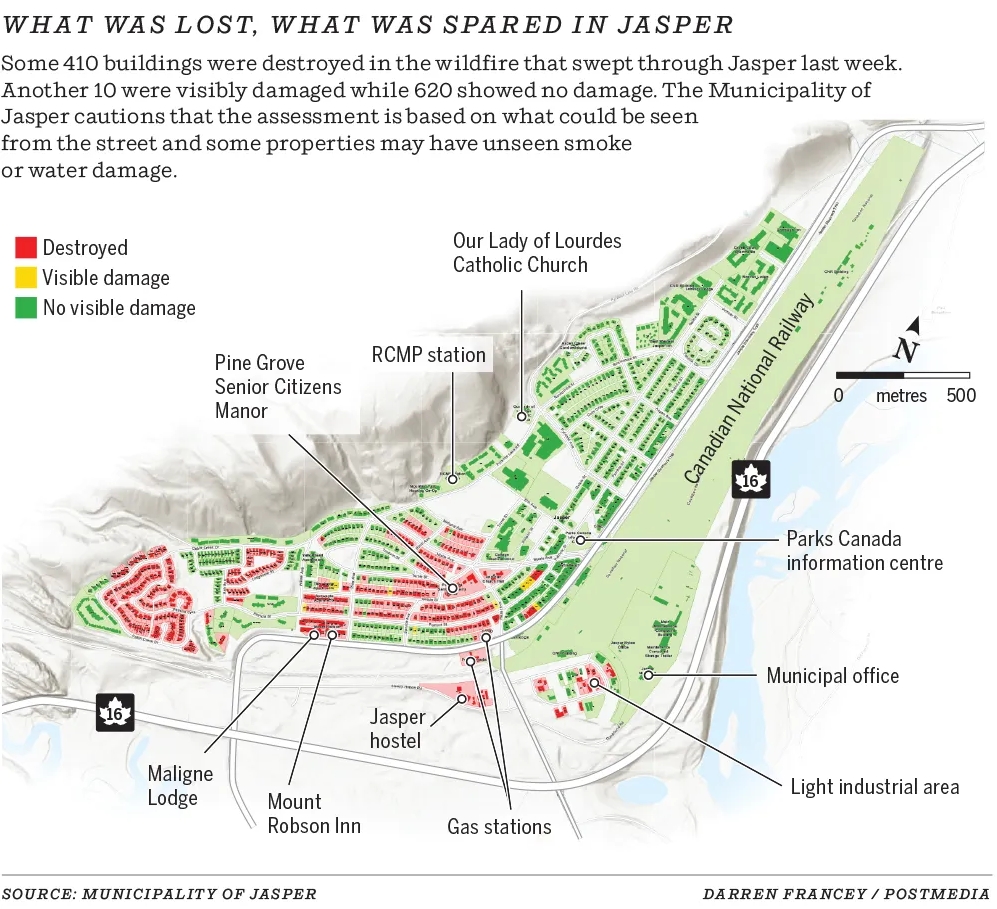
Here is a map of downtown Jasper showing which structures were lost in the fire. The map states that 420 structures were destroyed or visibly damaged while 620 showed no damage. Wikipedia states that 358 of 1,113 structures were destroyed. Either way, the town did suffer significant property losses.

(Photo credit: Calgary Herald)

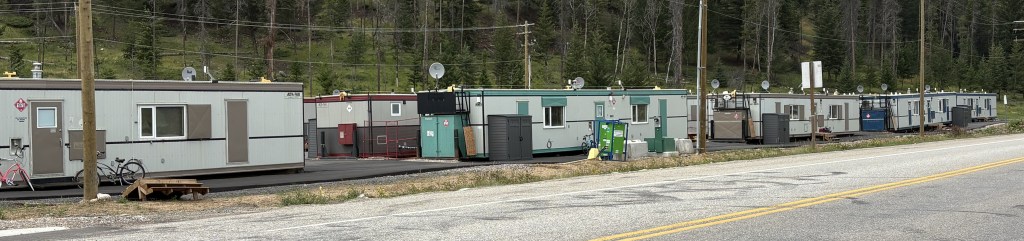
These are trailers which were brought in as temporary housing for some of the residents who lost their homes. I saw them at several locations in the area.

The next post will show some other things I saw in the area before heading back to Golden.

2024 Jasper Wildfire

August 8, 2025

I am now approaching the town of Jasper, AB from the south and have started to see damage caused by the massive wildfire which started a little over a year before I arrived in early August, 2025. You won’t see much evidence of it in my photos but I would be remiss if I didn’t explain what happened.

Jasper National Park is the largest of the six National Parks I would visit over the next few days from my base in Golden, BC. At 4,335 square miles it is larger than Yellowstone National Park (3,472 square miles). Comprised mainly of mountains, forests, lakes and rivers, it is a popular tourist destination.

The town of Jasper has a population of around 4,800 permanent residents according to the 2021 Census. That population swells significantly over the summer months.

Around 700pm the evening of July 22, 2024, a fire was detected northeast of town. A short time later, other fires were discovered well south of town. All of the fires are believed to have been started by lightning, and spread rapidly.

Within several hours, authorities made the decision to evacuate the entire Park! This was done due to the weather and ground conditions, as well as the forecast for the coming days. There are not many escape options, and it was the middle of summer so there were thousands of people visiting the area, in hotels, camping or staying in their RV’s. It is estimated that 25,000 residents, employees and visitors were told to immediately evacuate the town and Park.

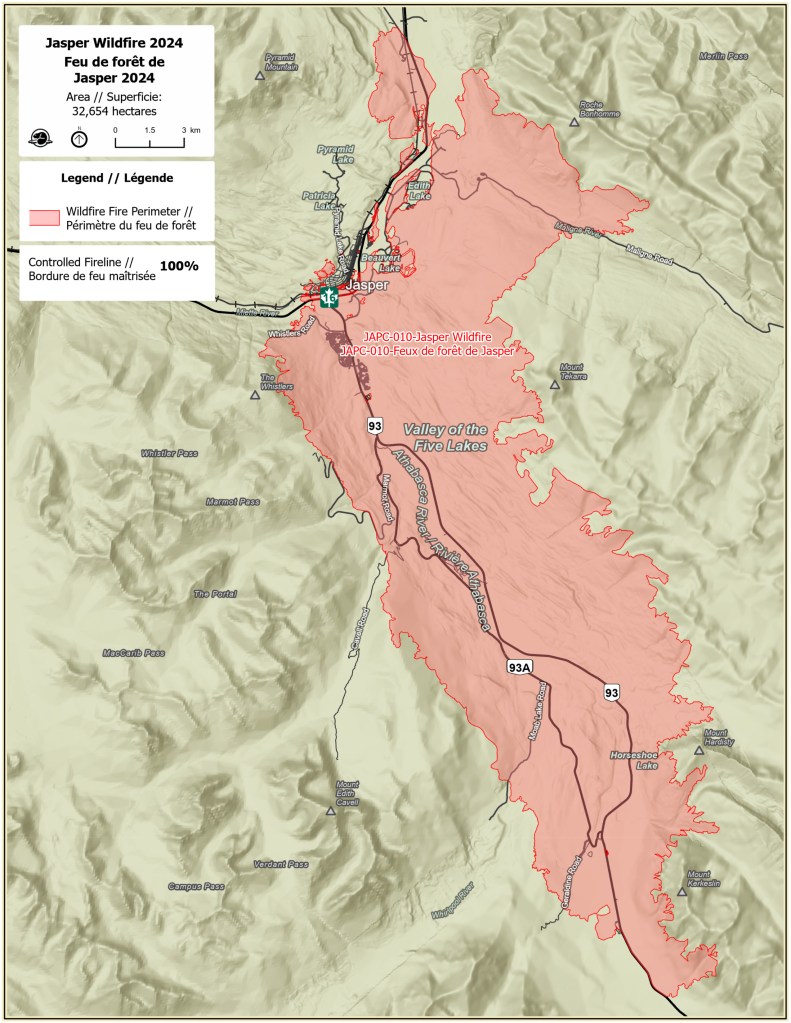
Here is a map of the area eventually consumed by the fire.

(Photo credit: Parks Canada)

As I stated, the fire started July 22, 2024 and wasn’t considered “under control” until September 7, more than a month later. Due to the remote wooded areas within the Park it wasn’t actually considered “extinguished” until April 1, 2025! In all, the fire consumed 156 square miles.

I am approaching the town on Route 93 and started seeing burnt out areas on both sides of the road after I drove around Mount Kerkeslin and Mount Hardisty at the bottom of the photo. Everyone south of town was probably encouraged to drive south on 93. People in and around the town of Jasper could go either east or west on Route 16. Due to the fact that some of the fires were northeast of town, most people probably went west and eventually ended up in Valemount, which quickly became overrun with evacuees.

Only one death was attributed to the fire. A 24-year old trained firefighter died northeast of town when a tree fell on him. He had come up from Calgary to assist in fighting the blaze. No doubt that quick action by authorities, mere hours after the small fires were first discovered, saved countless other lives.

I will discuss the impact on the town of Jasper in my next post.

Icefields Parkway to Jasper, AB

August 8, 2025

To refresh your memory, I effectively stopped making “current” posts with photos I had taken August 8 while en route from the town of Golden, BC to the town of Jasper, AB.

(Photo credit: Parks Canada)

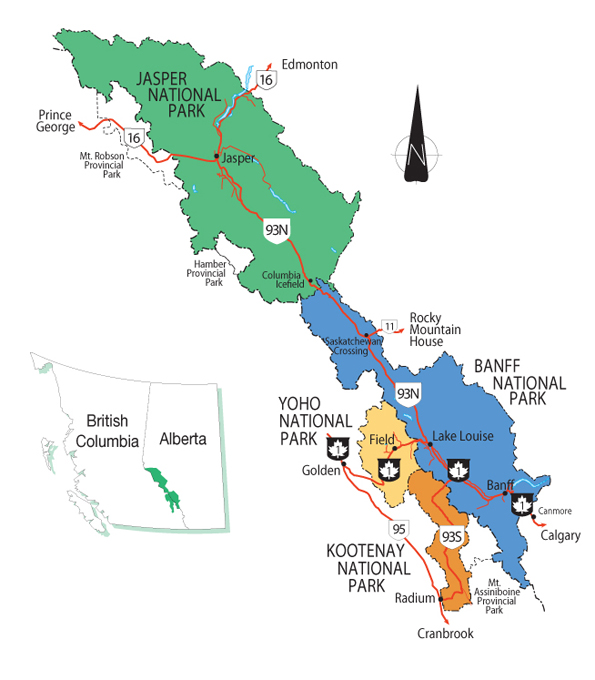
On July 7 I had traveled through Kootenay National Park (brown) and then through part of Banff NP (blue) and Yoho NP (yellow) to get to Golden, where I would be based for 6 nights. The following day I backtracked to Lake Louise and went north towards Jasper National Park (green) and have already posted photos taken in the northern part of Banff NP getting to the point where I crossed into Jasper NP, which is where the Columbia Icefield is located. The entire road (Highway 93N from Lake Louise to the town of Jasper) is called the Icefields Parkway and is considered by many to be among the most scenic roads in Canada.

Here are more photos I took as I traveled north, deeper into Jasper NP.

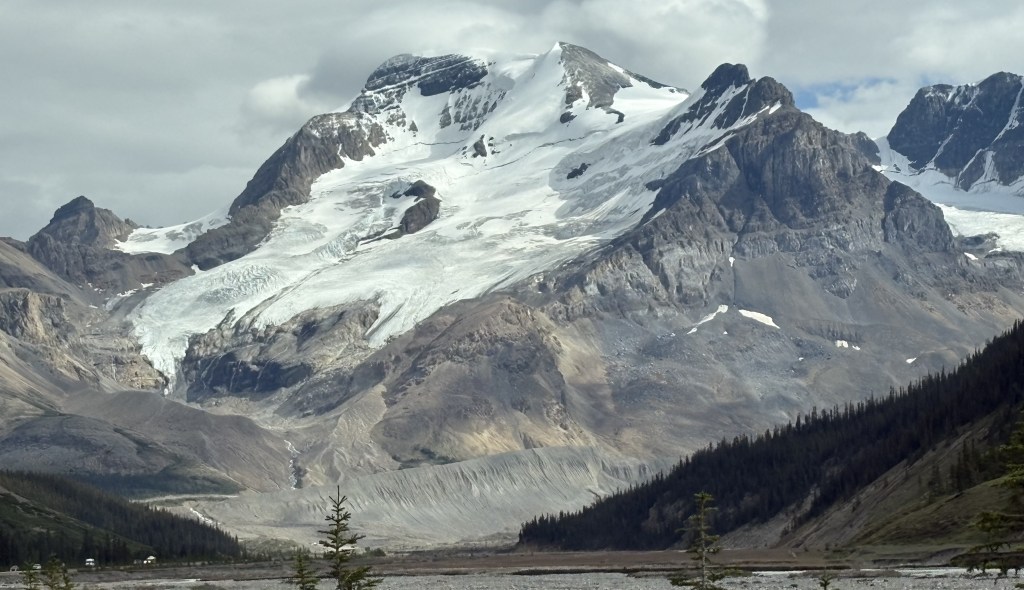
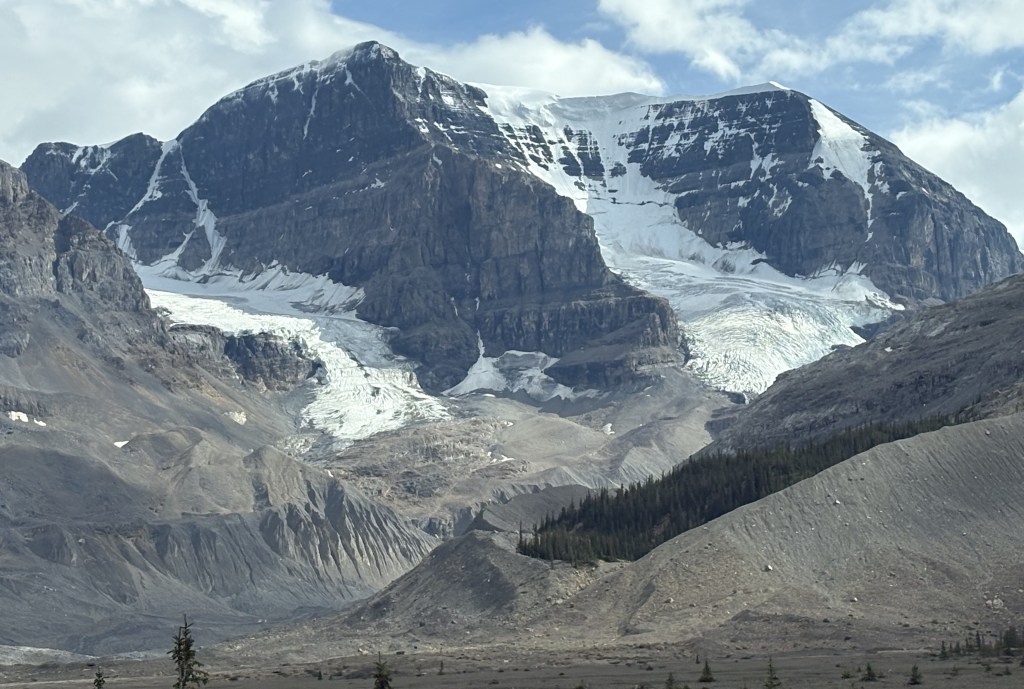
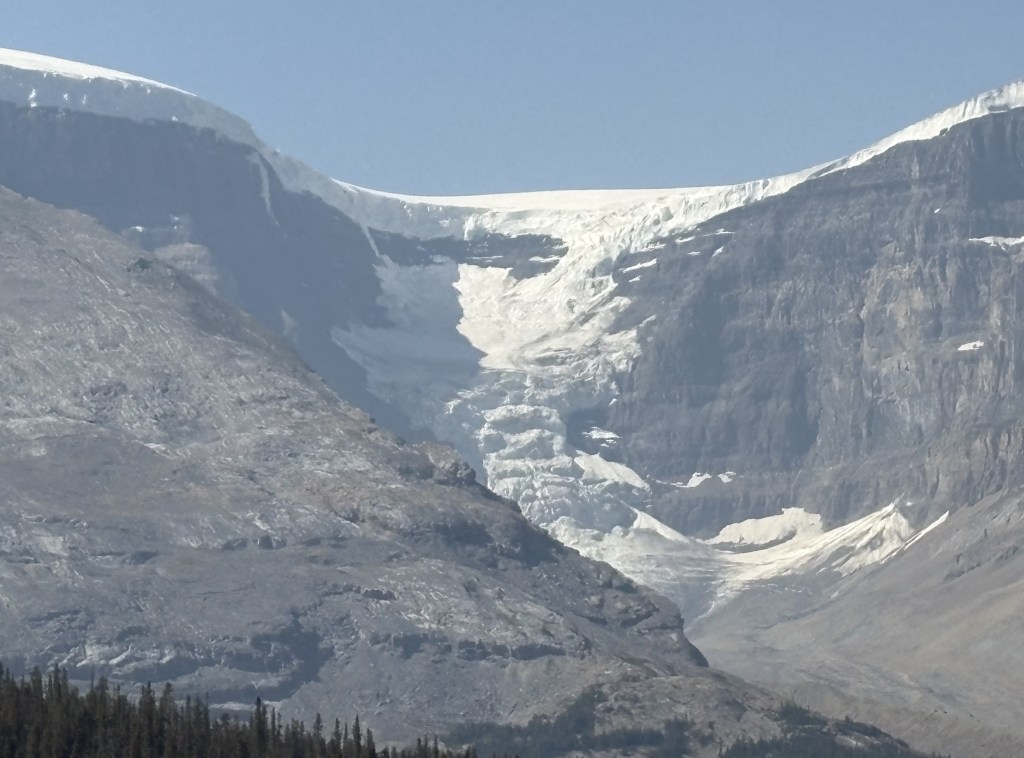
The two photos above are of the Athabasca Glacier, the largest one in a group of six which comprise the Columbia Icefield. I actually took those photos on my way south back towards Golden after having been to the town on Jasper.

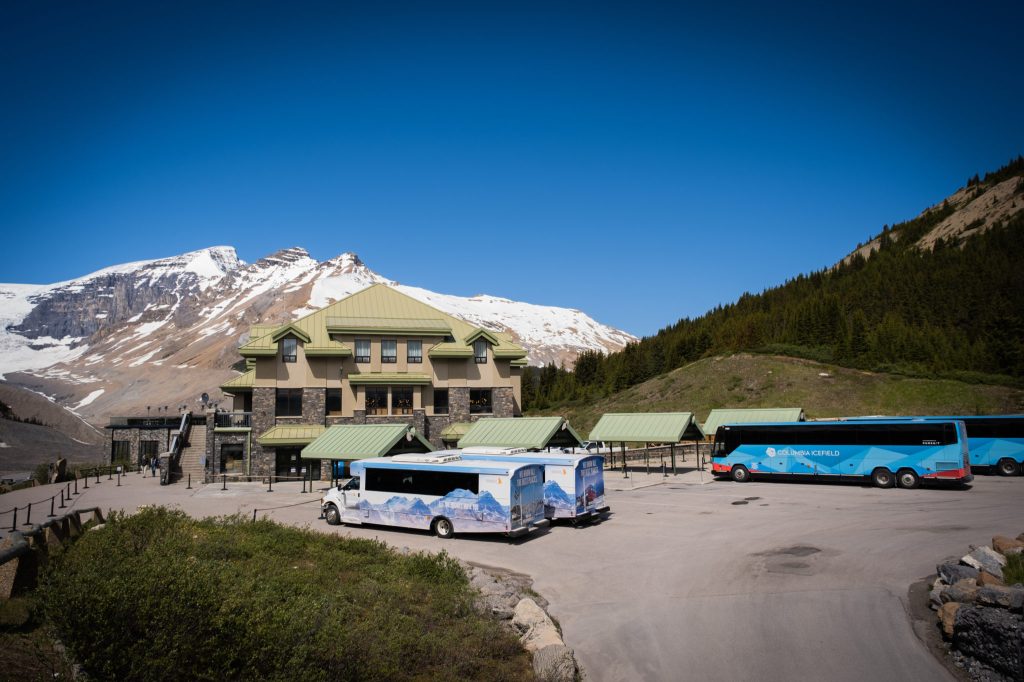
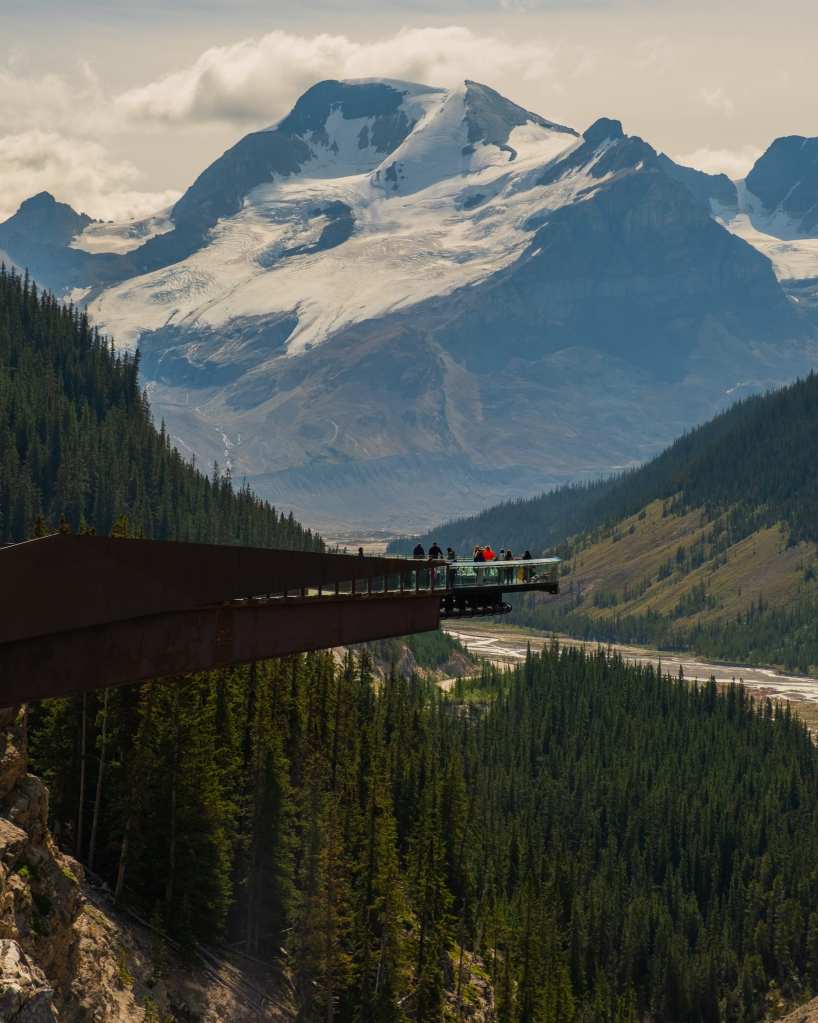
The Columbia Icefield is a major tourist draw, so much so that I didn’t take part in the guided bus tour and excursion to the new Icefield Skywalk (a viewing platform similar to the one in the western Grand Canyon). To do those things most people make reservations at the Icefields Center, a large building next to the highway. Here are two photos I found on someone else’s blog:

(Photo credit: Thebanffblog.com)

Those blue buses will transport you to the base of the glacier so you may get an up-close look. They also give you exclusive access to the Columbia Icefield Skywalk:

(Photo credit: Thebanffblog.com)

There is another company that has large, red and white specialty vehicles with oversized snow tires which will actually take you out onto the glacier itself.

So you must park your car and use other means of transportation to truly experience the glaciers. I didn’t do any of those things.

I opted to continue driving north as I wanted to see the town of Jasper and get back to Golden before dark.

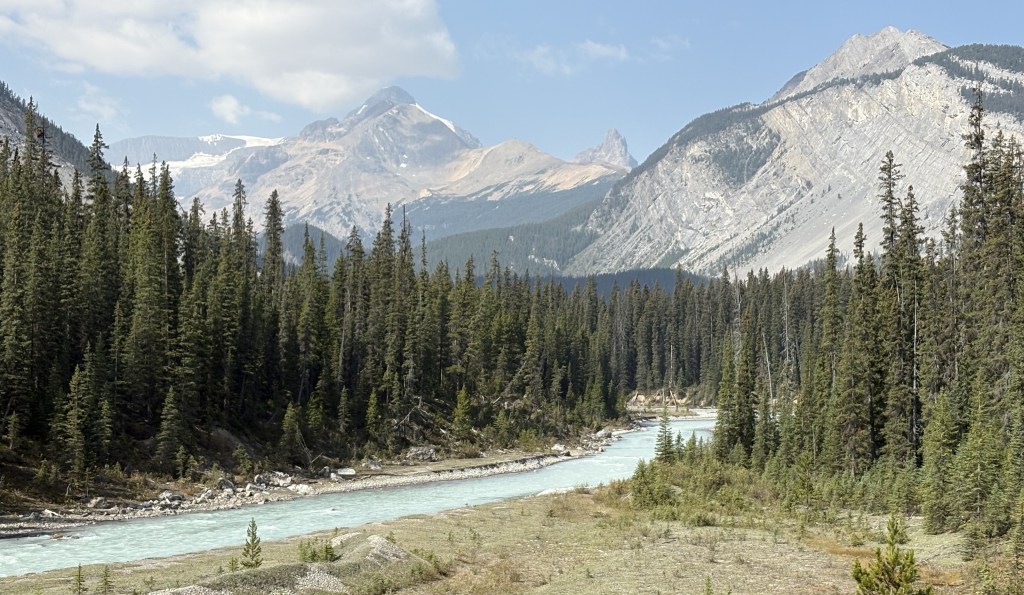
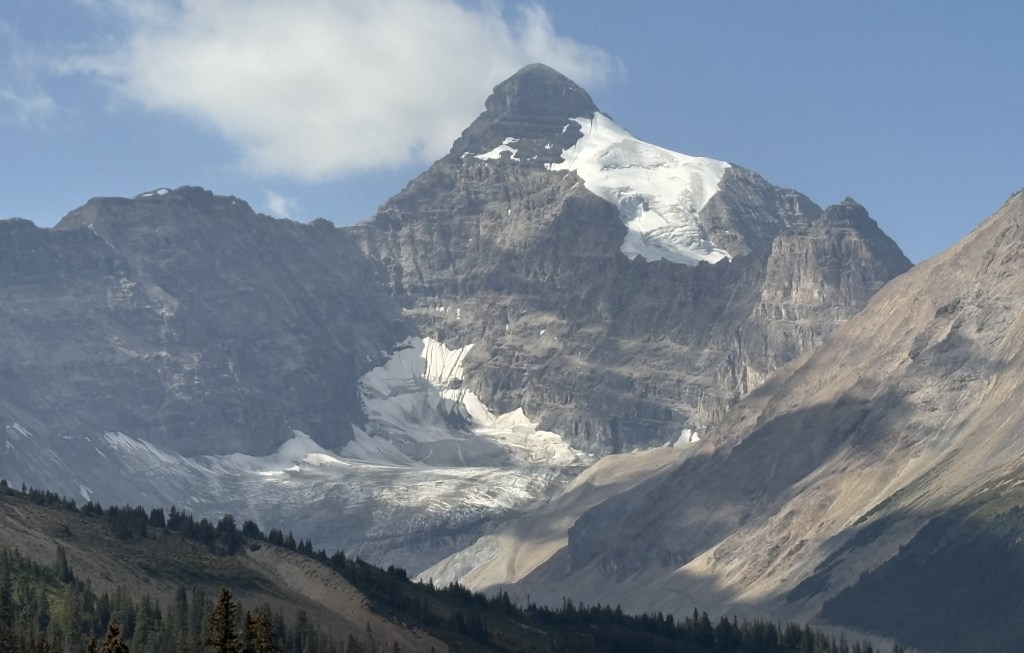
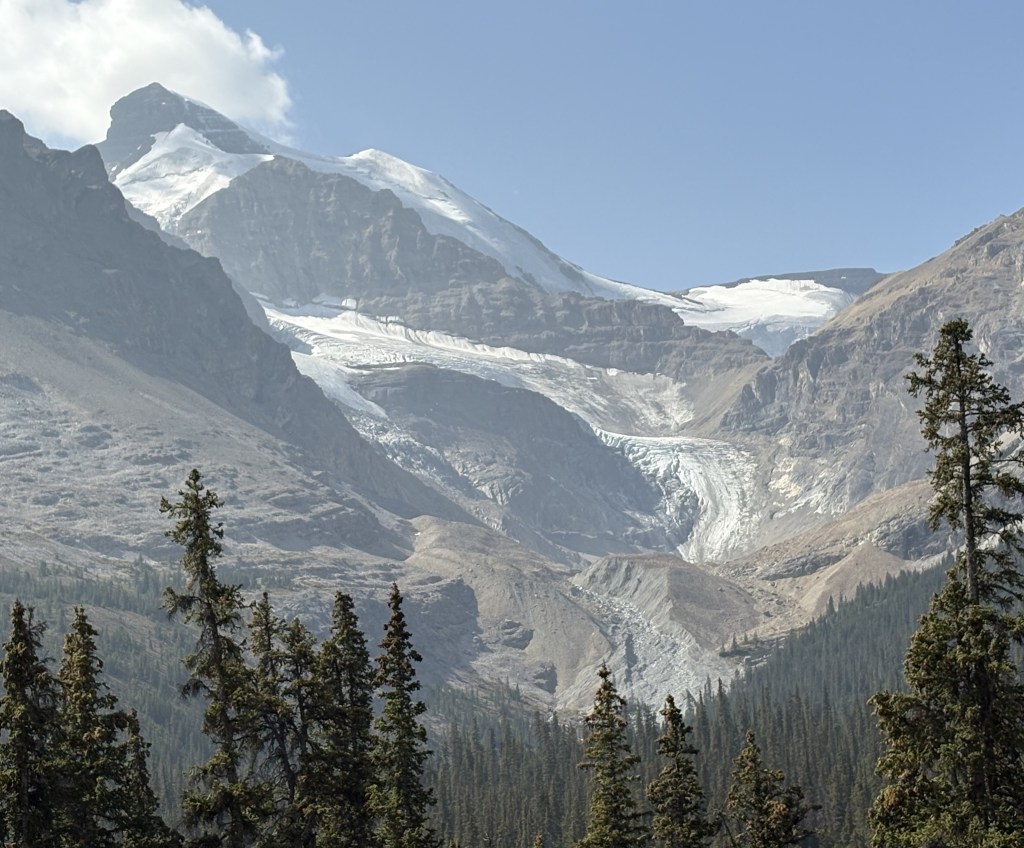
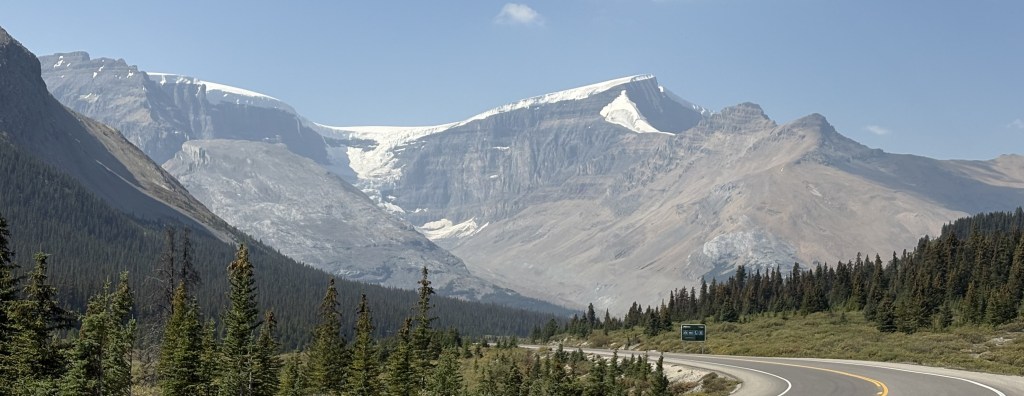
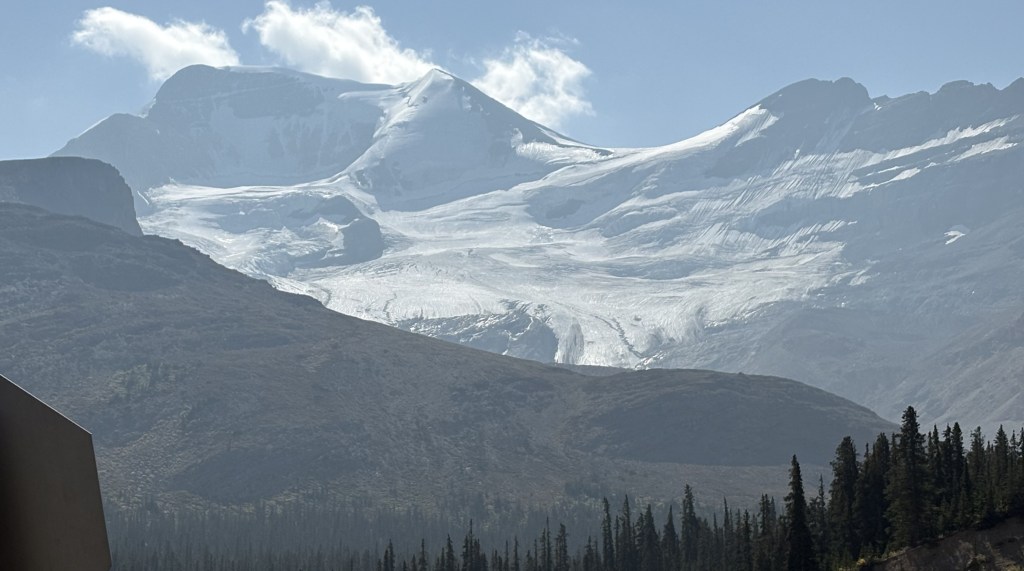
I am embarrassed to admit that I don’t know the names of the rest of these mountains. I have scoured maps and brochures but they don’t always name them and even looking at pictures online didn’t help, as they are often taken from other vantage points. In hindsight I wish I had taken better notes of exactly where I was when I took each photo. Most things don’t have signs explaining what you are looking at, and even using the time stamp on the photo didn’t help much since I make so many stops and frequently backtrack if I see something interesting.

My apologies!

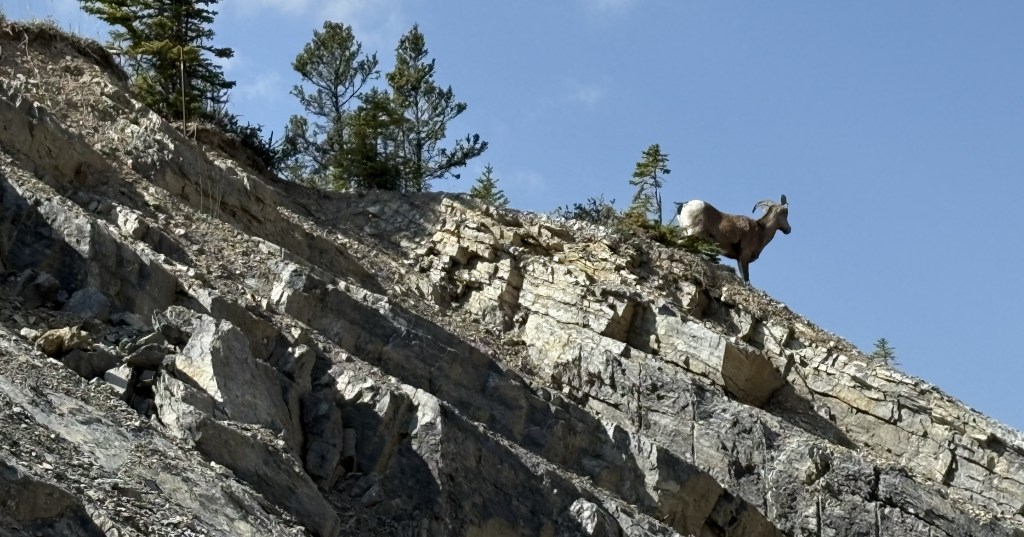
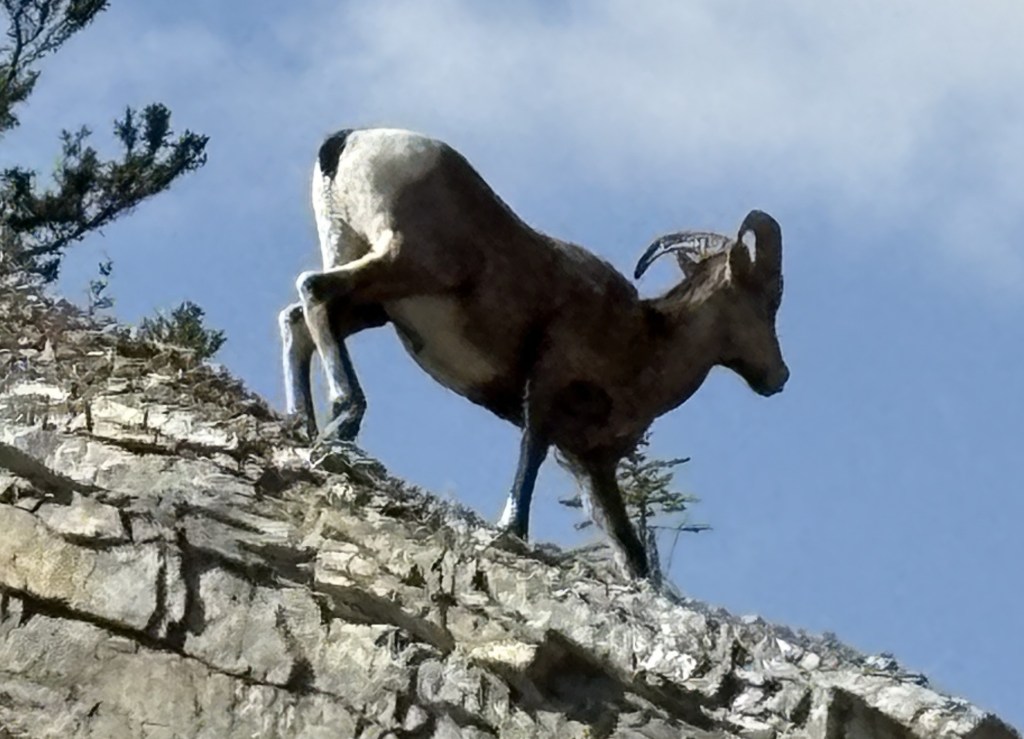
I have the tour bus that was on the road ahead of me to thank for the last two photos. It had pulled off the side of the road to let the passengers take pictures of the bighorn sheep high up on the rocky hill next to the highway. I wouldn’t have seen it otherwise.

If you are a hiker and plan to visit the Canadian Rockies I strongly encourage you to budget considerably more time than I did. There are MANY popular campgrounds and hiking opportunities and they can get you to places where you’ll have even more incredible views than I had from the road.

2025 Canada/Alaska trip recap

I am back in Durham after my 5-month 2025 road trip. I apologize for the long delay, but I have now reviewed all the photos I took between August 8 and August 31 and will begin posting them in small batches. Some days will have lots of photos, some days will only have a few. I will continue to review photos taken during the remainder of my trip and that should allow continuous posts highlighting my time in Canada and Alaska.

All told, I drove a total of 26,490 miles. 10,061 in the “lower 48” getting to and from western Canada, 12,608 in four of the provinces in Canada, and 4,421 in Alaska.

I spent 142 nights on the road. 20 with family and friends and the remainder in Airbnbs. Most of my time in Canada was spent in British Columbia (33 nights), with 16 in Alberta, 6 in Saskatchewan and 6 in the Yukon Territory (mainly stops while driving to and from Alaska).

I was very fortunate to have had good weather most places, and was able to get in and out of Alaska before any significant snow fell. I encountered little bits here and there, but nothing which impeded my travel. My car was a real trouper, only breaking down one time (in Utah) towards the end of my trip. In all the years I have traveled my cars have treated me very well.

My overall experience was AMAZING! I saw so many beautiful places and met some very nice people along the way – both fellow travelers and my Airbnb hosts. I have had very good luck using Airbnb over the years and find it a pleasant way to get local knowledge as well as staying close to the places I want to see. I passed on some of the more popular ways to see things (by air, by boat or by train) but prefer to do my own thing and travel by car. I avoided some of the more crowded venues.

I hope you enjoy the photos I am about to share.