Lethbridge, Alberta

August 28, 2025

After having visited Waterton Lakes National Park yesterday I had returned to my Airbnb in Lethbridge to spend my first night here. Lethbridge is the 4th largest town in Alberta province with a population of just over 100,000. People who live here are called Lethbridgians or, are you ready for this, Lethbians.

Today first place I went was the Paradise Canyon Golf Course, as it was listed on TripAdvisor as being a good place for photo ops. Well, it is in a nice canyon but it is a golf course (duh) so I didn’t spend much time there.
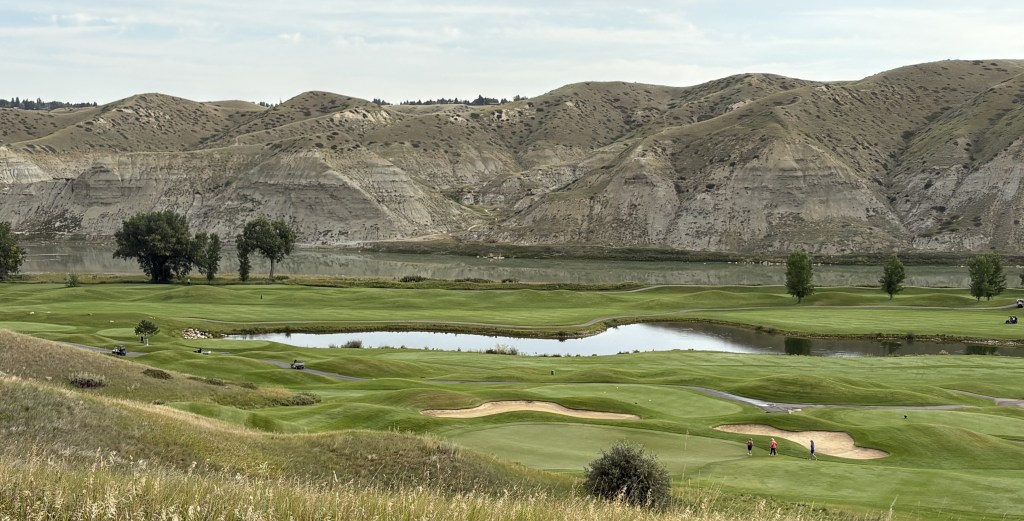
Running alongside it, in this long coulee, is the Oldman River which you will hear more about in a moment.

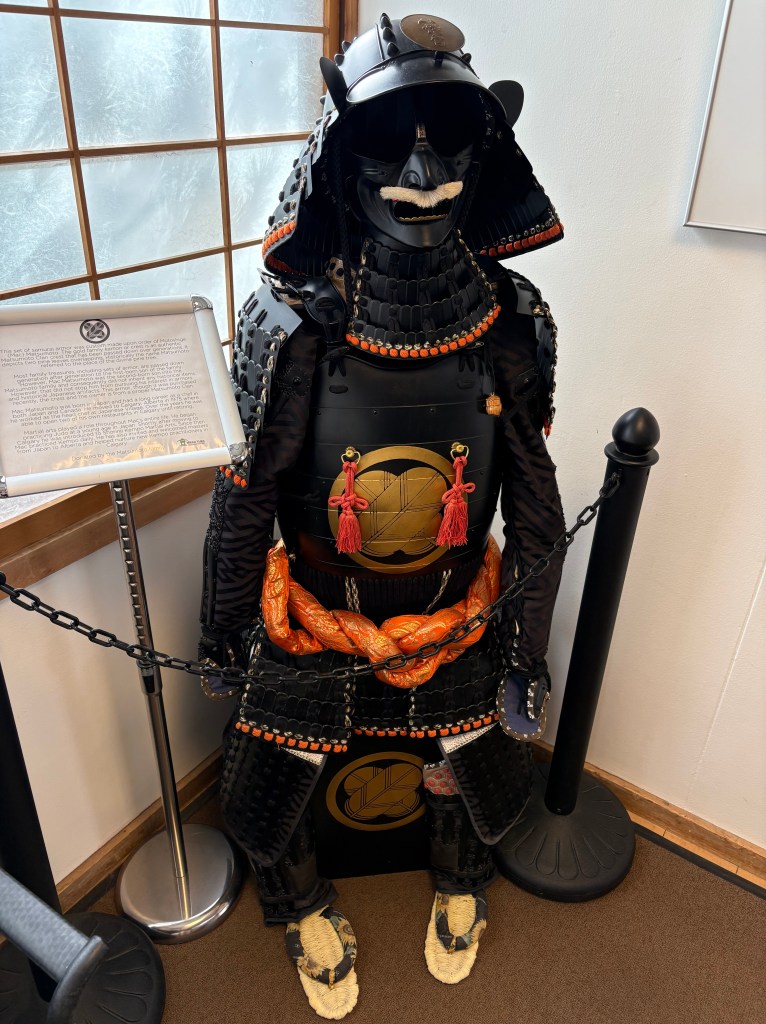
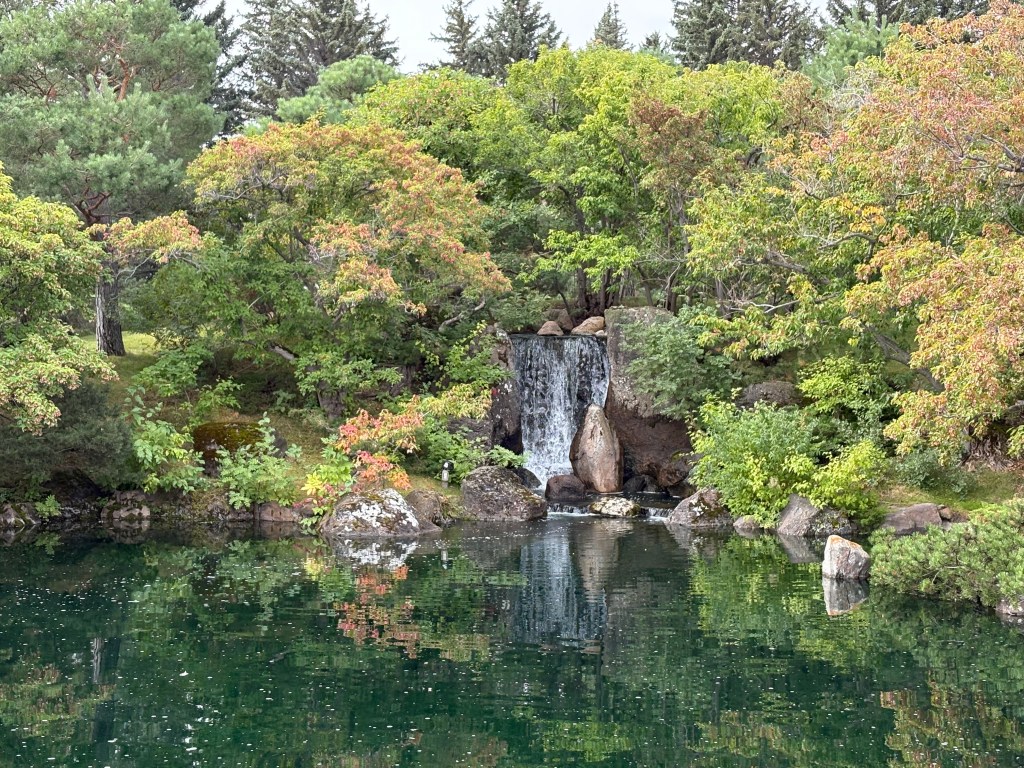
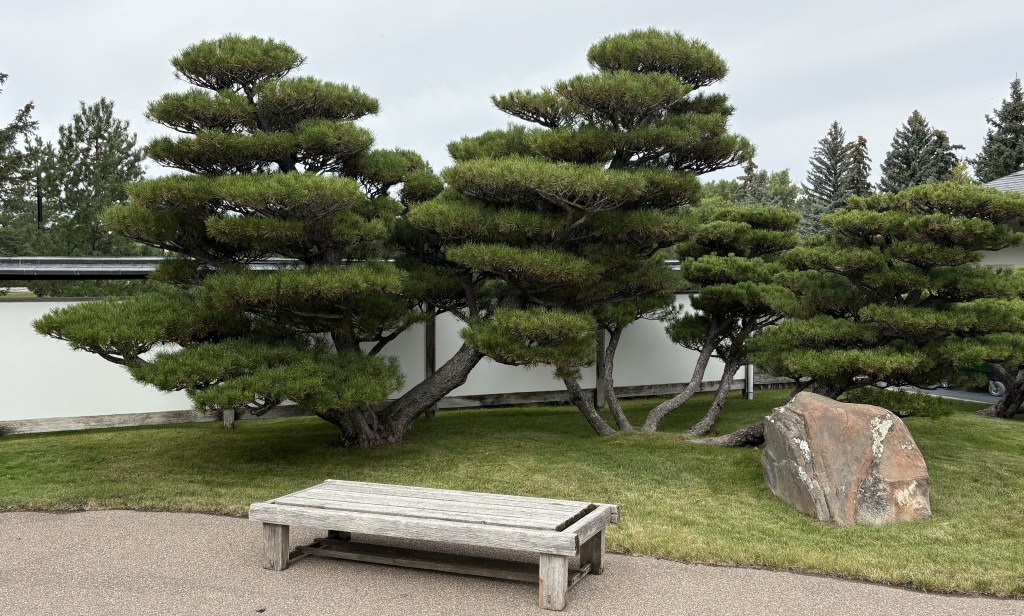
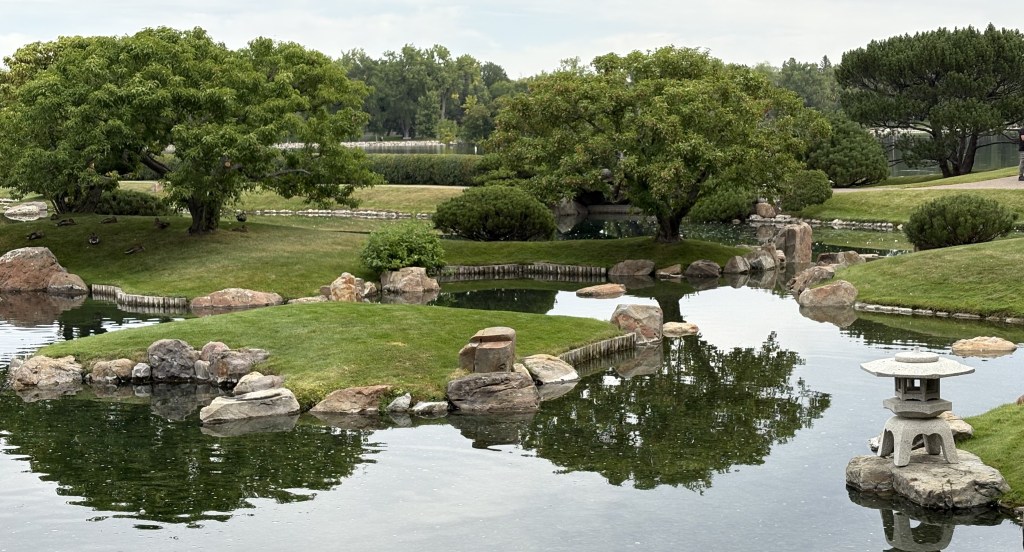
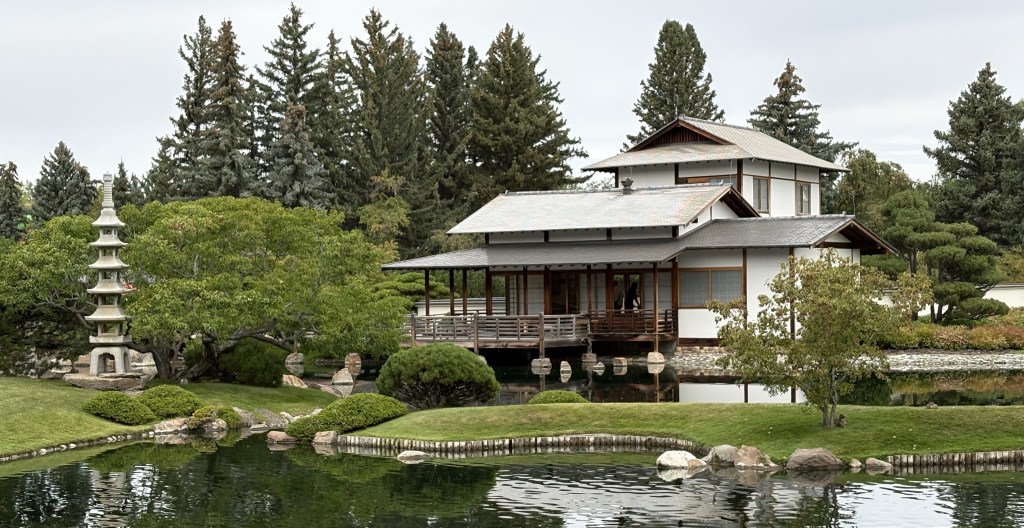
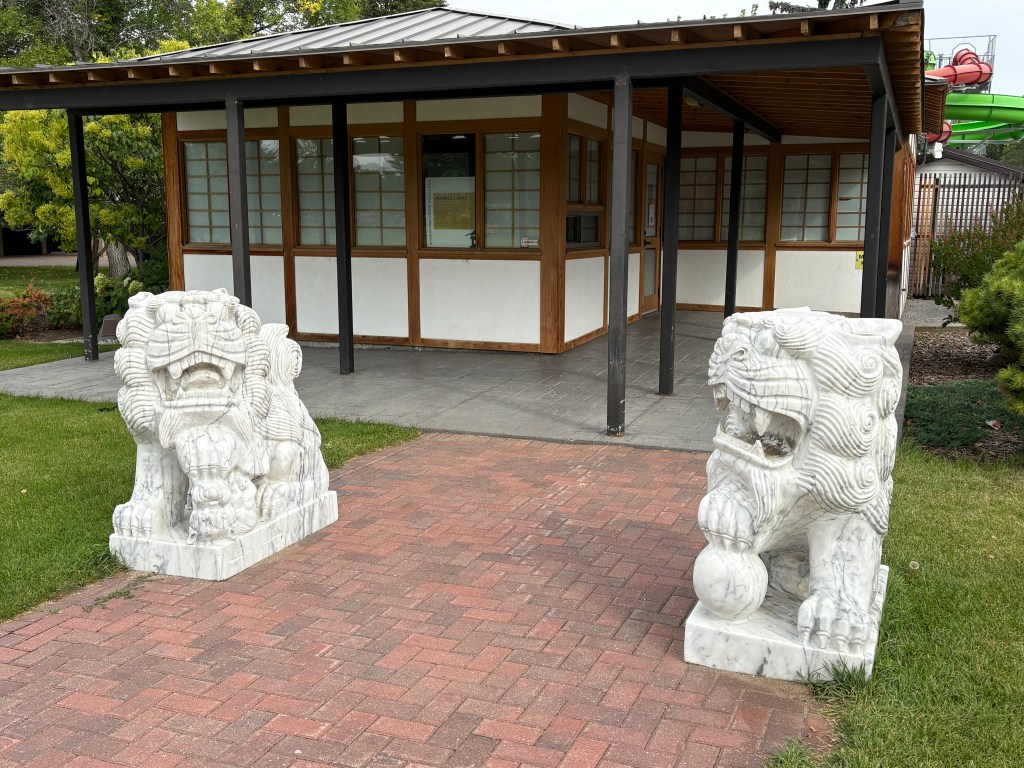
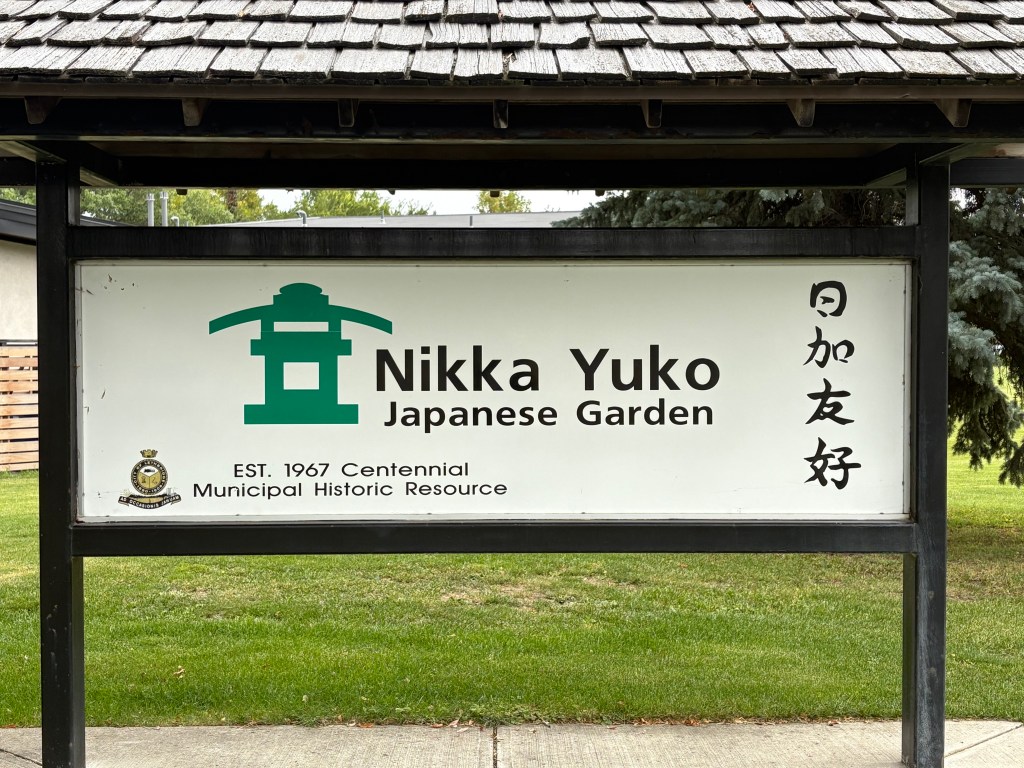
My next stop was the Nikka Yuko Japanese Garden, which I had passed as I was driving into town yesterday.
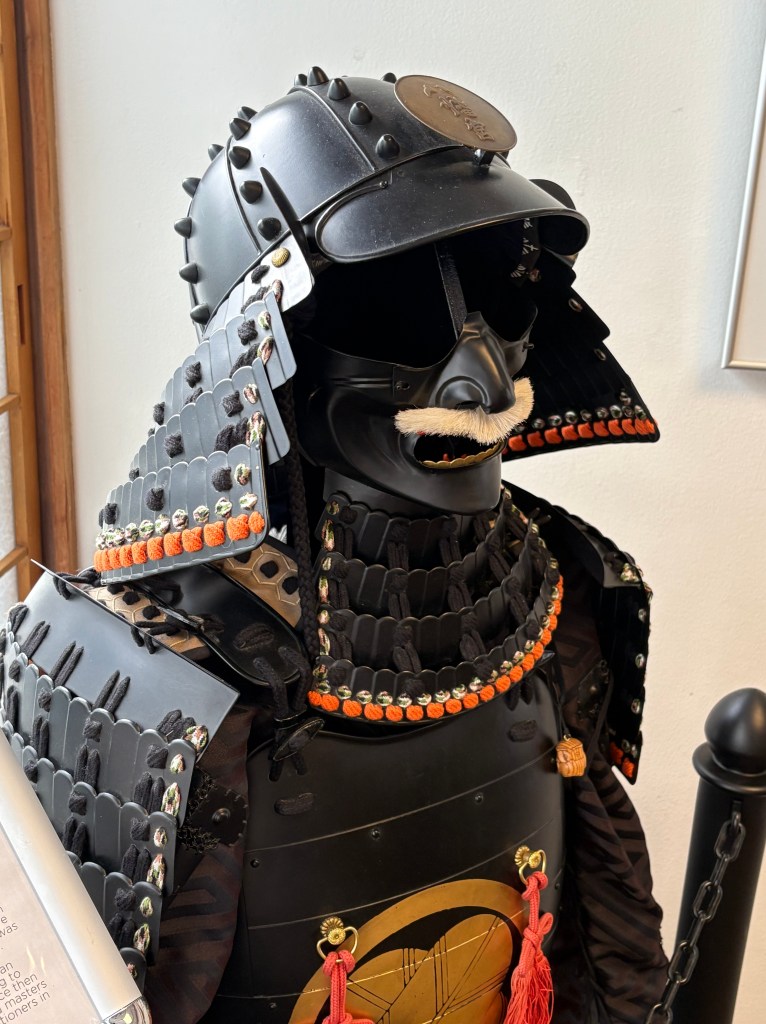
No, that’s not a Japanese Darth Vader. It is authentic samurai armor.
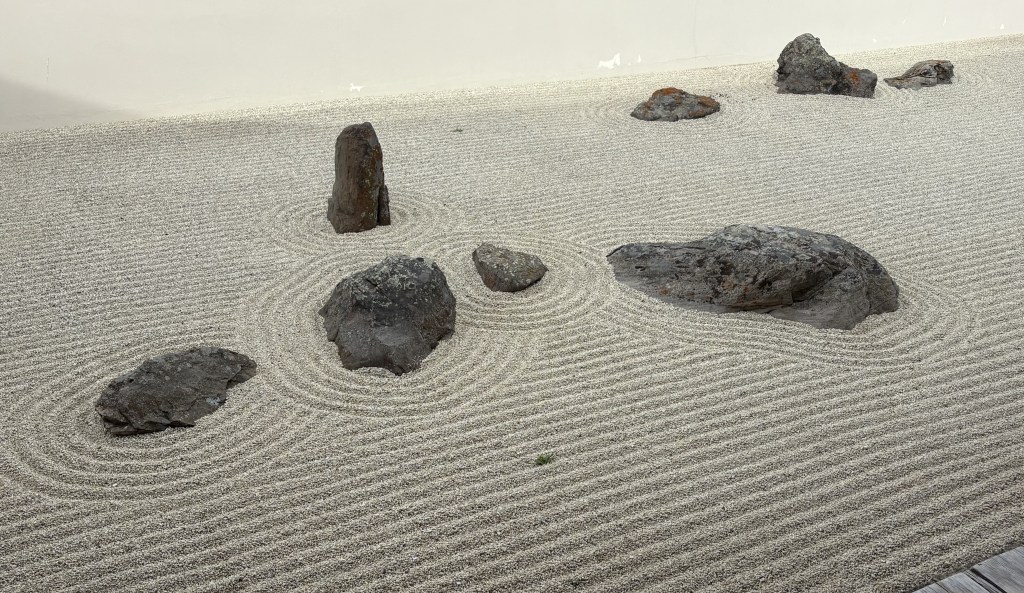
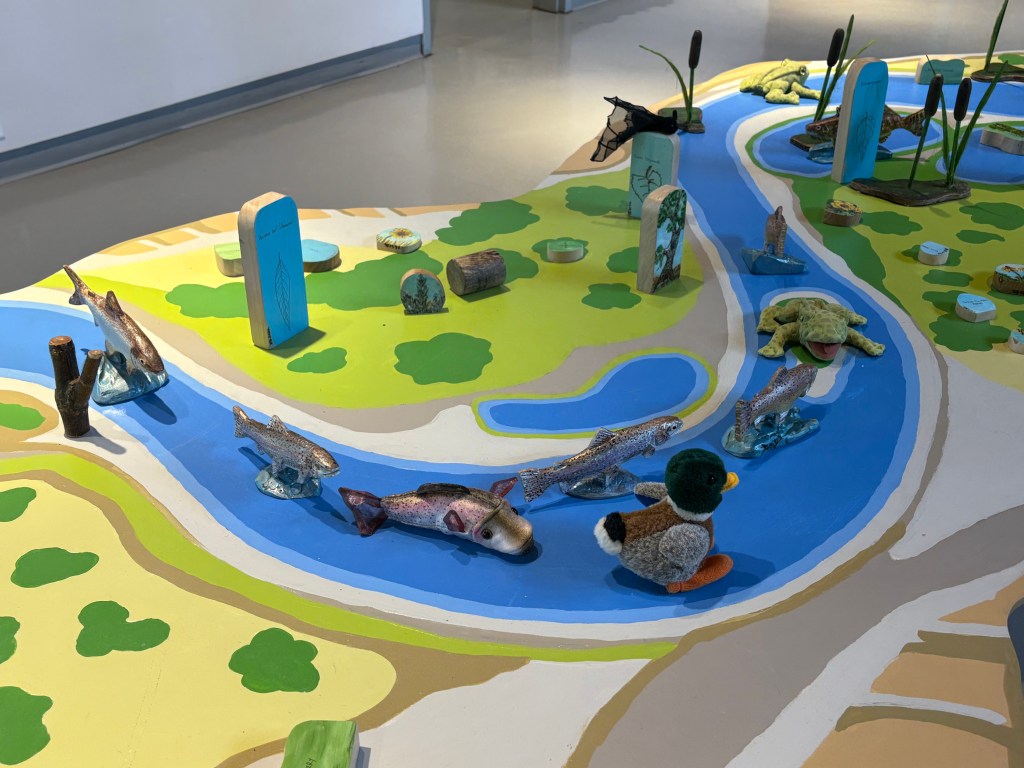
After that I drove to the Helen Schuler Nature Centre. I was greeted by this sign:
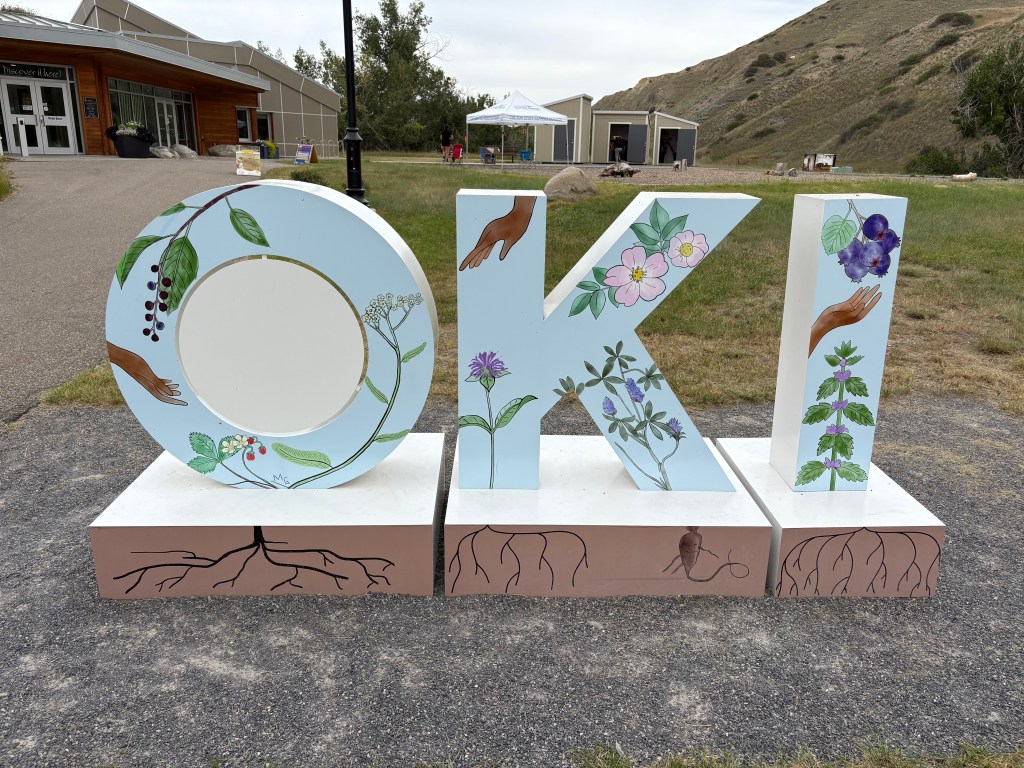
Oki is an indigenous Blackfoot word meaning hello, or welcome.
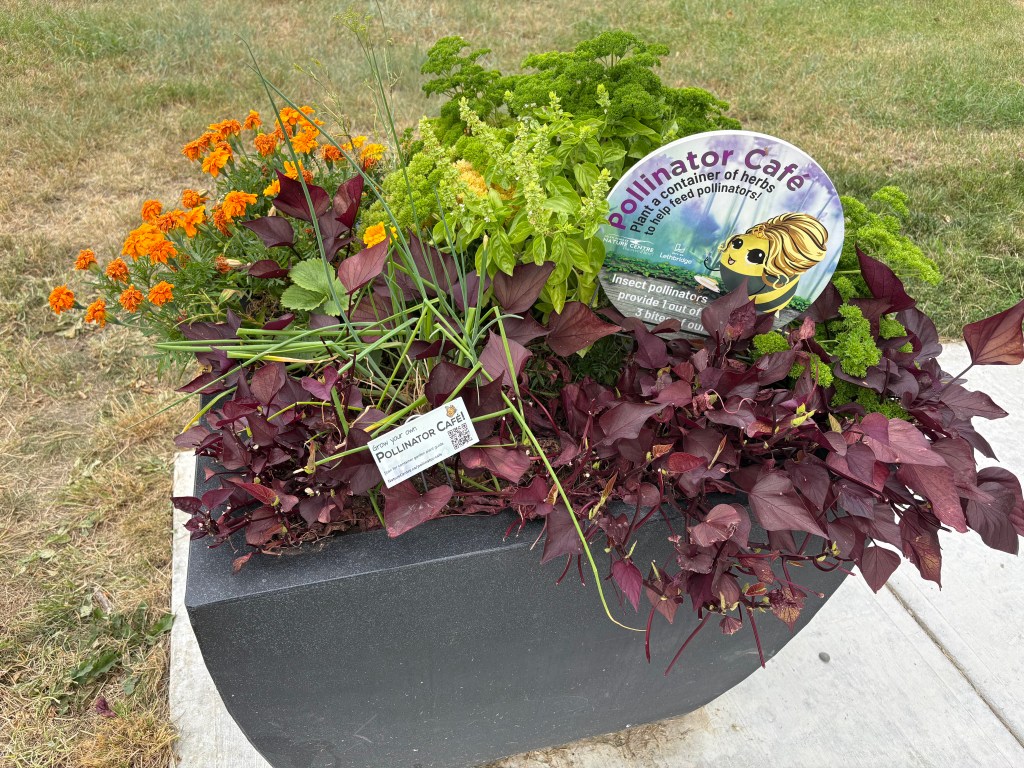
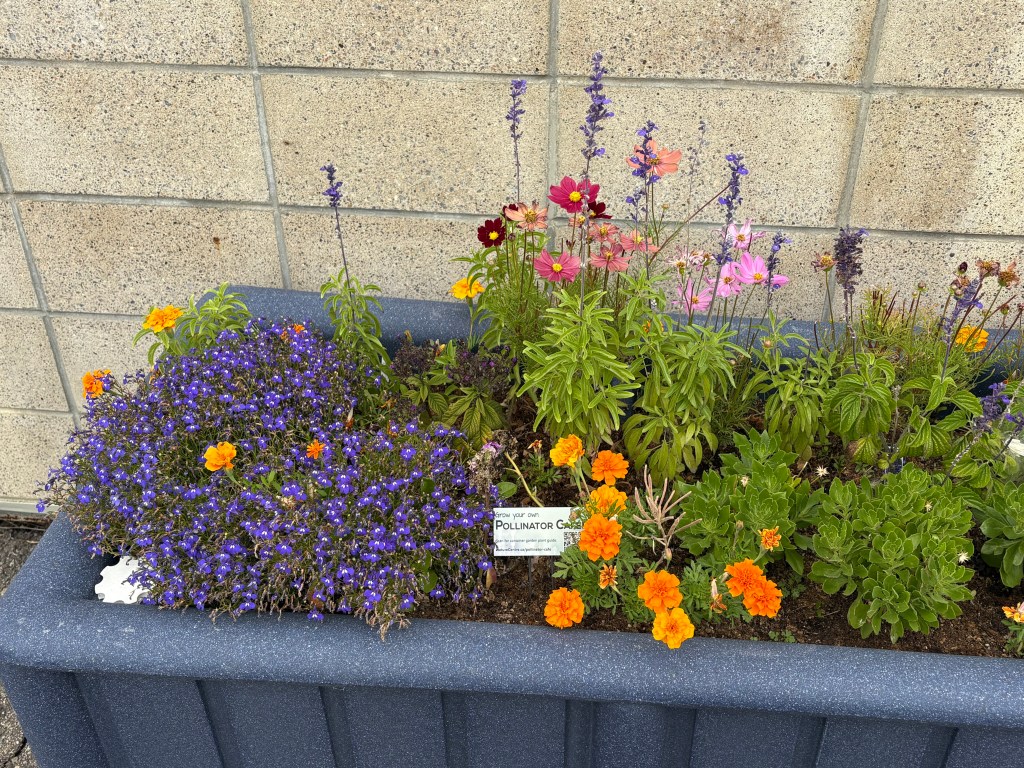
Most of the displays in the Centre seemed to be targeted at kids, though there were numerous messages scattered about clearly directed at adults.

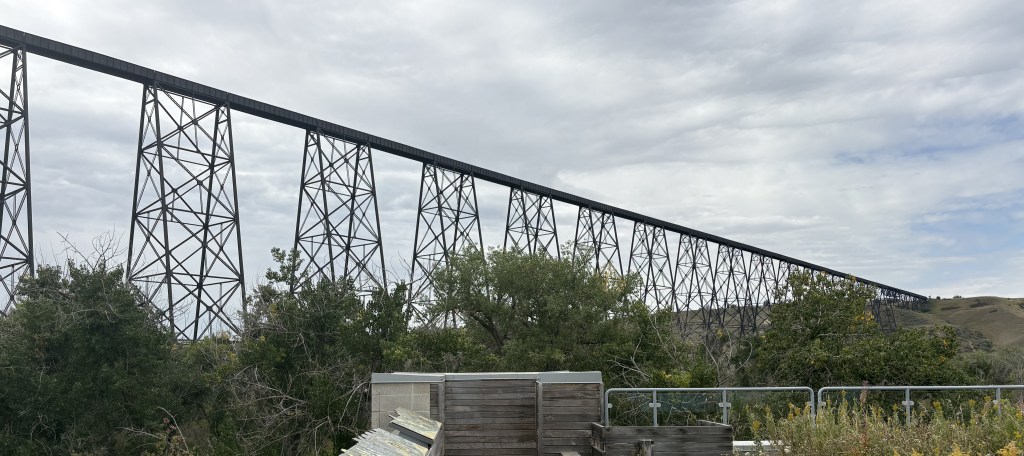
The building did have a rooftop deck which was promoted as having a variety of plants, but I can’t say as I was terribly impressed (they weren’t flowers so much as herbs and non-flowering plants). It did, however, give me a great view of another local landmark – the Lethbridge Viaduct, or as is called locally, the High Level Bridge. I had driven under it to get to the Nature Centre.
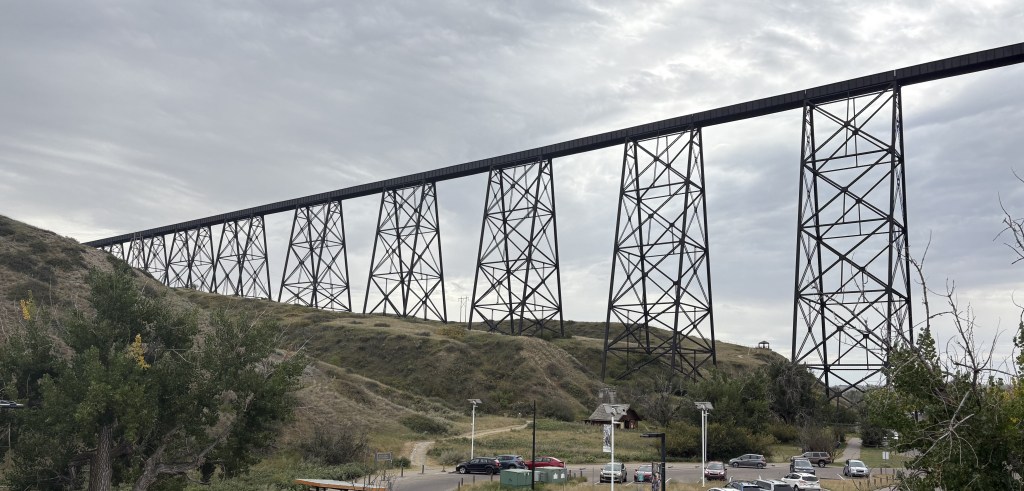
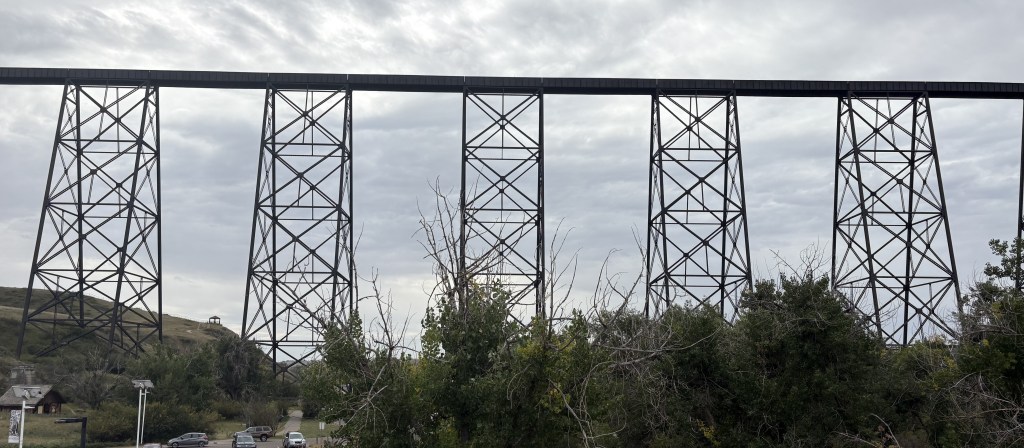
It was completed in 1909 by the Canada Pacific Railway and is the longest and highest railroad trestle in the world. It spans the Oldman River and reaches a maximum height of 314 feet. At 5,327 feet it is just over a mile long. It is still in use, and I did see a long train traveling over it later in the day.

I drove to a wetlands/nature preserve in another part of the coulee. I walked along a series of paths and on a pier-type walkway, hoping to see some critters but I did not. I then drove downtown as I had picked up a brochure touting a mural contest with some pretty clever entries, but it must have been dated as I only found one – painted on an electrical box in a big city park. The map I had showed lots more…

I got a little uncomfortable as there seemed to be lots of rough looking people hanging out in the park, and there was an obvious police presence, so I decided to go back to my Airbnb and do some trip planning. I had improvised visits to Medicine Hat and Castlegar (my next stop) but needed to look at my maps and plot out some more stops in British Columbia and Alberta and start planning my route to Alaska!
Kananaskis Country – Post 2 of 3

August 14, 2025

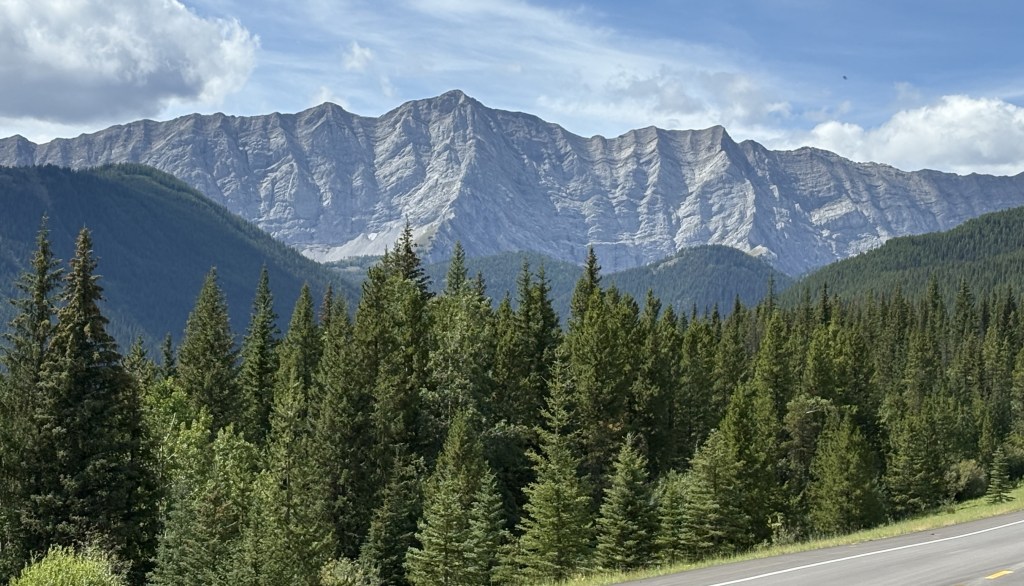
I didn’t mention in the first post that Kananaskis Country is big. It covers over 1,500 square miles, larger than four of the six National Parks I visited while based in Golden. Lots provincial parks, rivers, hiking trails, lakes (large and small) and other publicly accessible areas.

Here are more things I saw as I started driving back from the southern end.

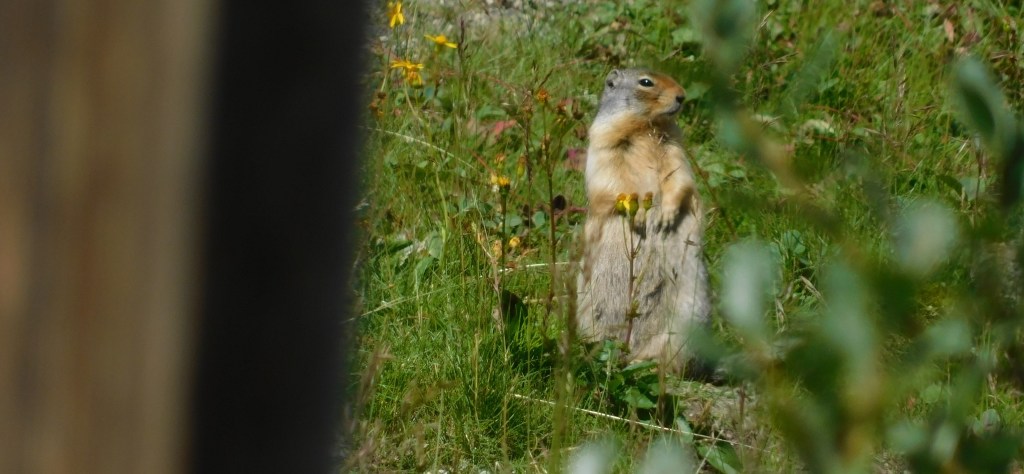
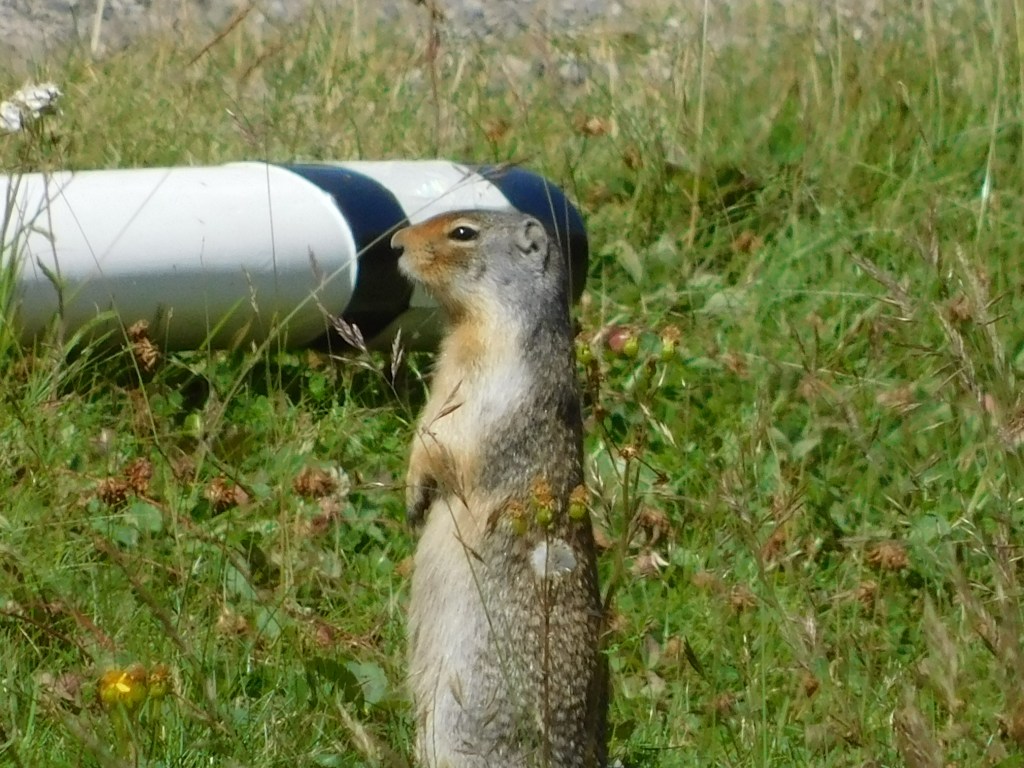
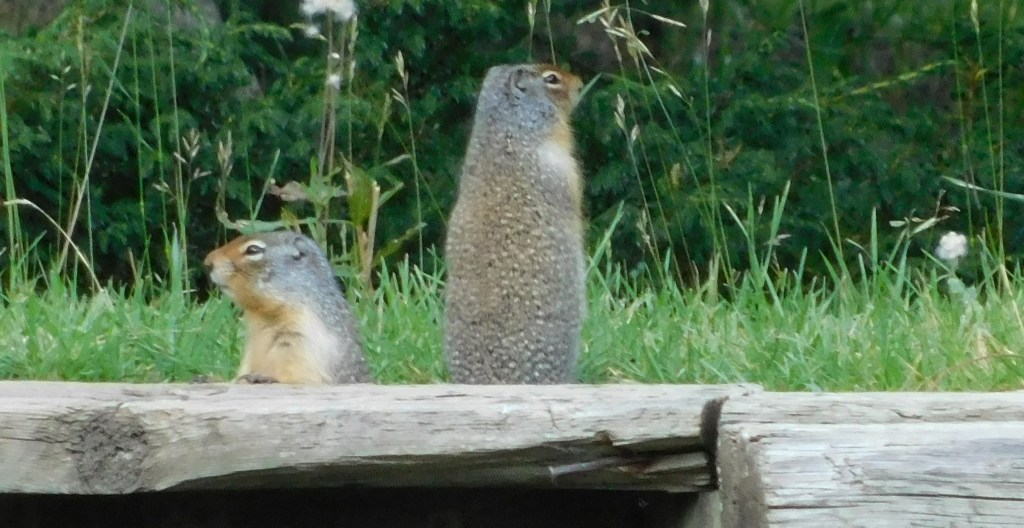
At one point I was pretty sure I saw a marmot run across the road. There was a small park nearby so I pulled off the road, parked and waited. Sure enough two them came out of their burrows and looked around.

The small marmot above is acting as a sentry. I had quickly pulled off parallel to the road near the entrance to a parking area and when I stopped I realized it was right in front of my car (like only a few feet away) looking right at me. He never flinched. The only time he moved was when I got out of the car with my camera, at which point he ran back to shelter to alert his friends (which he would have already done audibly). I waited, trying to hide behind the stop sign post, and in a short while he came right back out and resumed him position (I had pulled my car back into the parking area by then).

It was the same thing the first set of marmots I saw were doing. Looking for danger so they can alert others.

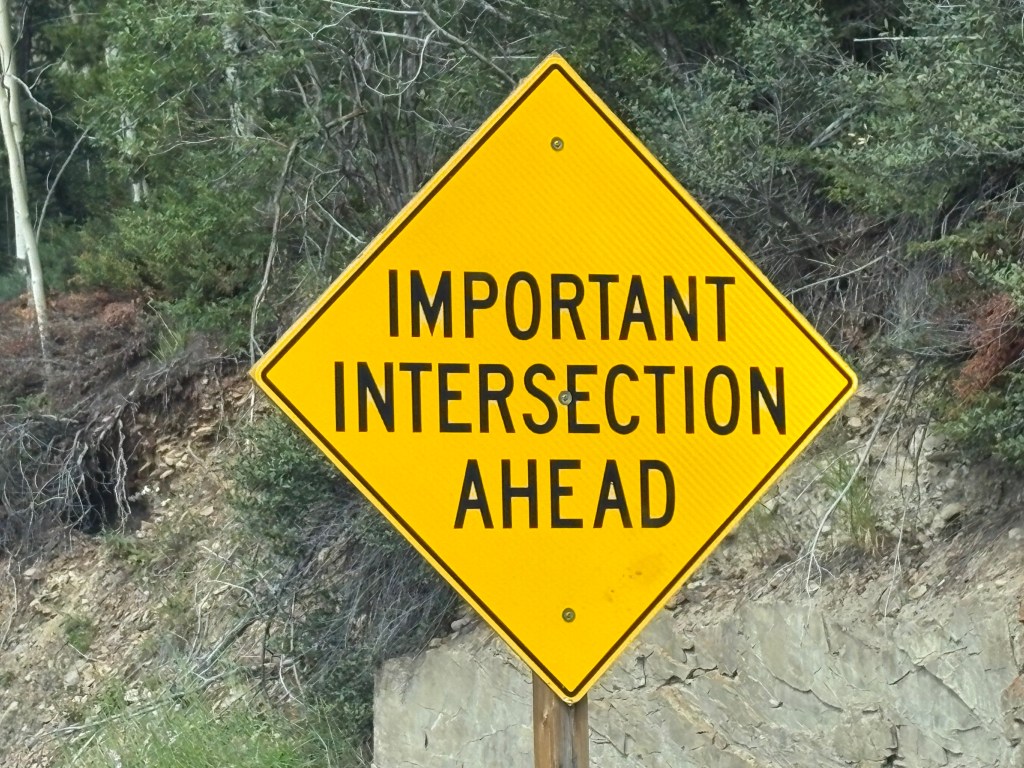
This what I had stopped to take a picture of:

This is a sign I have started to see more and more often. I don’t really understand the significance of it, as the intersection I ultimately encounter doesn’t seem to be any different than other intersection.

Just another Canadian thing, I guess…

Kootenay NP Redux – Part 1 of 3

August 11, 2025

Today I decided to drive back down south and go through Kootenay National Park again. The first time I went through the weather was less than ideal for photos, with some low clouds obscuring some of the mountain tops. The weather was forecast to be better today so I thought I’d give it another go.

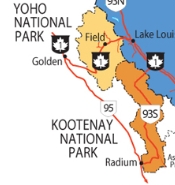
Sorry the map is kind of small but it focuses on the route I would take. From Golden I drove south on Highway 95 to the town of Radium Hot Springs. There I would turn left on Highway 93S which goes through Kootenay National Park and up to the Trans Canada Highway (Hwy 1), which I would take back to Golden. The entire loop is about 200 miles.

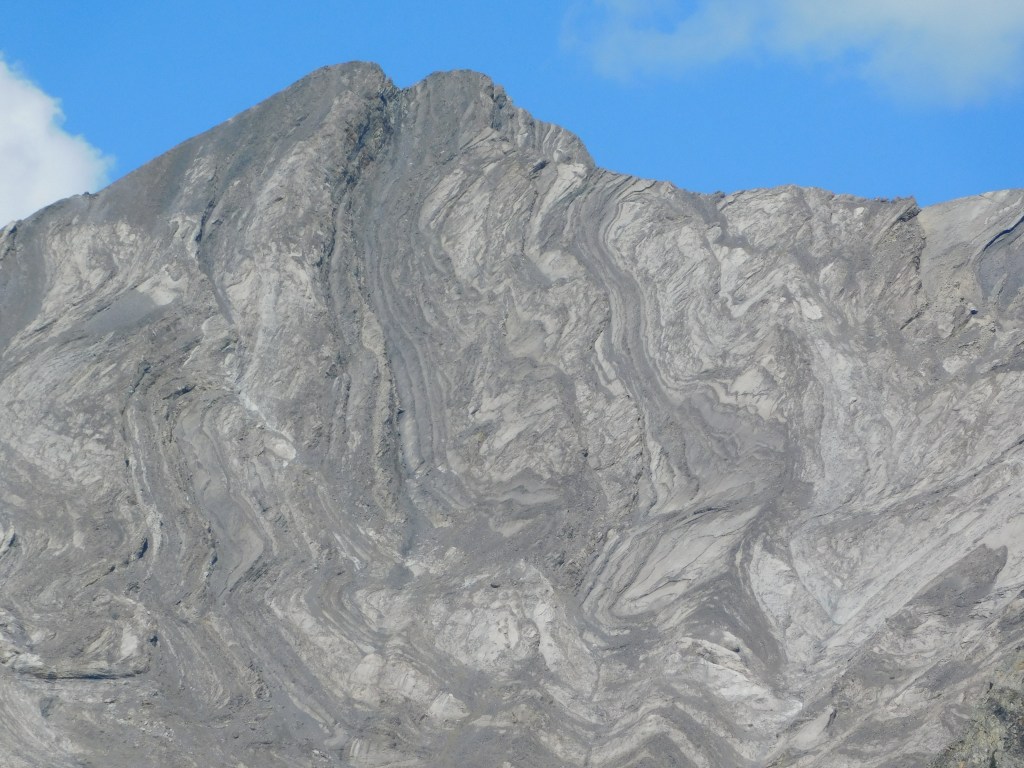
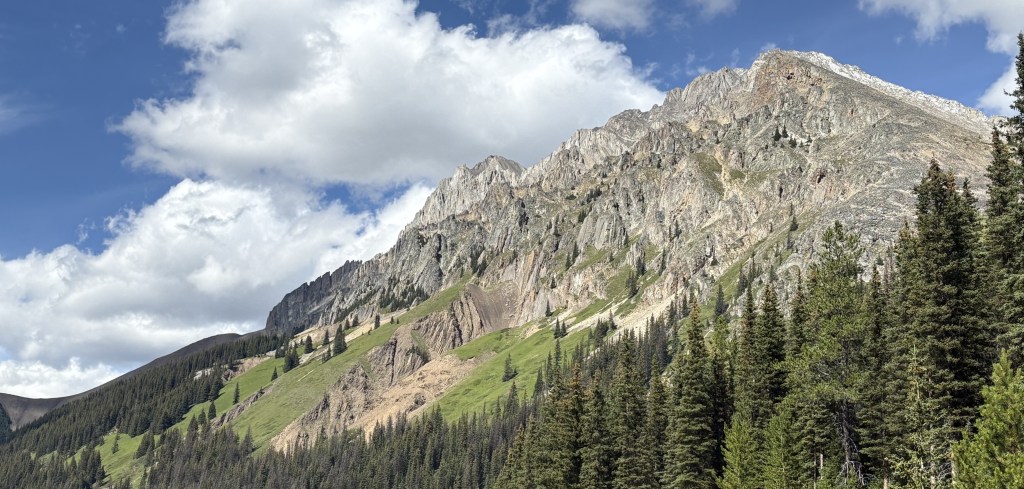
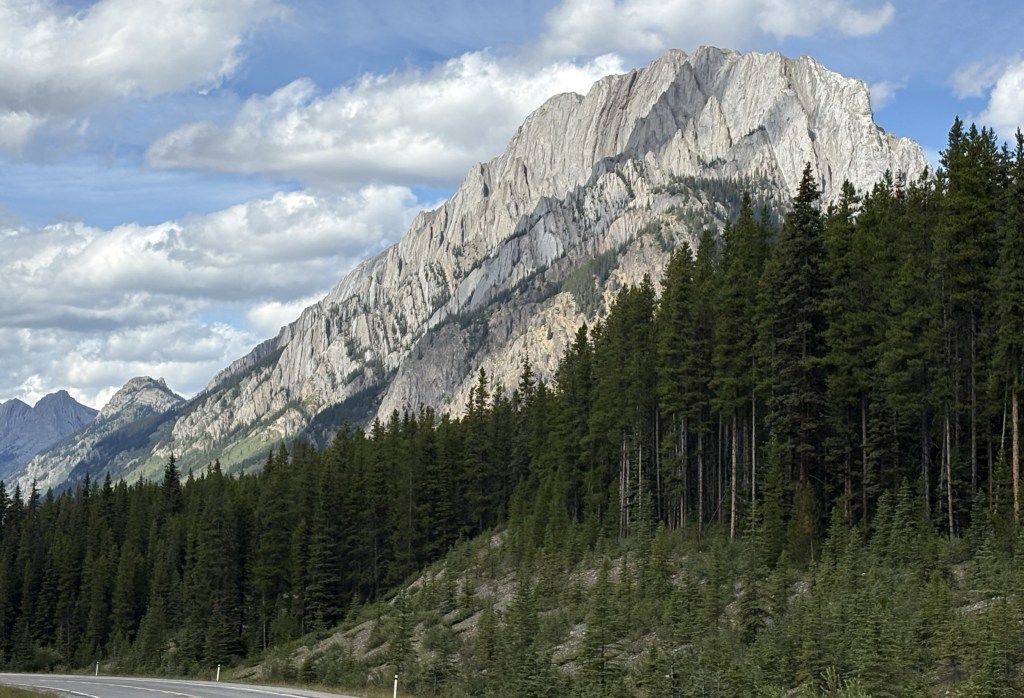
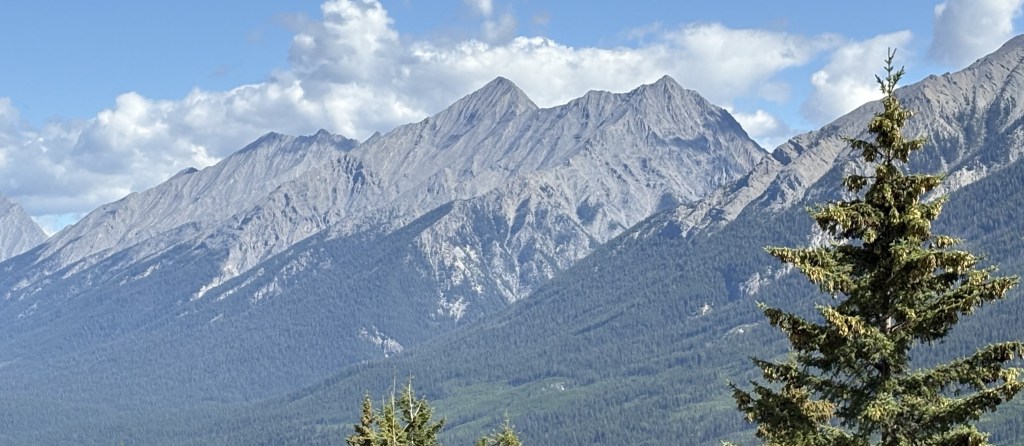
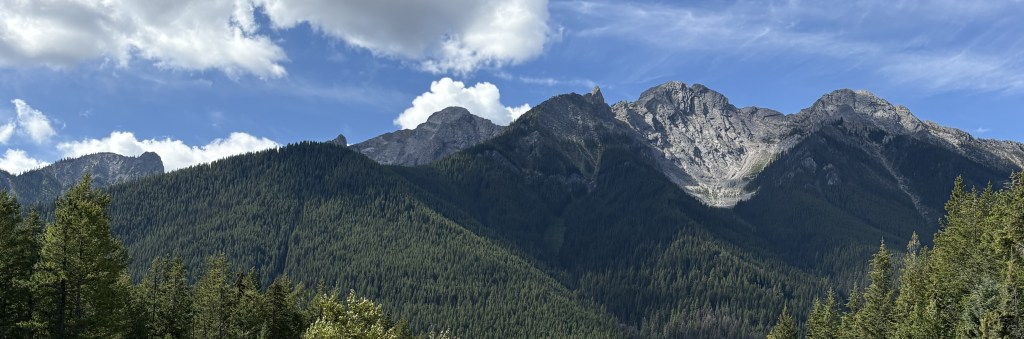
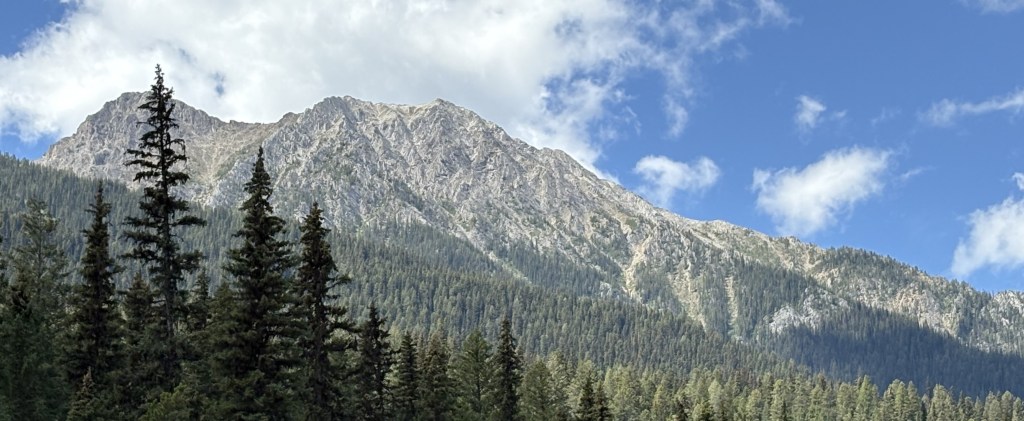
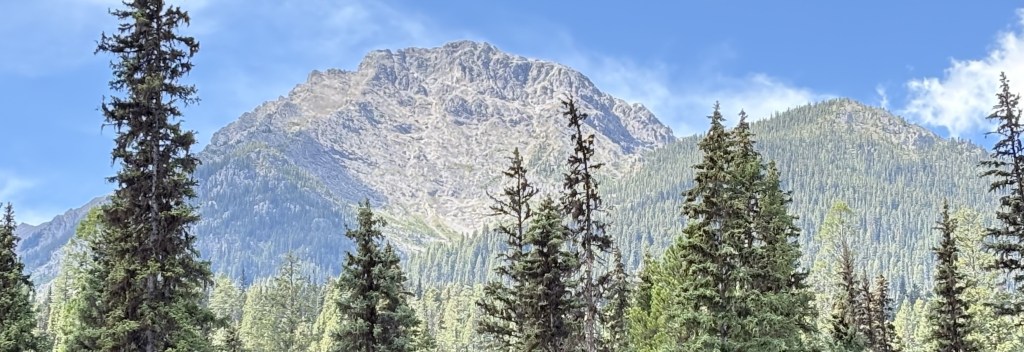
I did post some photos of my original trek through the Park so you will probably see things you have seen before. I have more photos than what I am about to post but I went through them and eliminated ones that seemed repetitive or were not very clear. I am in the Canadian Rockies so obviously mountains are the main things I see. Many of the mountains have a different appearance than ones I have seen elsewhere so I hope you enjoy the variety as much as I do!

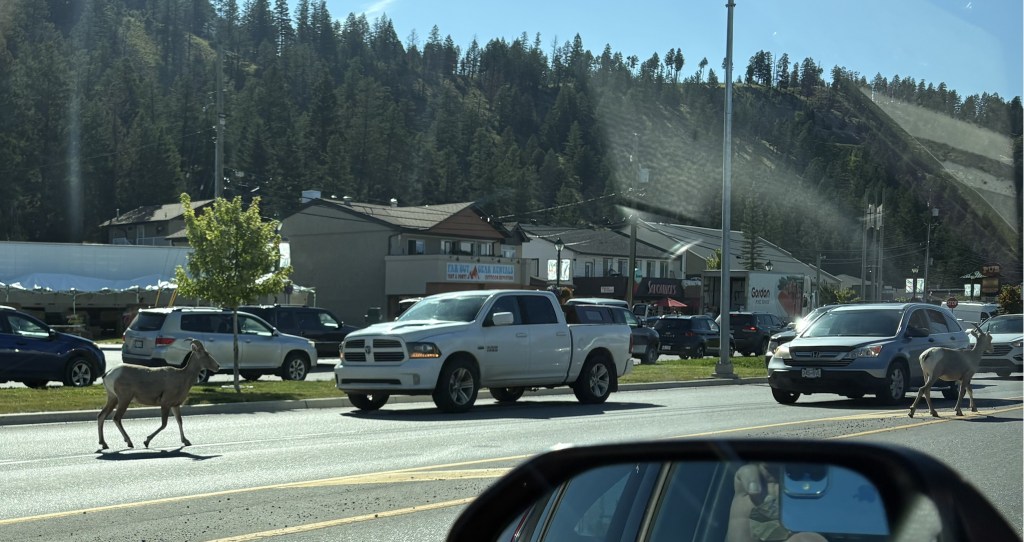
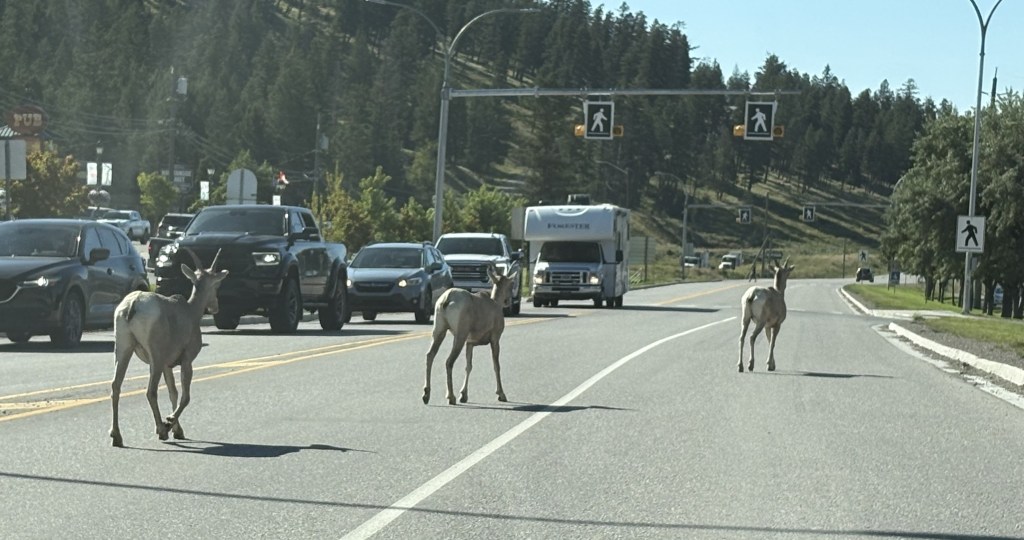
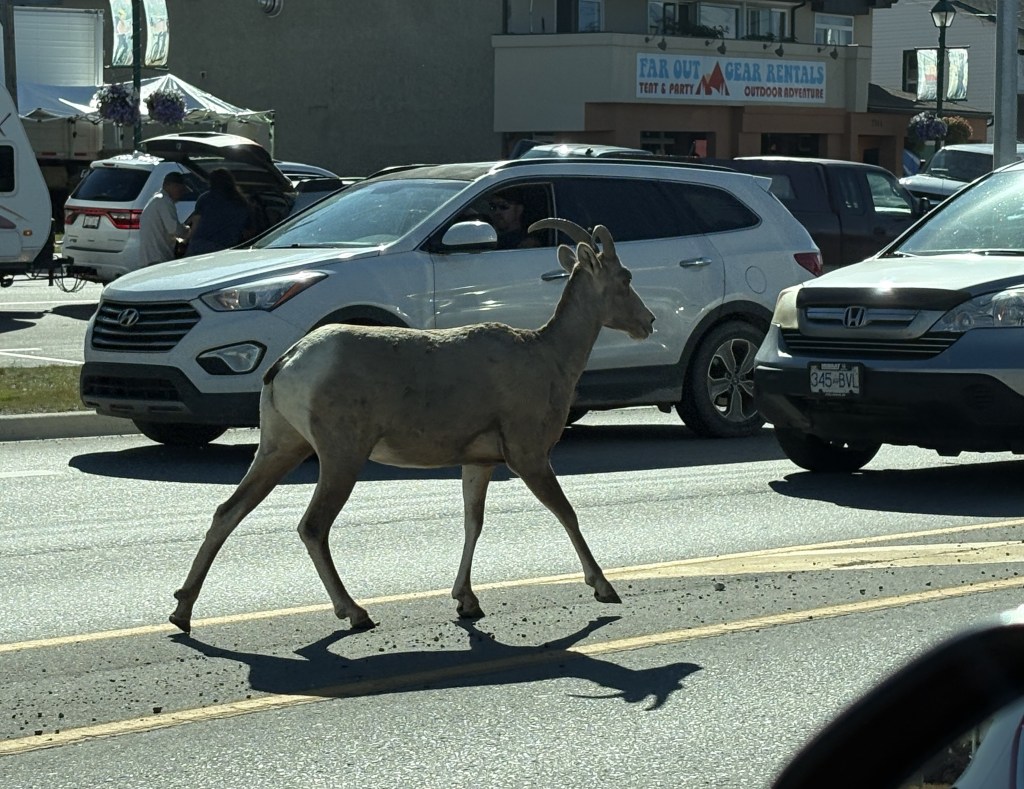
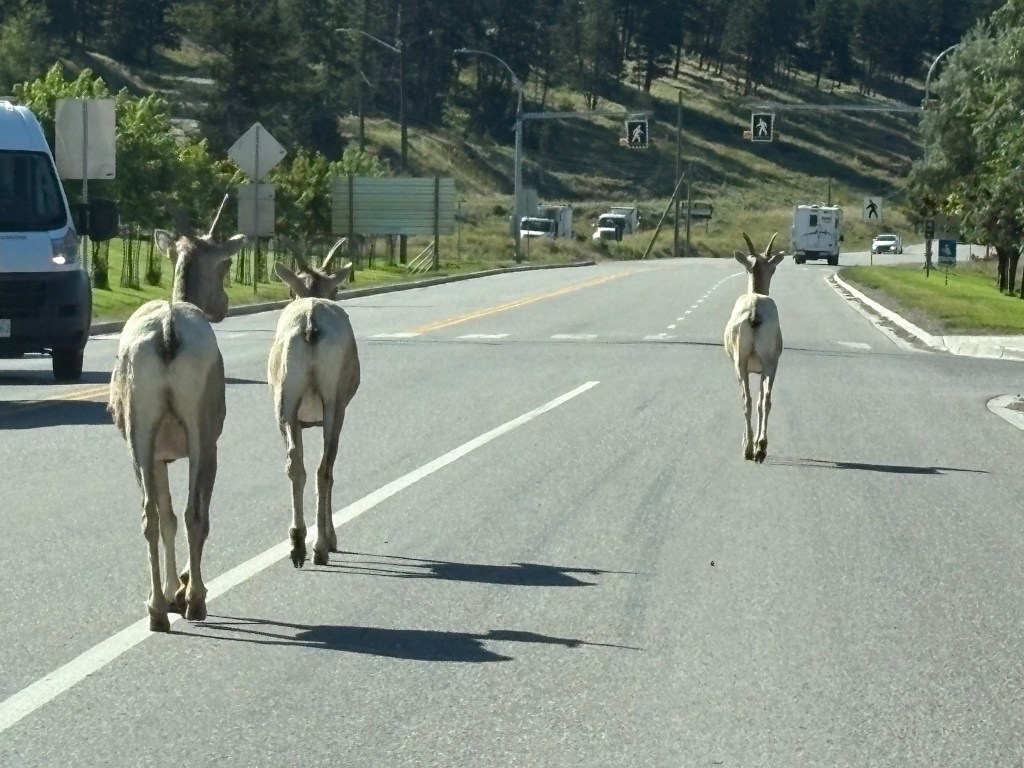
I start off with a few repeat photos from Radium Hot Springs (the town). As I drove in to town around 10am I encountered several young bighorn sheep, strolling down the highway seemingly oblivious to the traffic around them.

I stopped briefly in the Visitor Centre and then drove back about a half mile to enter the Park itself. A short ways in are the actual Radium Hot Springs, which gives the town its name. They are an odorless natural hot springs which are popular among visitors to the area. They have their own fee structure and one must have a Park Pass to access them. I was thankful that Canada waived the entrance fees to their National Parks for the summer, though I was prepared to buy an annual pass when I arrived here.

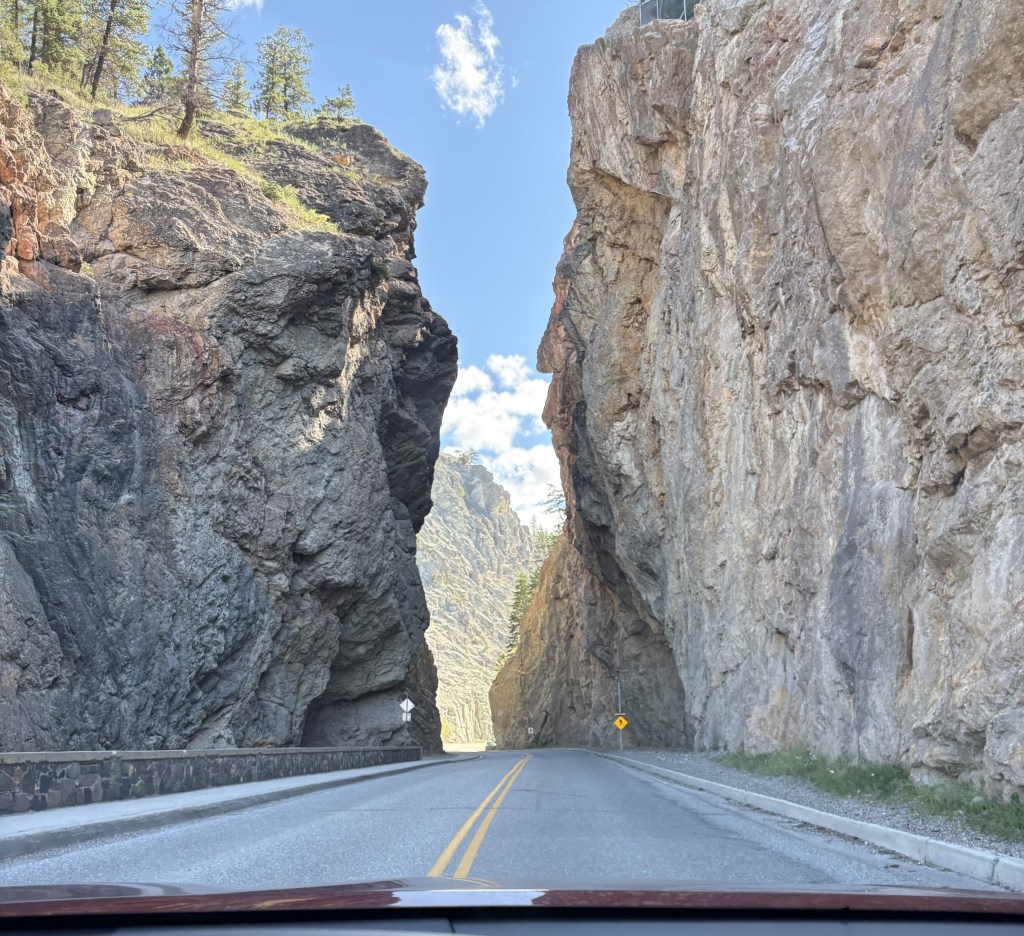
This time I was better prepared for the first thing I saw after I drove past the hot springs.

There wasn’t anyone behind me so I was able to stop in the road and take that photo through the windshield.

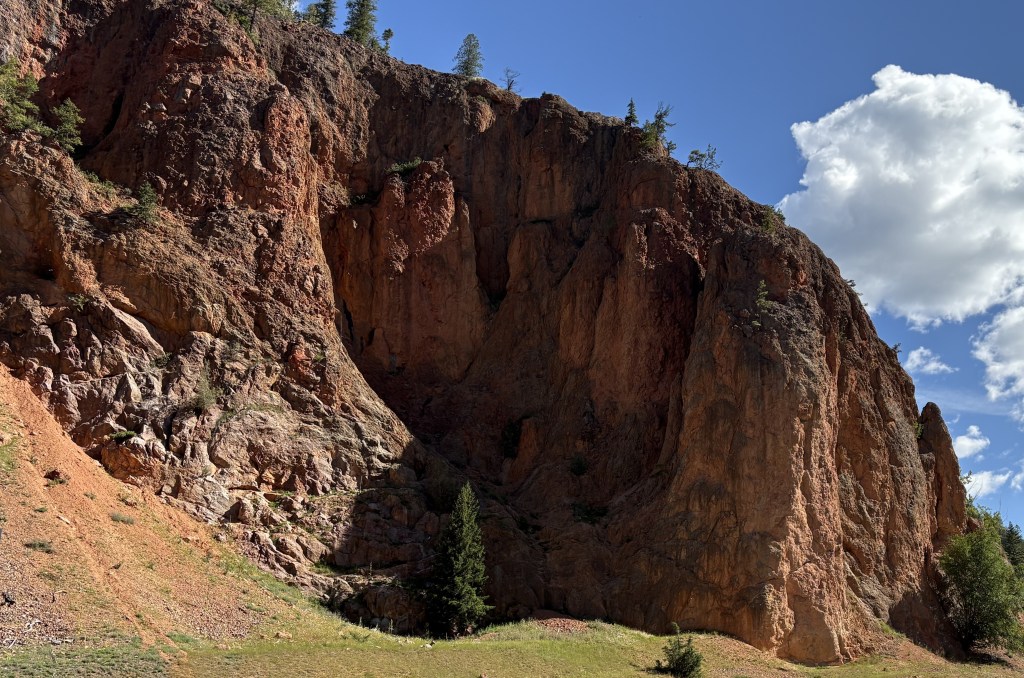
The next thing I saw was also something I didn’t photograph the first time through the Park. A large red rock wall on the left side Highway 93S. This time I pulled off into the area where the entrance gate for the Park is and walked back to take a photo of the wall. I have not seen anything like it so far in Canada and suddenly I felt like I was in southern Utah!

Redstreak Mountain is located right behind the Visitor Centre, and I presume this is how it got its name.

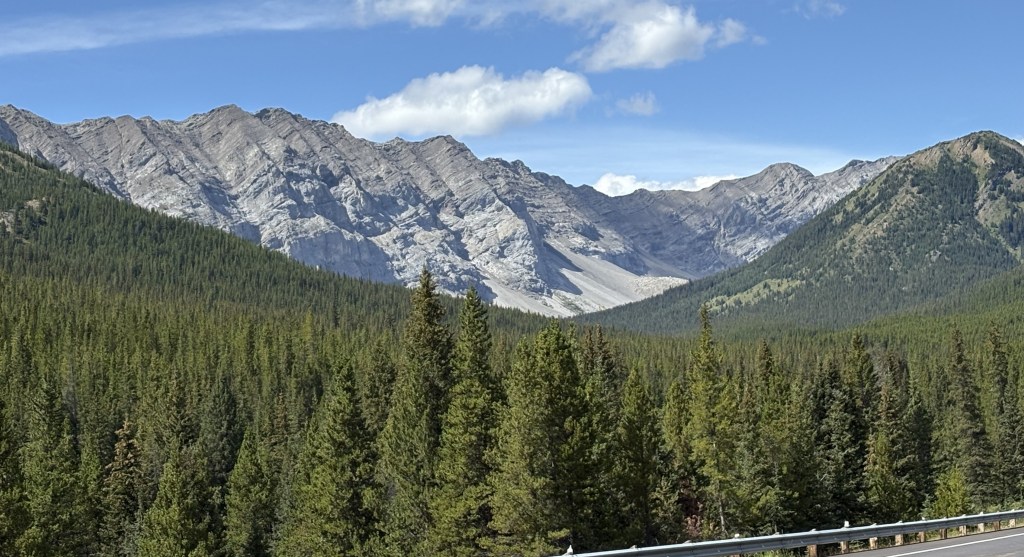
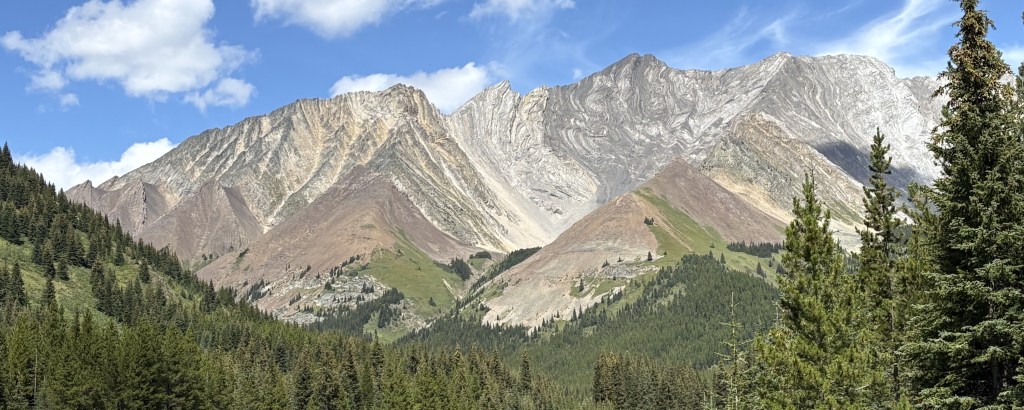
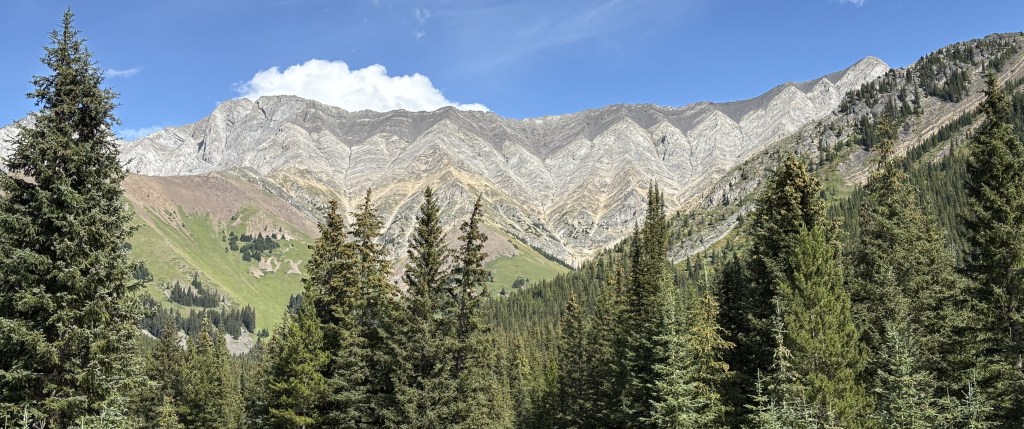
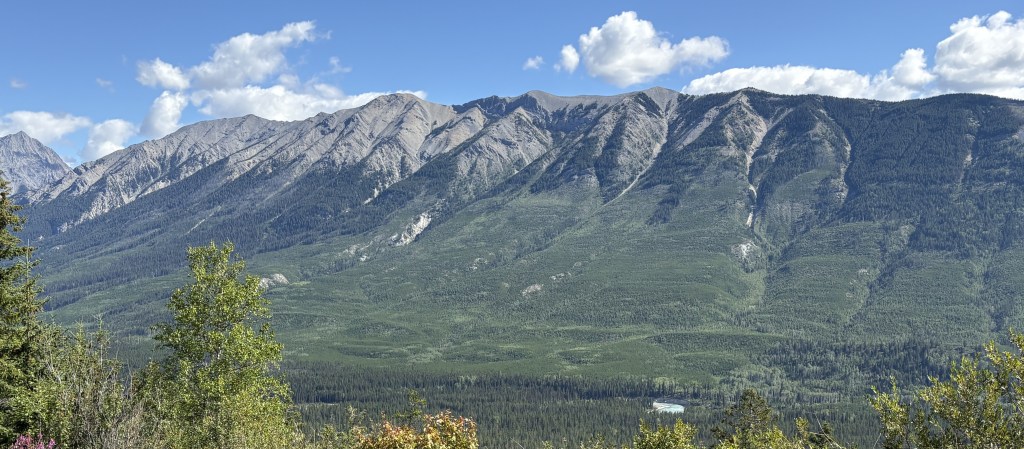
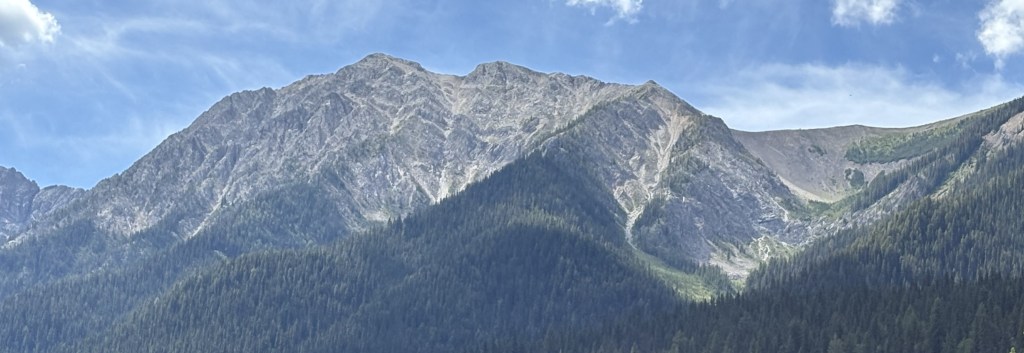
Ok, so from this point forward all you will see are mountains. Most are a fair distance off the road. I have tried to crop the photos to focus on the mountains themselves but occasionally left in more of the surroundings for perspective.

The map for this Park did a much better job of identifying many of the mountains but I will not try to match them to the photos. According to Wikipedia there are 71 named peaks within the Park but the map identifies only about half that many. There are at least 5 mountains over 10,000 feet tall and at least 11 over 9,000 feet tall.

The Park ranges from 3,012 feet elevation at the south entrance to 11,234 feet at Deltaform Mountain, near the north entrance and the Continental Divide. The roadway ranges from around 2,600 feet at Radium Hot Springs to 5,510 feet at Vermilion Pass near the north end of the Park.

The tallest mountain in British Columbia, Mt. Assiniboine (11,870 feet), is located south of the Park in its own Provincial Park. Despite its height it is not visible from within the Park due to other mountains which are closer blocking the view.

Here, now, are three posts with photos of some of the mountains.

Continued in next post

Mt. Revelstoke National Park

August 9, 2025

After passing through Glacier National Park I continued west on Hwy 1 to Mt. Revelstoke. It is located next to the highway, near the town of Revelstoke.

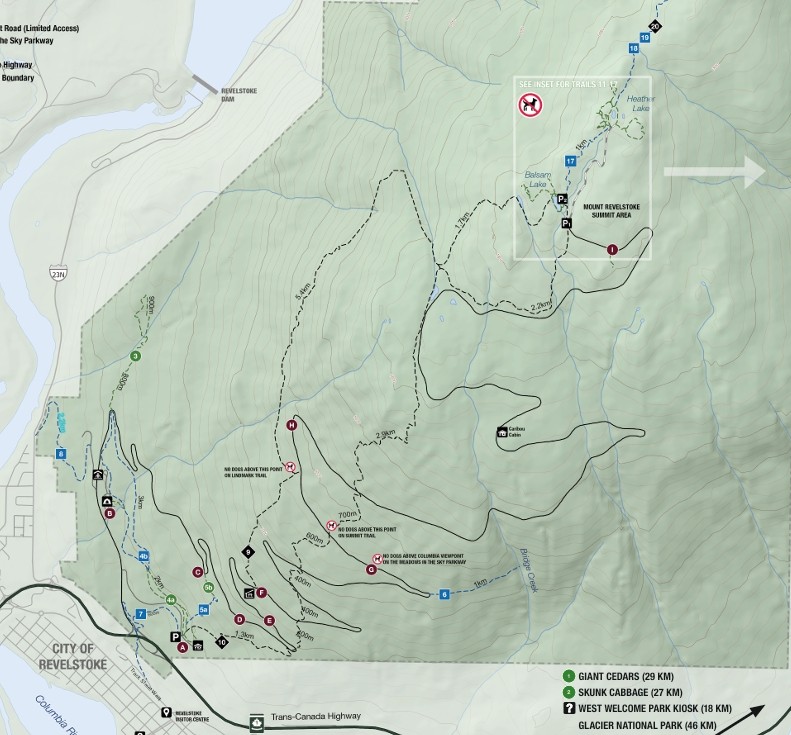
(Photo credit: Parks Canada)

I stopped at the information kiosk between the two Parks and the ranger there suggested I get to Mt. Revelstoke sooner rather than later, as parking near the top gets scarce as more people arrive. She was right.

The Trans Canada Highway doesn’t even go through the Park, but runs along part of the southern edge. Once I got close to town I pulled off onto the entry road and found that the only road in the Park is the “Meadows in the Sky Parkway,” a 16-mile, two lane road comprised of a set of many switchbacks (and with a low speed limit) which leads to the top. There were a handful of parking areas for hiking trails along the way.

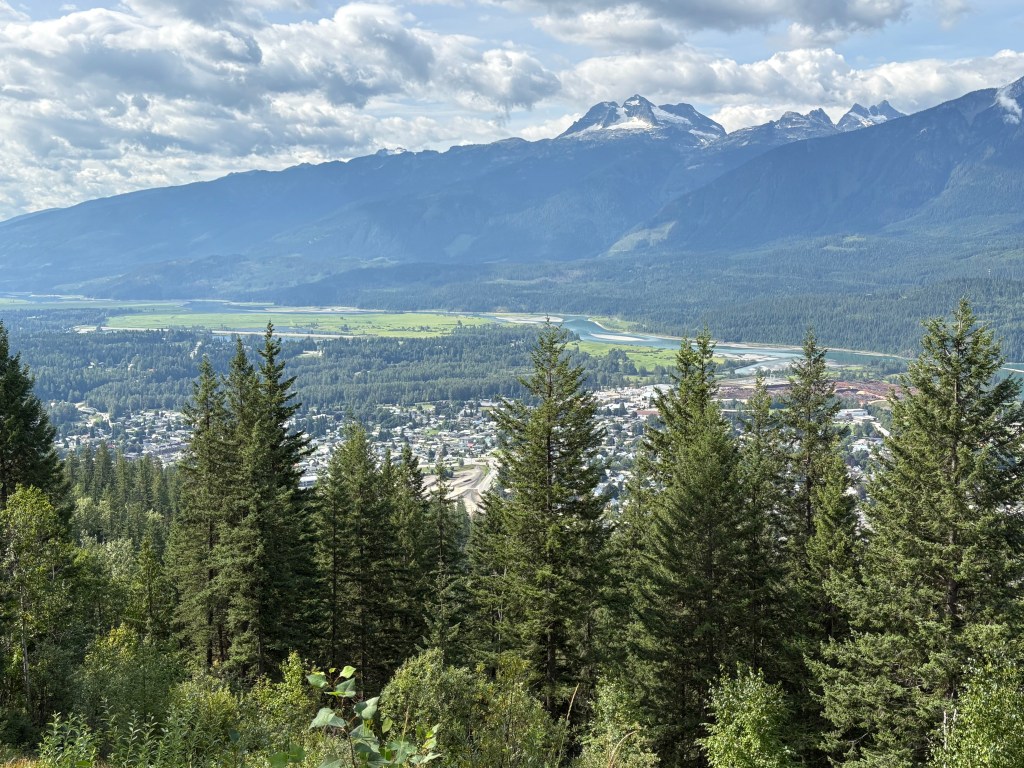
This one looks down at the town of Revelstoke. Beyond it is the Columbia River, and the mountain in the distance is Mt. Begbie, which is almost 8,000 feet tall. I proceeded all the way up to the small parking area at the top (which I had to walk to as vehicles were lining up along the access road). There was a small cabin with rangers to answer questions.

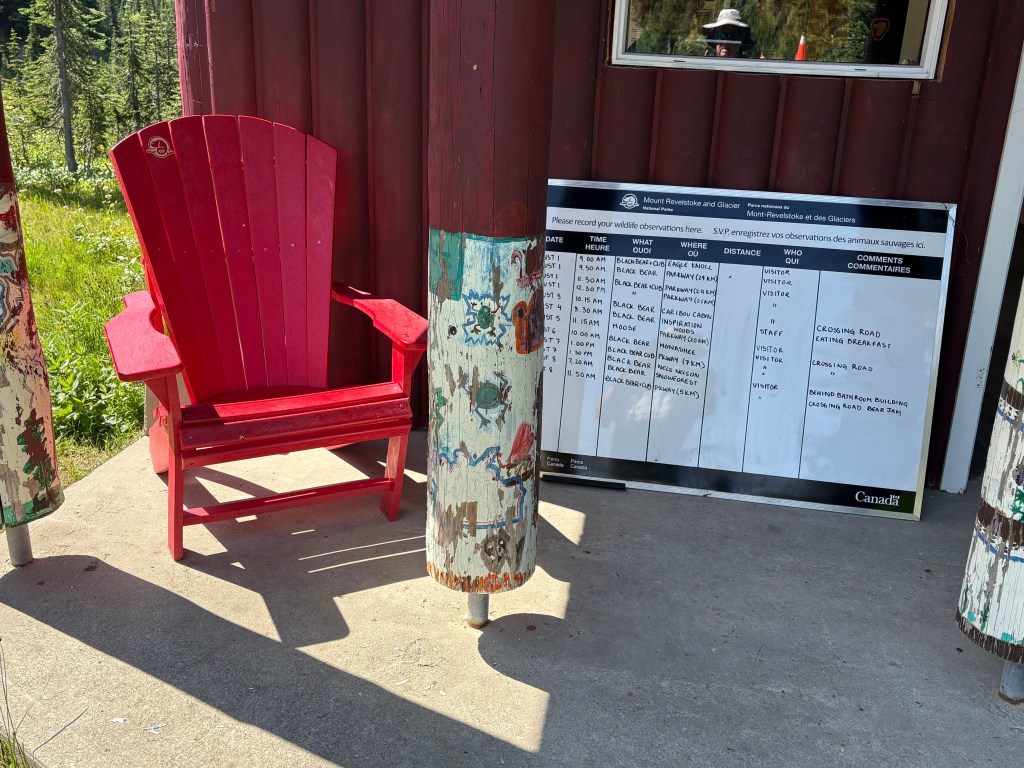
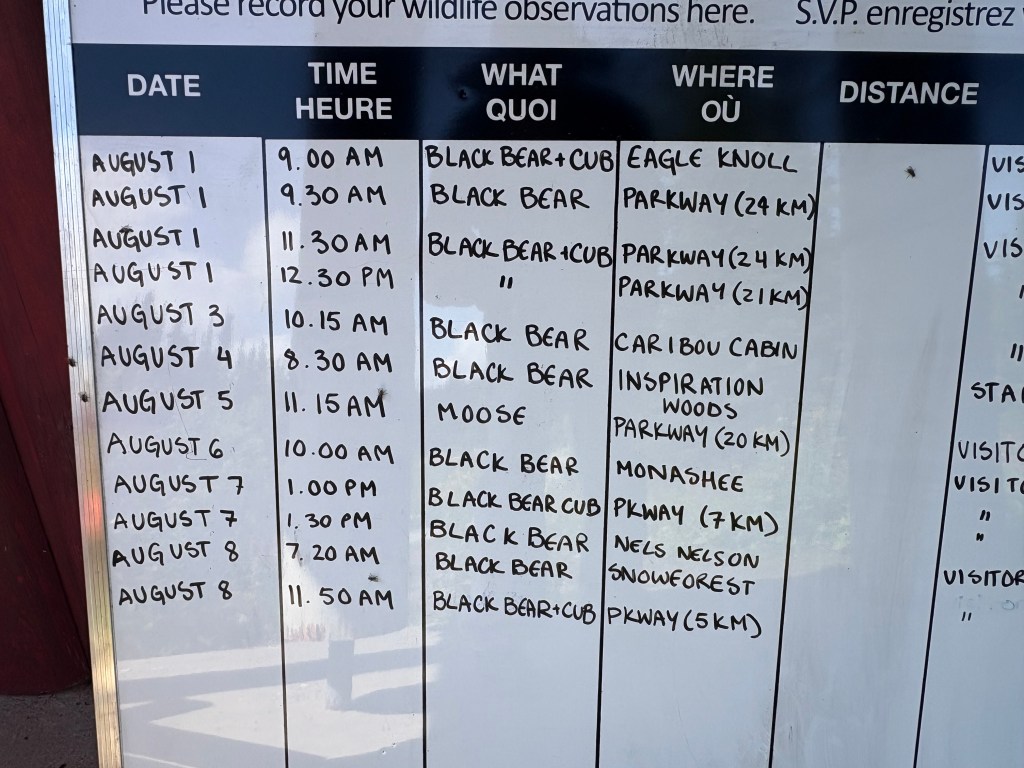
The sign reports recent wildlife sightings:

There wasn’t even a view from this vantage point, and one had to hike out to the actual mountain peak to see anything. There was a sign indicating I was at 6,360 feet elevation.

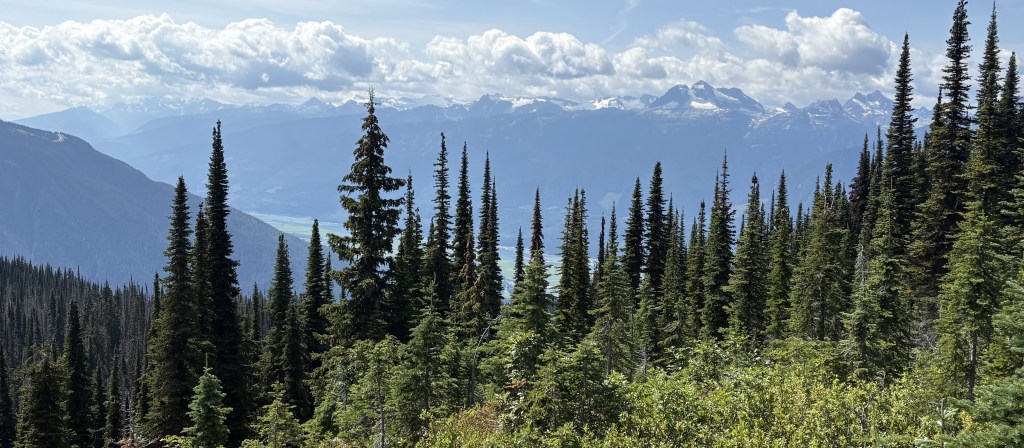
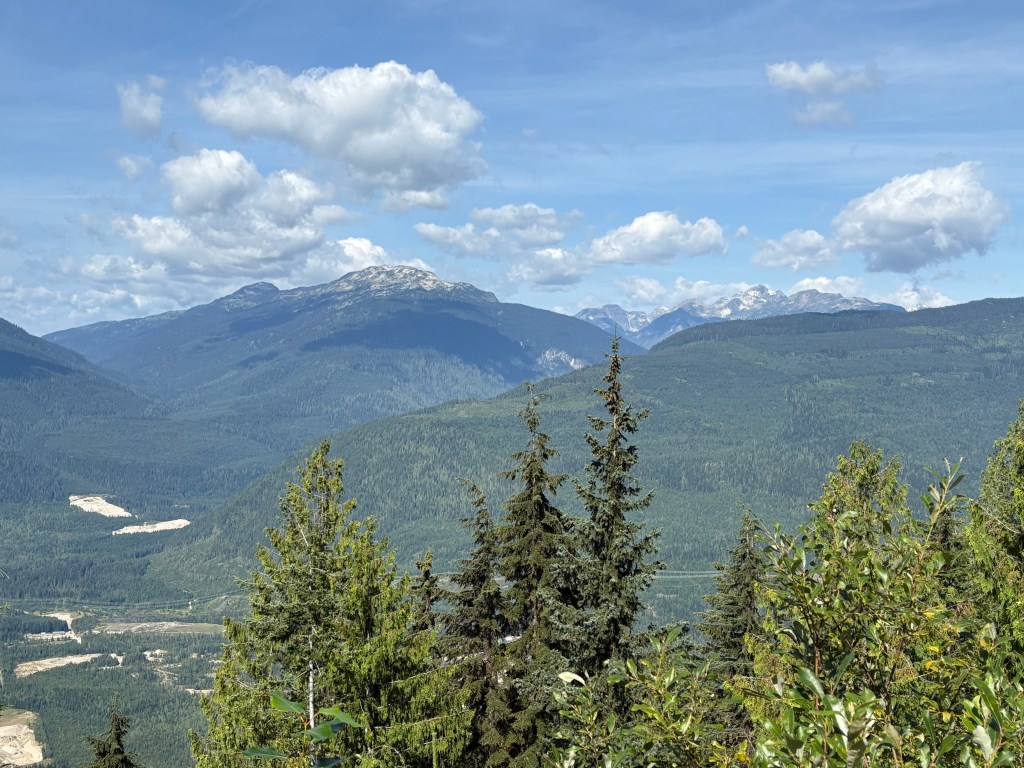
I asked if there were places to get views on the way back down and stopped at two of the places that were suggested to me.

I should also mention that as I was driving up the mountain I was interested to see a sign in the road prohibiting dogs “beyond this point”. Of all the Parks I have been in I have never seen that restriction. Apparently, some dog owners would let their pets run loose, contrary to Park rules (which pretty much all Parks have. Pets must be on a leash). This often resulted in bear attacks, and then the bears might think that, hey, this might be a nice place to hang out. So this Park decided to ban dogs altogether above a certain elevation.

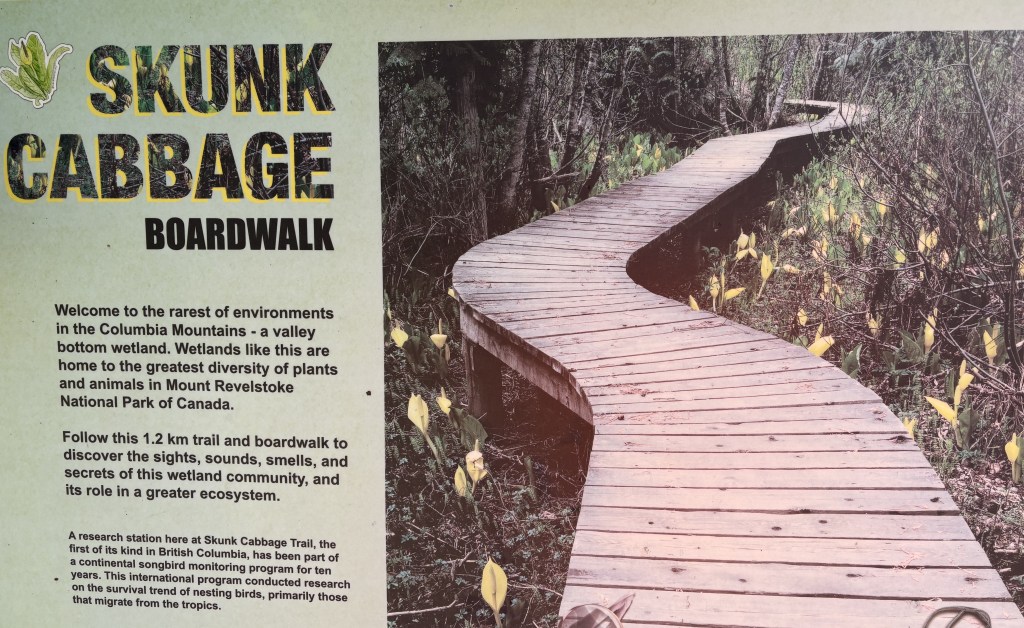
When I got back down I went into town to get something to eat and then started back to Golden, a 2 1/2 hour drive. When I had stopped at the kiosk earlier the ranger had suggested two places I would now pass on my way home. The first was a place called the Skunk Cabbage Boardwalk, a wetlands area next to the Illecillewaet River (the name is pronounced Ill-a-silhouette) and the water flows down from an enormous glacier of the same name in Glacier National Park. It is well south of the highway and not visible from the road.

I walked towards the boardwalk but met some people coming back who told me that there was a chain across the pathway that prevented anyone from going any further. I found out later that there were probably birds nesting in the area and authorities didn’t want them to be disturbed.

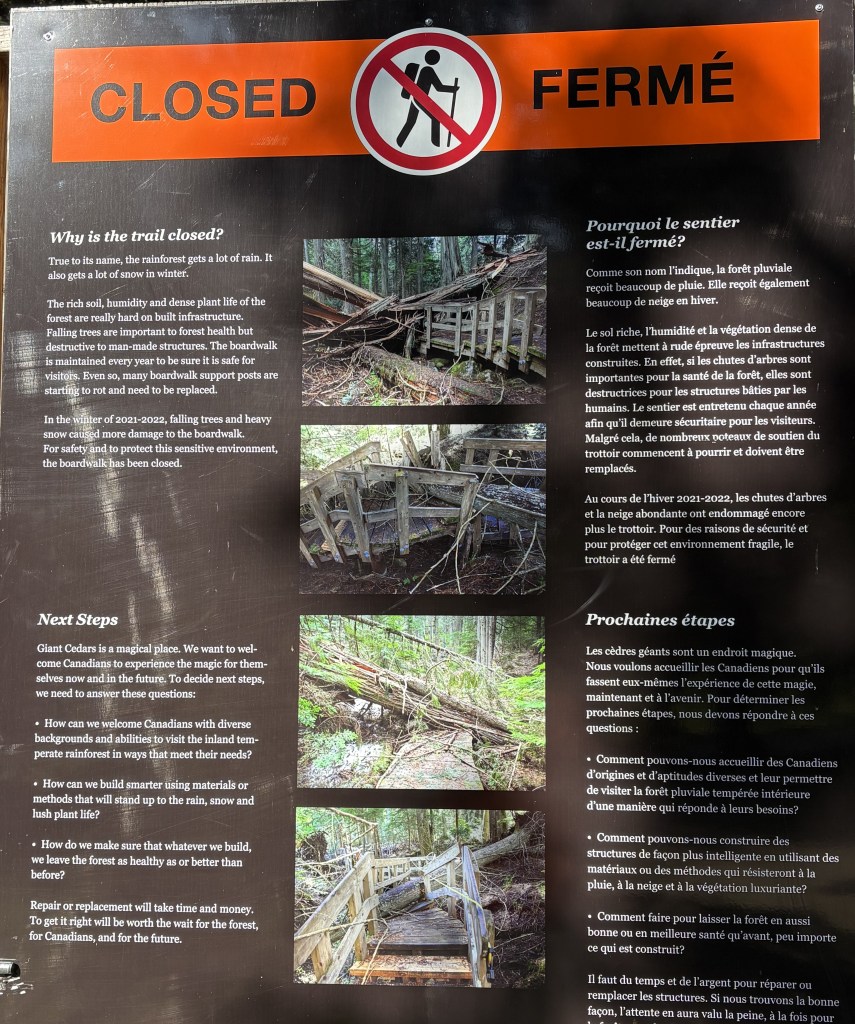
So I drove to the Giant Cedars Boardwalk just up the road, and the lack of vehicles there should have been a clue. It, too, was closed:

It is in a small rainforest and some of the trees toppled, severely damaging the boardwalk.

So although it was a nice day it was incredibly disappointing in many respects. I was hoping to see much more, especially in Glacier, but it just wasn’t meant to be.


Later in my trip when I shared with my family where I had been one of my brothers, an avid skier, asked me about the ski area at Mt. Revelstoke. I told him I never heard of it, and didn’t recall seeing any signs for it.

I looked into it and found that the Revelstoke Mountain Resort is across the road from the National Park, and is located east of the town of Revelstoke. It is actually located on Mount MacKenzie. It features the longest vertical drop in North America, at 5,620 feet (from a top elevation of 7,300 feet), and they compare themselves to Breckenridge in Colorado, which is an enormous resort, and is where my brother who asked me about it worked for one season after getting out of college. Revelstoke Mountain Resort is one third the size of WhistlerBlackcomb near Vancouver, and the longest run is over 9 miles!

5 weeks in – a JohnBoy travel update

Sunday, August 31 marked the end of 5 of my planned 8 weeks in western Canada. So far everything is going exceptionally well. I am behind with posting photos which means every day is filled with new adventures. I am prepared to post my photos of the first National Park I visited in the Canadian Rockies but can’t find my Park maps on which I made many notes which I need to reference. The back seat of my car looks like a bomb went off, and I need to root through it and find them. Of course, they aren’t where I thought they were…

As I write this I am in Red Deer, Alberta – finishing the first of 3 nights here. I was in for a shock yesterday morning as I drove up here from High River, AB, south of Calgary. After I bypassed Calgary to the east on Highway 2, a major north/south route, I continued north towards Red Deer (about halfway between Calgary and Edmonton) where I was greeted by a very noticeable low brown cloud of haze. It didn’t smell like smoke, and I wasn’t aware of anything going on in the immediate vicinity, but there it was. I drove a little past Red Deer and it seemed to improve somewhat so I just chalked it up to smog, even though Red Deer only has a population of about 113,000 people.

Overall visibility after I left Castlegar and drove east of the Canadian Rockies Sunday morning was not that great and I thought maybe it was just high pressure keeping whatever was in the air close to the ground. Well, this morning I learned that an air quality alert of over 10 (they call it 10+ on a scale of 1 to 10!) has been issued for little Red Deer. It seems that smoke from a massive wildfire up in the Northwest Territories (a large province due north of Alberta and Saskatchewan) has made its way south. In the last day or two I had read about a big wildfire up in Yellowknife (in the NWT) but didn’t pay much attention because it is 1,000 miles north of here and I wasn’t going much further north than Edmonton. Well, nature works in mysterious ways…

Environment Canada says it is supposed to clear out of here in the next day or two. Today I am planning to drive about 50 miles west to “The Cowboy Highway,” Route 22, the southern part of which I had driven on to get to High River on Sunday. Route 22 has been on my list of scenic roads here and I am sticking with that plan. Other than photo ops I will be in the car with the A/C on “recirculate” so hopefully whatever is in the air won’t bother me. I am tempted to just hunker down and stay inside for the day but I figure one day won’t kill me… If I start out this morning and the haze has gotten any worse I will retreat to my Airbnb and prepare more photos for posting. When I leave Red Deer Thursday morning, I will be driving much further west and should be away from the NWT and the smoke for good. Everything on my route going forward looks fine.

The other travel news is that I am moving my trip to Alaska UP by a week and will start heading north Wednesday of next week! I have decided to hightail it up there and get it in sooner rather than later and then retreat in a more leisurely fashion and finish my time in British Columbia on my way back to the US. I had already booked things through Prince George, BC and will drive north and west from there. I don’t have the itinerary set yet but am hoping to be in Alaska 4 or 5 weeks depending on the weather. I am still on the original overall plan, just rearranging the order in which I’m doing things.


So as of Sunday, 5 weeks in to my original plan, I have driven 6,225 miles in Canada, and a total of 10,825 miles since leaving Durham the morning of July 1.

I just had my oil and filters changed and had the tires rotated so I am all set for the next 10,000 miles! Bring it on!

Cranbrook to Radium Hot Springs

After spending two nights in Cranbrook, near the foothills of some of the southern Canadian Rockies, I started heading north instead of east. My destination for the next 6 nights would be the town of Golden, British Columbia. From there I would visit 6 National Parks. Curiously, both Cranbrook and Golden, while located in British Columbia, are in the Mountain Time Zone, which encompasses all of Alberta province – maybe not all that unusual, but I thought that the border between the two provinces was the dividing line. This is how we learn…

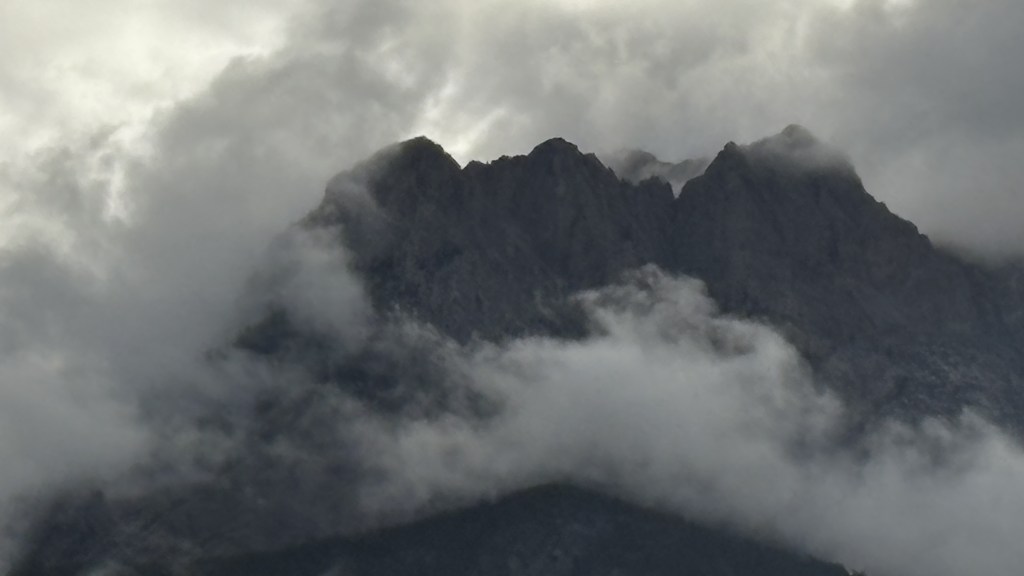
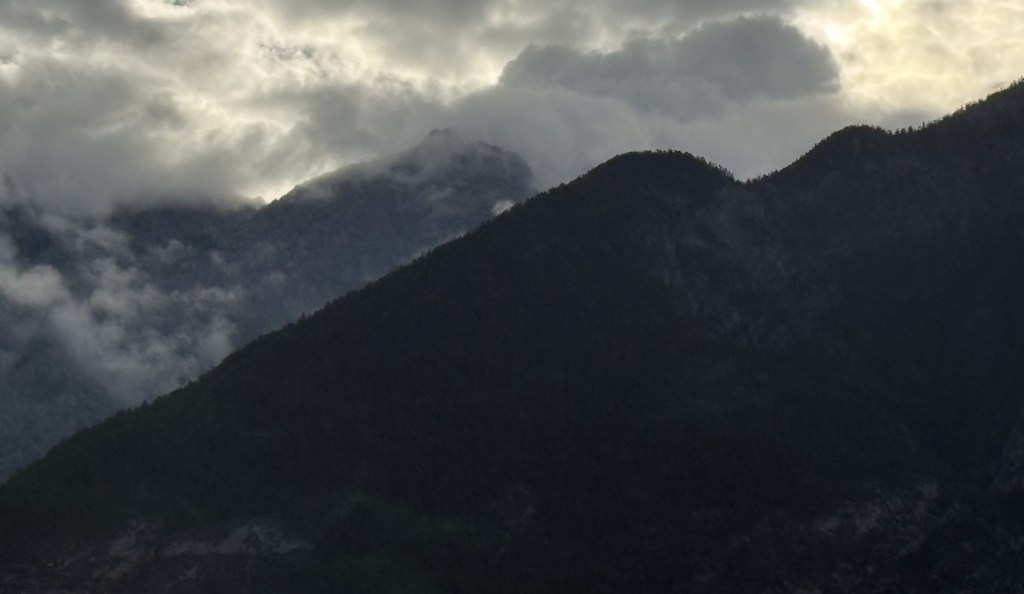
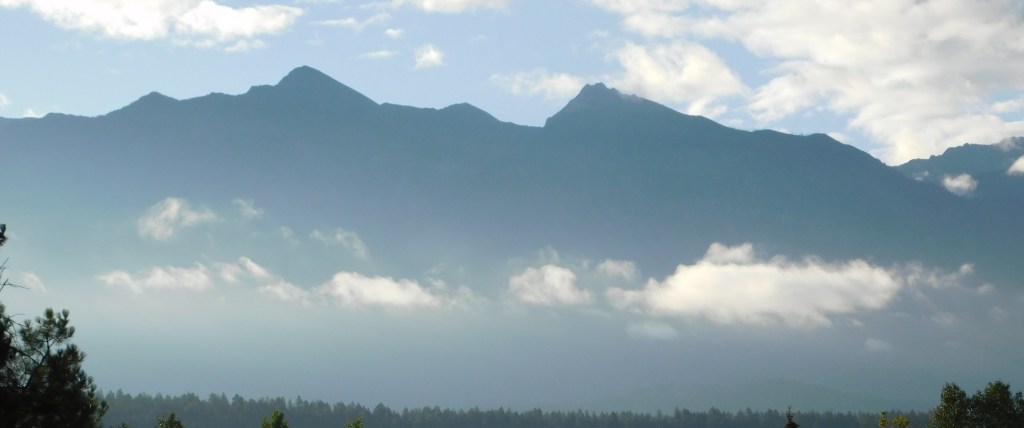
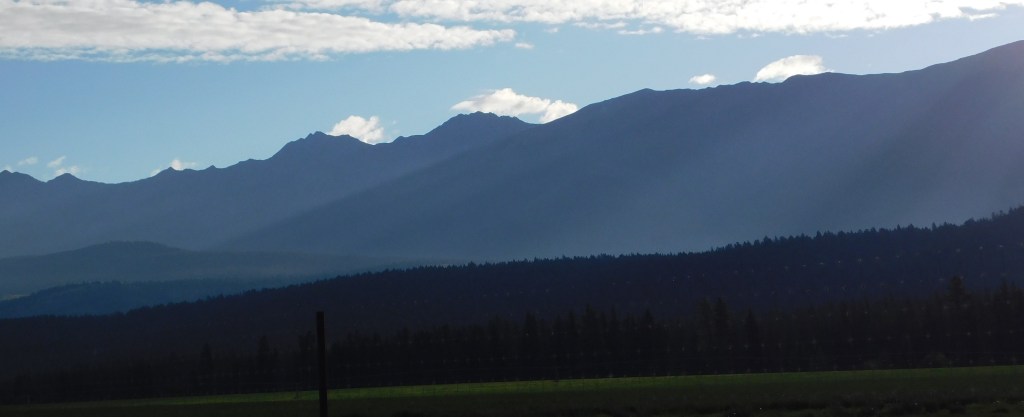
The mountains which I was able to get a clear look at the afternoon I arrived in Cranbrook were now partially hidden under a low layer of clouds. Some of the higher peaks have snow on them, not always visible from the foothills, and the moisture from that alone often results in clouds forming immediately over the mountain on an otherwise clear day. As I often do, I started my day soon after first light and many of the low clouds would “burn off” once the sunlight starts to penetrate them.

They do make for some interesting photos, though:

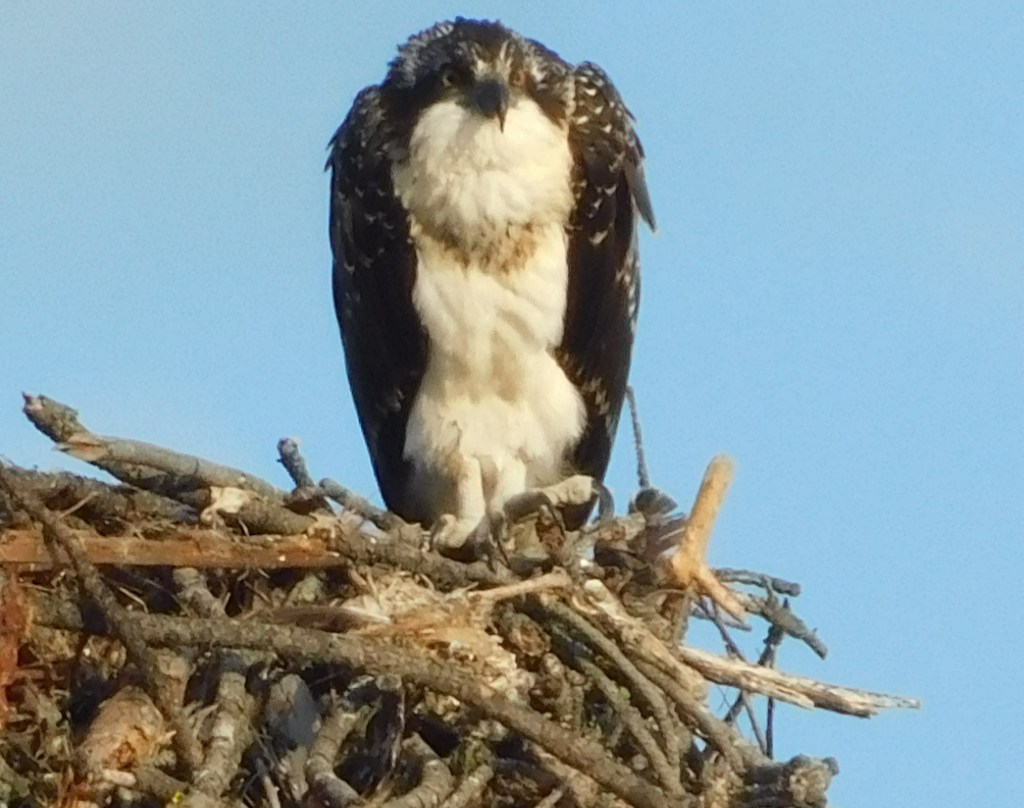
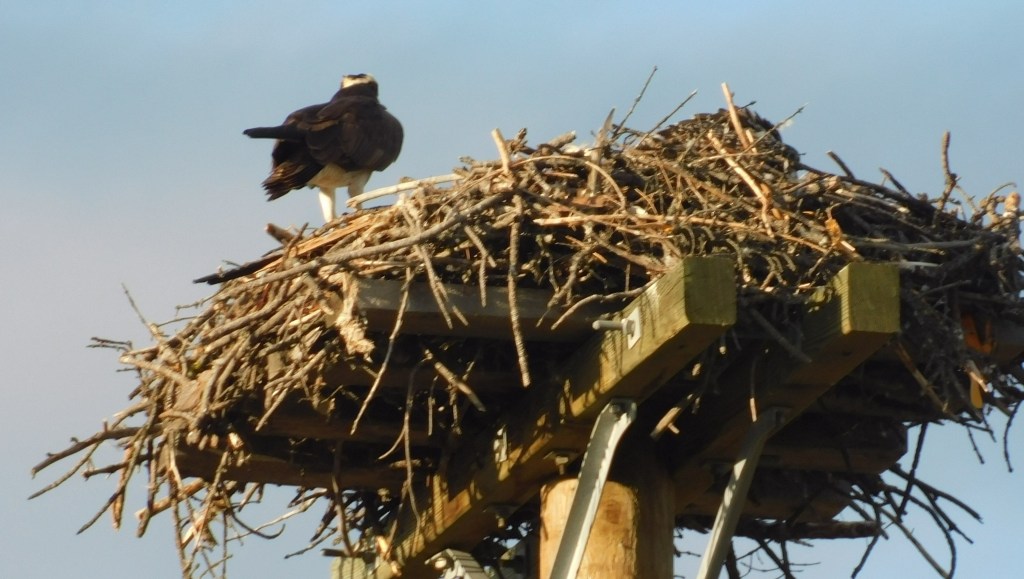
As I drove further north I saw a hawk perched on the edge of a nest atop a telephone pole next to the road (note the beautiful blue sky when looking away from the mountains!):

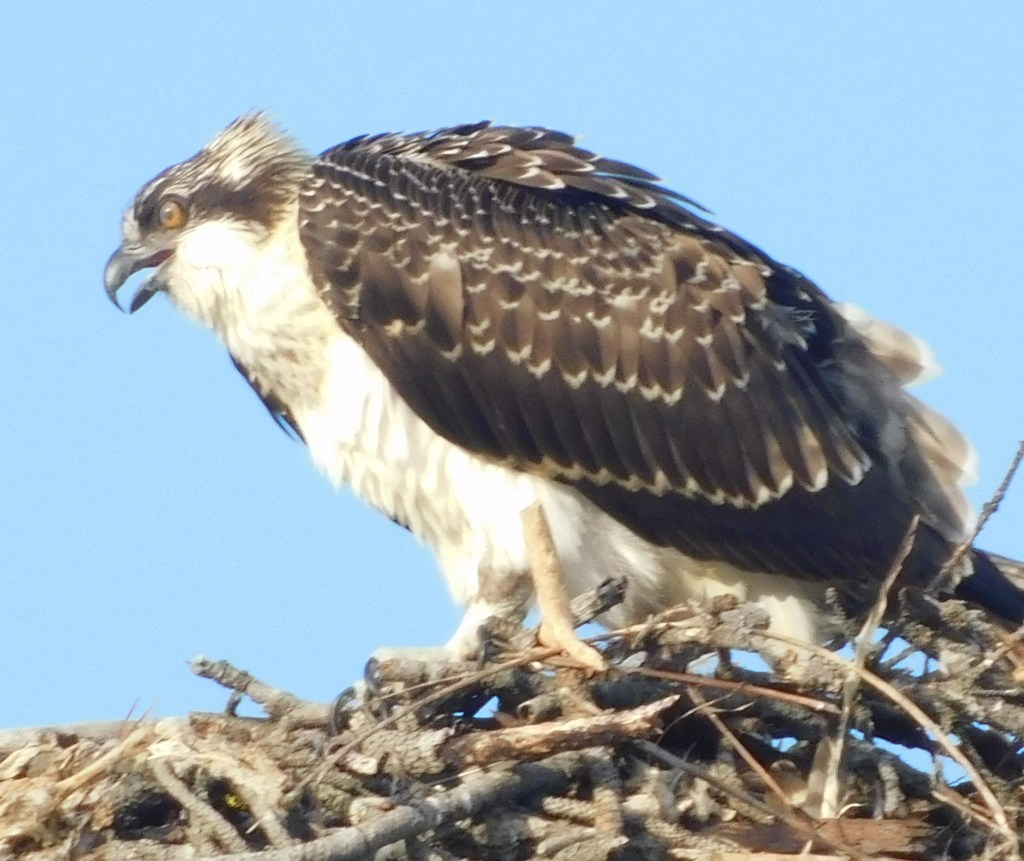
It didn’t take her long to spot me (although I was far away, using my zoom lens on the digital camera). It also became apparent that there were some newborn chicks in the nest beneath her. Between photos I would sometimes see a tiny head or beak pop up, and she sometimes tamped it down with her “foot”.

I had shifted position to be even further away and up the road a ways. She still knew where I was and wasn’t happy, and put out a call for backup.

Sure enough, here came the reinforcements.

After Dad arrived Mom (barely visible on the right in the photo above) took flight towards me and made a low pass, maybe 15 feet off the ground – just enough to get my attention, and circled back to the nest. I took the hint and went on my way.

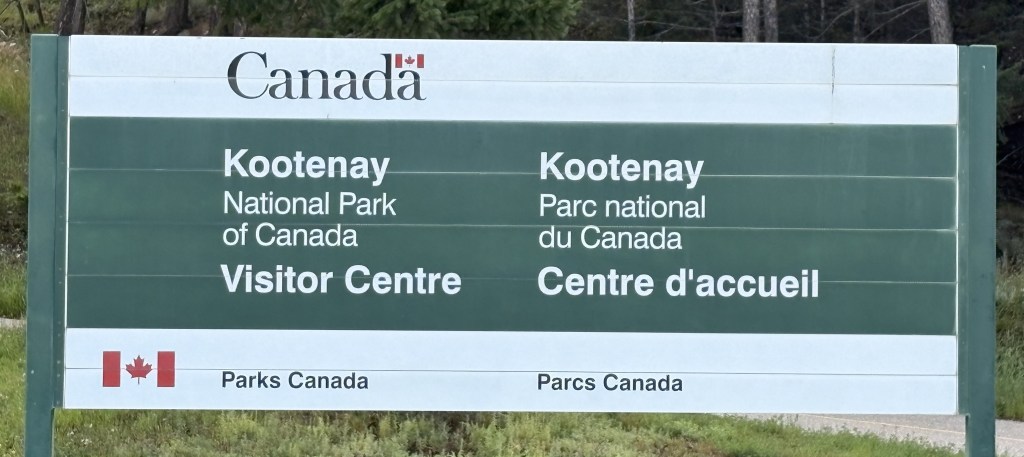
I had a very pleasant drive north, about an hour and a half, to the little town of Radium Hot Springs. I went to the Visitor Center there, which is also the southern entrance to Kootenay National Park.

Kootenay (pronounced just the way it looks, with the emphasis on the first four letters) would be the first National Park I would visit on this trip. I was prepared to buy a Senior Annual Pass, as I did in 2019 when I visited the Maritime Provinces in eastern Canada, but was delighted to learn that in 2025 admission to Canada’s National Parks is free until after Labour Day (the day I am posting this).

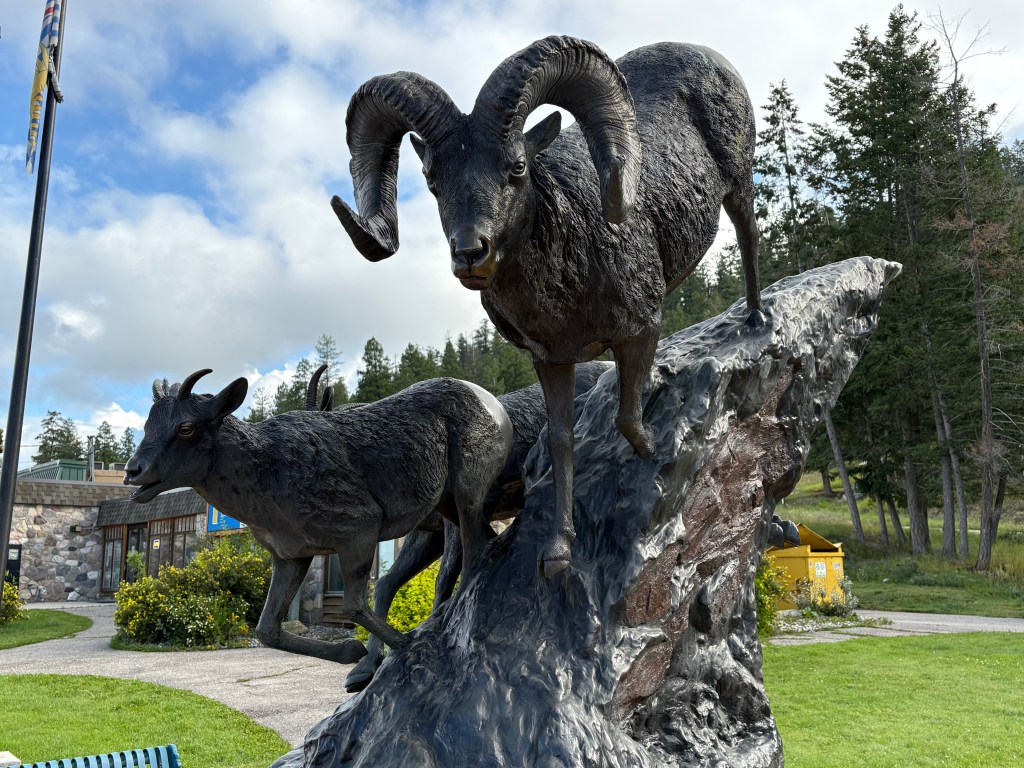
“Radium,” as the locals call it, is also well known for their Bighorn Sheep.

And there is also a set of “much larger than life” ram horns in the traffic circle just up the road towards the entrance to the Park.

If you go back a few posts to “Breaking News!” (posted August 11) you will see that Radium was, in fact, my first up close encounter with four young Bighorn Sheep as they meandered up the highway, completely oblivious to traffic.

After getting my maps and learning the layout of the Park I set off to drive through my first Canadian National Park of 2025.

Campbell River to Gold River

I was originally planning a much longer drive on my first full day based in Campbell River but with the tsunami warning issued after the big earthquake in Russia the night before I decided not to go near the ocean. Authorities were still warning British Columbians to stay away from the coast, although those warnings were lifted after I was already on the road.

I chose another route which would take me about as far from the ocean as I could get. I took Route 28 out of Campbell River and headed west, up towards Gold River. It’s only about 55 miles but Google Maps said it would take about an hour and 15 minutes, though with all my stops to take photos it took a lot longer than that. I even turned around before I got to Gold River as I had other places I wanted to go as well.

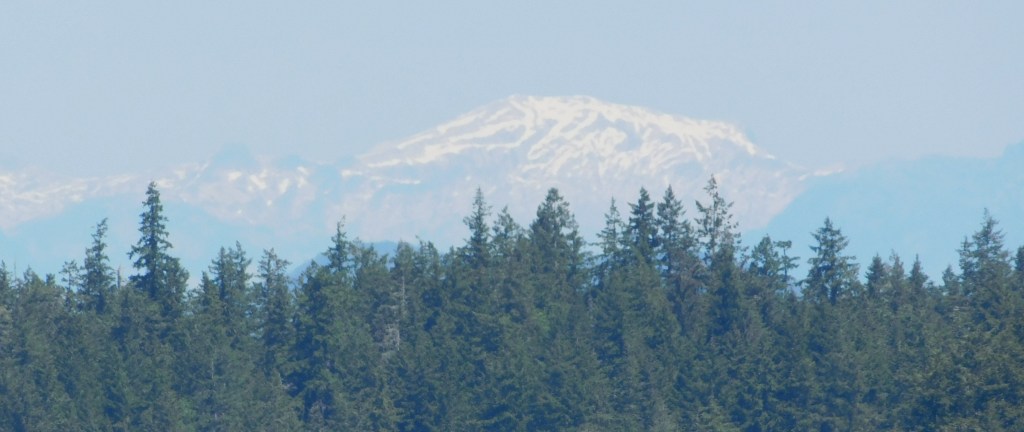
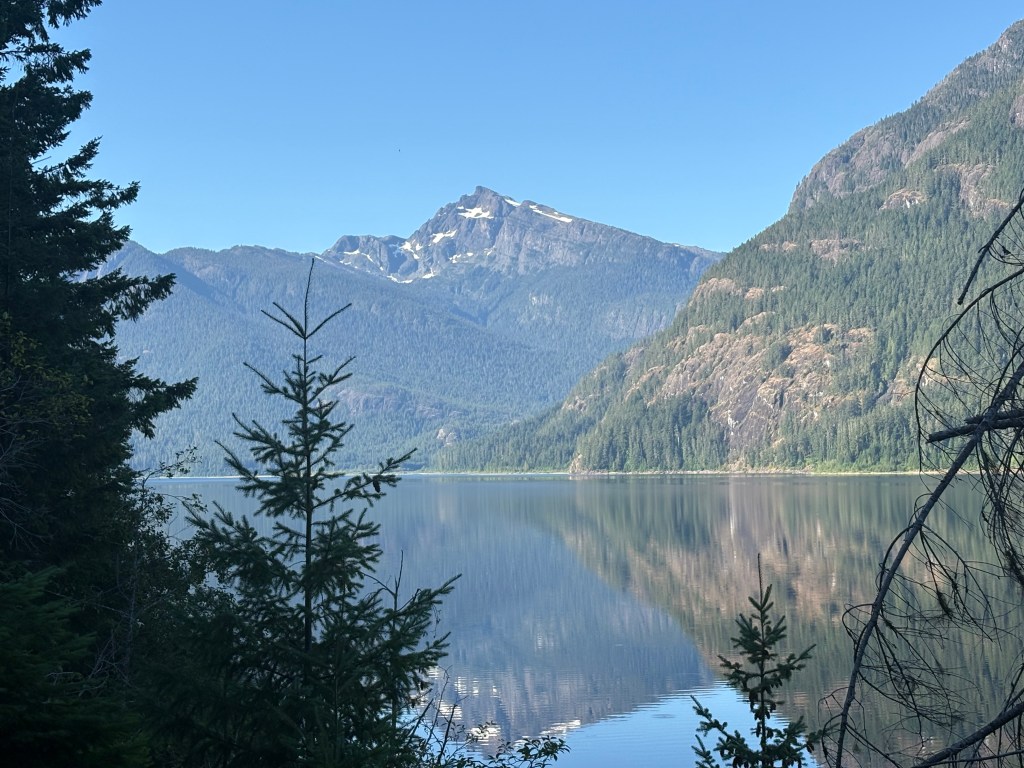
These are photos of various lakes, mountains, and distant mountains with snow on them, even in early August. I apologize for not knowing the names of most of them – there were only signs in two places. I don’t know the lay of the land and, as I learned to my dismay in Victoria a few days earlier, I don’t even know which direction I am looking, or walking. This is one reason I don’t hike.

Just enjoy the views as I did. A lot of repetition I know, but everything is just gorgeous…

I suspect I am seeing the mountain above from various places on the island but I still don’t know which one it is!


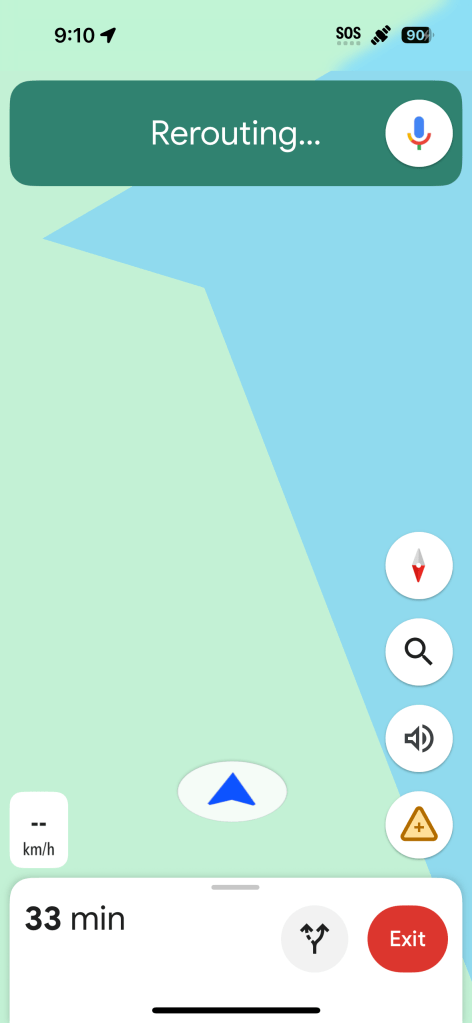
I posted the photo above because, while I started using Google Maps to guide me to Gold River, it got to a point where it apparently didn’t know where I was, either!! Scary thought…

I will tell you again about an app which may also be useful in a situation like this. It is called What Three Words. Someone has plotted a 10-square-meter grid over the entire planet and assigned each grid section a unique three word designation. Like: bacon, lettuce, tomato. If you provide the EXACT three words for where you are, anyone with access to What Three Words can see your location, within 10 meters. Less confusing than GPS coordinates, but with either of them you MUST be precise or you might send your rescuers to the middle of some lake close to where you actually are, or to another continent… Plurals matter. Spelling very much matters.

As I write this I am at blatant.glided.snakeskin (which should take you to Cranbrook, BC, Canada). Use glided NOT gilded. If you made two errors and gave 911 blantantly.gilded.snakeskin it would send my rescuers to Kugluktuk, Nunavut – still in Canada but 2,044 km away from where I am, and I think we’d ALL be cranky.

I was without cell service for long periods while I was on Vancouver Island, and that will be the case once I get to the mainland, too.

If you note in the upper right hand corner of the photo above you will see a satellite icon next the 90 (showing that my phone is charged to 90% capacity). This is something new on Verizon. If you are out of cell service but get the satellite icon you may still be able to send a text message (ONLY, for emergencies most likely) but not voice calls or sending photos (like of the grizzly bear which is about to consume you). I tried it and it asked me to point the phone towards the satellite in the sky (like a divining rod…). Even on satellite it seemed that I only had a marginal signal and I didn’t send an actual text to anyone, but I did find the satellite in the sky using the image projected on my phone’s screen. Clever, IF it works….


OK – back to the photos:

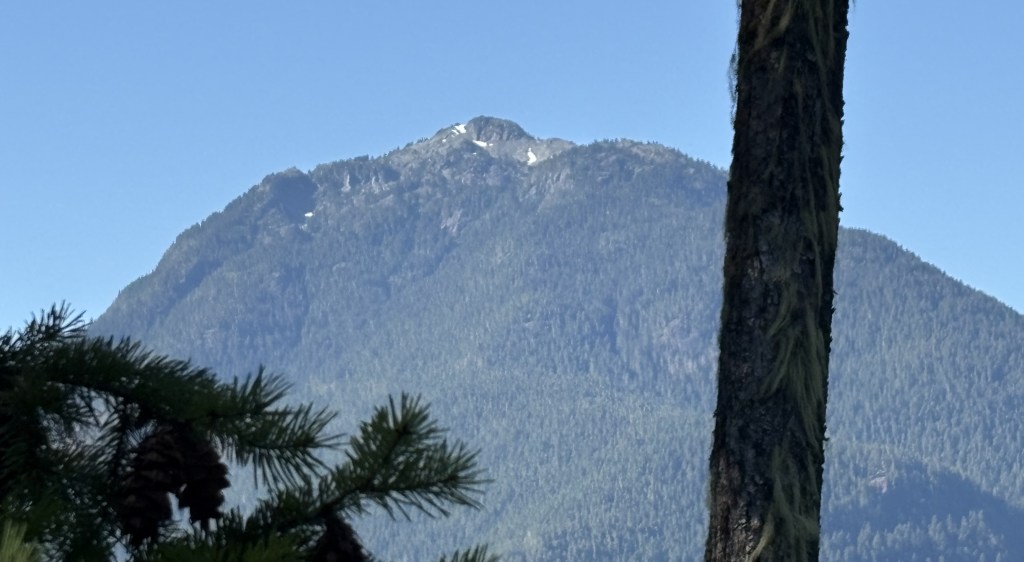
That one I know (thanks to a sign pointing to it). Marble Peak, elevation about 5,800 feet.

The one just to the left of it from my scenic viewpoint is Mt. Phillips, just a few feet shorter:

Sorry about the tree. If I had tried to move just a tad to the left there was another obstruction blocking where I could stand.

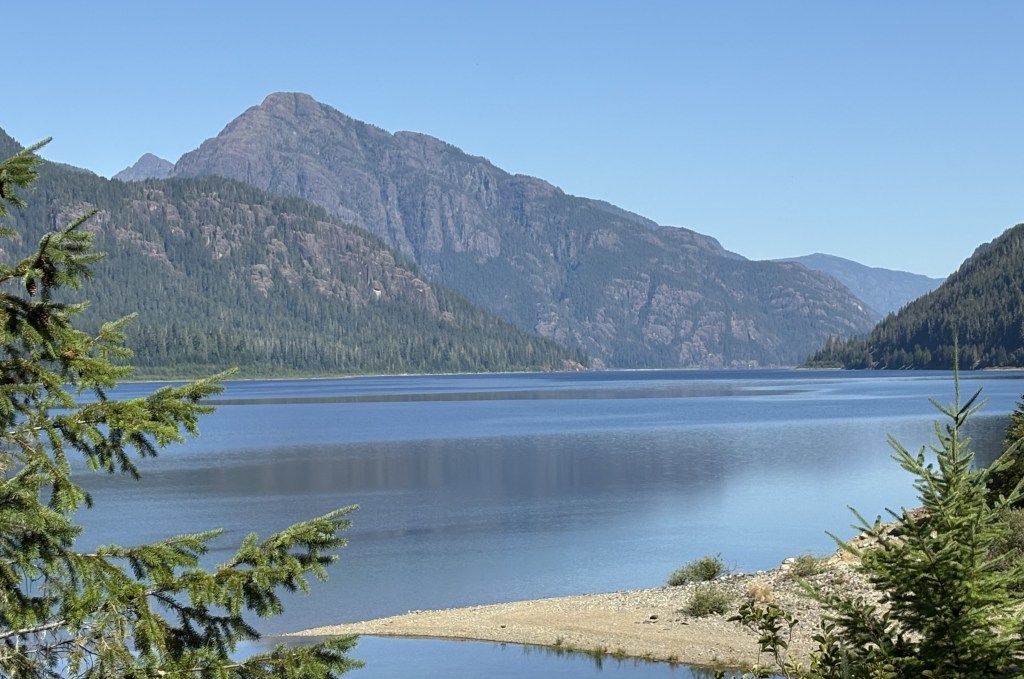
The sign above was located just past Strathcona Park Lodge, a large, modern resort about halfway between Campbell River and Gold River (the towns). Just about every body of water in this post is Upper Campbell Lake, which covers a massive area.

I saw very little traffic as I ascended the mountain but there were lots more vehicles going up as I went back down later in the morning. Had I made it to Gold River its elevation is “only” about 524 feet but the mountains along the way are much higher than that.

FYI – the highest peak on Vancouver Island is Golden Hinde, which tops out at 7,201 feet. Who knows, it might be the mystery mountain with lots of snow on it…

Campbell River – Odds and Ends

Before I start posting about the two driving days I had once I arrived in Campbell River, let me show you a few miscellaneous photos.

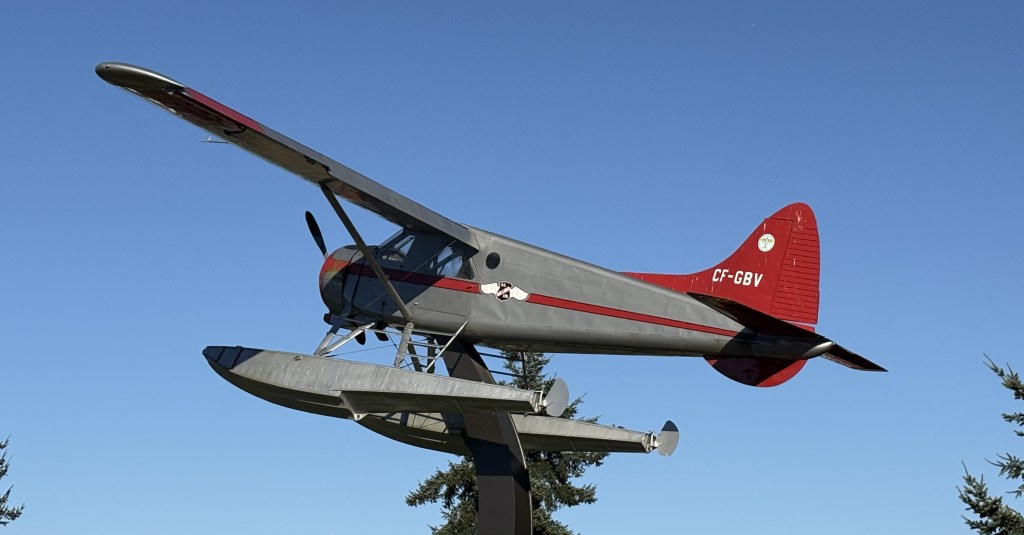
As I was driving home from the Elk River Suspension Bridge the afternoon I arrived, I drove past this real sea plane mounted high off the ground between the north and southbound lanes of a divided highway.

The restaurant where I had lunch the second day I was in town had these words of wisdom from the Dalai Lama posted on the wall:

I’d say he’s a pretty smart dude.

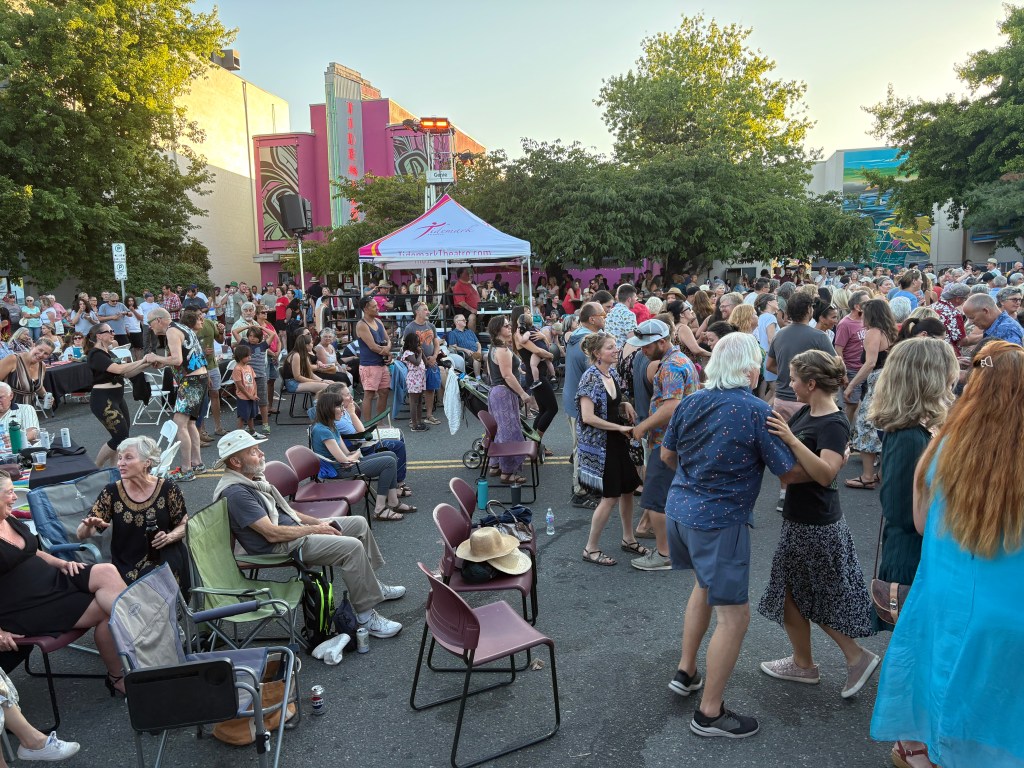
And finally, after I long day of driving to three different destinations the first full day I was in town, my Airbnb hosts invited me to go with them to “Latin Night” downtown, in an outdoor area often used for music events and the like. There was a Latin band there (very good, I must say) and the place was overflowing with people – about 1/5 were there to dance and the rest were watching and/or socializing with their friends.

The three of us were among the watchers, though my Airbnb hostess was actually down here the night before taking lessons. She says she isn’t quite ready to get out there yet but I somehow think it will happen sooner rather than later. Her husband loves the music but says he can’t dance worth a lick (well, he didn’t say that exactly).

As you can see in the top photo, we were very close to the action but were behind the barricade (alcohol control line). There were LOTS of people off to the sides and behind us, too. I was shocked how many people were there!

The dancers were REALLY into it and changed partners often. Young people dancing with other young people, young people dancing with older people, it didn’t matter. They were just there to have fun, and they clearly did.

No, I didn’t dance but I enjoyed watching everyone have a good time.

I have two video clips if anyone is interested. I also have some video of the various waterfalls at the Elk River bridge. Still photos of waterfalls make it difficult to appreciate the sound and sense the force of the water. I don’t know how to post videos on the blog but I can email them to anyone who asks. Click on “Contact” at the top of the home page to send me a request.

Corn Sex

I never imagined I’d be talking about sex on my blog, although when I entered that word in the Search box on the Homepage several posts appeared which included the word in their content. My mother is probably spinning in her grave… Sorry, Mom, but this is important stuff.

As I drove across several corn producing states on my way out west I noticed something I had never really paid attention to. In one specific field there were alternating, machine-wide rows (maybe 10 to 12 stalks wide), one group with tassels on the top and the next without. That got me thinking – male/female? Not so fast, Skippy. Upon doing a little research all corn stalks are monoecious, meaning they have both male and female “parts”. Yikes!!

(Photo credit: Nature Journals)

The tassel, a flower at the top of all corn stalks, is the male part and produces pollen. The sperm, if you will.

The ear, which grows before fertilization, has lots of silk strands which grow out of the end (and which you remove, along with the husk, when preparing the ear for consumption). Each strand of silk is attached to an individual kernel (the fruit) which will develop once the silk is pollinated. Let the wind do its matchmaking and voila!

So the farmer who planted the field I saw was trying to promote cross-pollination. The hope is that by removing the tassels at the top of one section of corn the silk on that stalk must get pollinated from a neighboring plant that still has a tassel atop it. They don’t want a stalk to “self-pollinate” (bad stalk…).

Who knew???

Only every farmer that grows corn.

Relax Mom, at least I didn’t name this post Corn Porn…


And since we’re talking about corn and not porn, here is a fun fact:

The highest ranking corn producing states in the US in 2024 were:

1 – Iowa – 2,627 million bushels

2 – Illinois – 2,311

3 – Nebraska – 1,803 (take that, Cornhuskers…)

4 – Minnesota – 1,345

5 – Indiana – 1,000

Then South Dakota, Kansas, Missouri, Ohio and North Dakota rounding out the top ten.

(Source: CropProphet.com)

Snake River – Dedication Point

Monday when I went to the World Center for Birds of Prey in Boise, Idaho I learned that there were several viewing points “nearby” along my old friend the Snake River to possibly see some of the big birds in action. Those of you that have followed the blog for a while know of my posts from Oxbow Bend in Wyoming, near there the “Snake” starts its journey towards the Columbia River Gorge separating Washington State and Oregon; Hells Canyon, with its world-class rapids; and Twin Falls, Idaho and other towns with beautiful waterfalls.

I was told that early morning was the best time to try and catch sight of some birds go I left my Airbnb in Boise at first light and drove to the first stop on the map I was given, Dedication Point. From Boise I went several miles west on the dreaded interstate and took the exit for the town of Kuna. From there it would be 24 miles due south to get to the river, further than I expected.

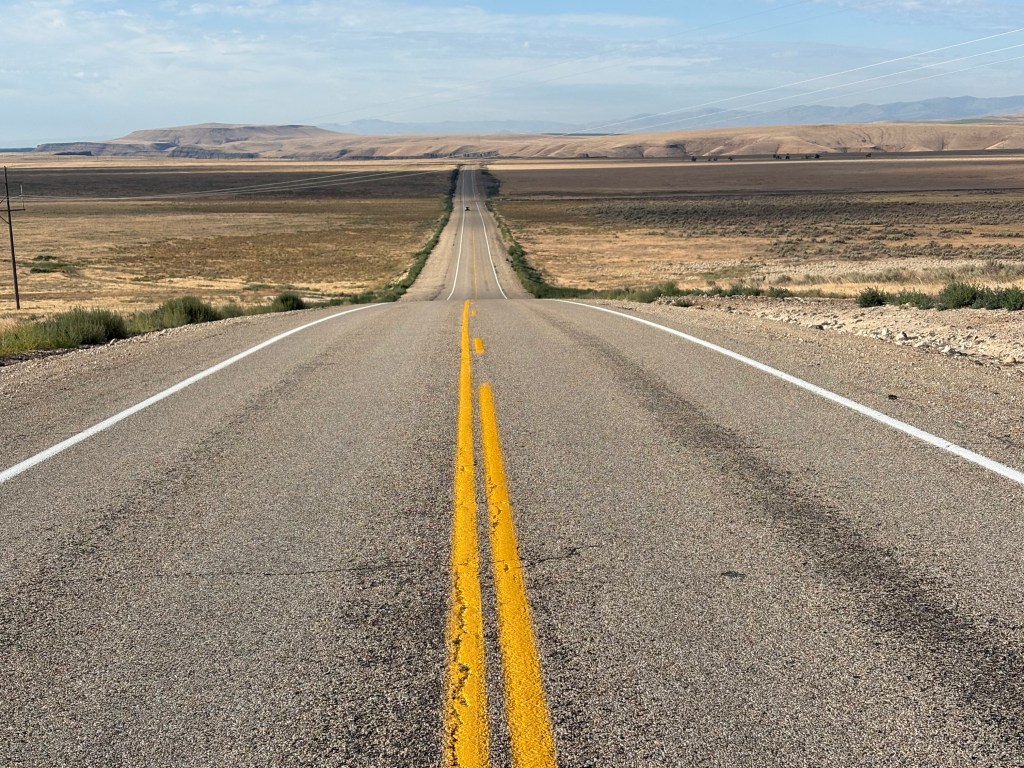
Once I got south of Kuna it quickly became very open and desert-like. Here is a shot of the road heading south towards the river.

The river separates the land on this side of it from the higher terrain you see in the distance.

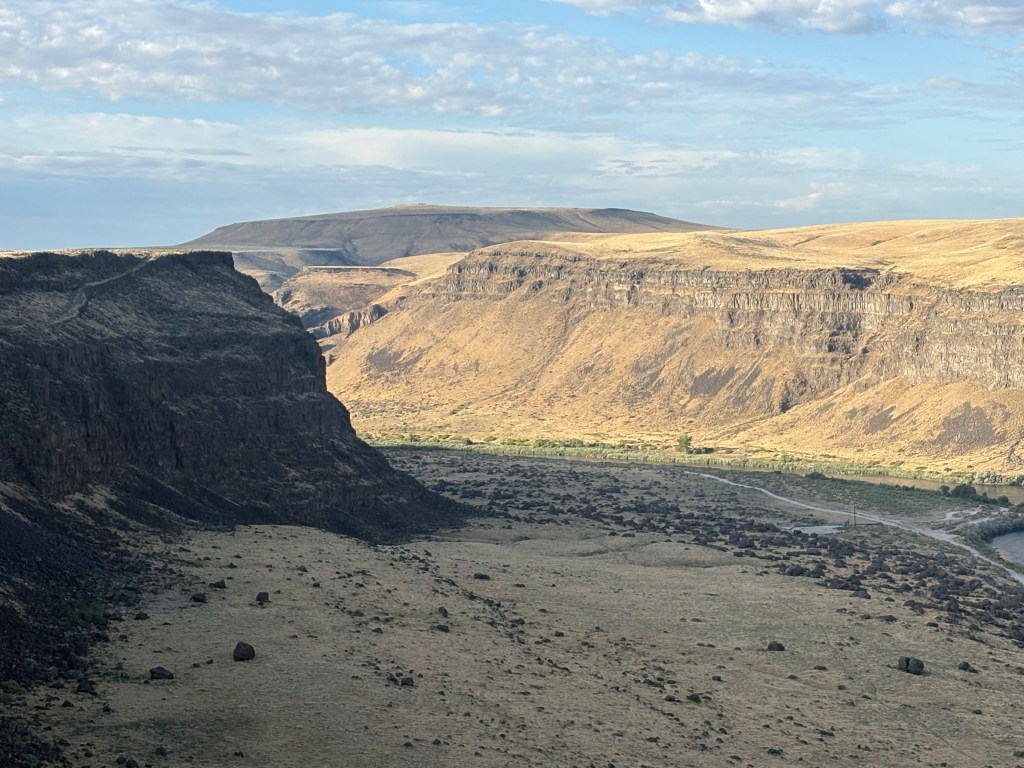
Once I arrived at the parking area it was a short walk down to the top of the canyon overlooking the river. There is an amusing JohnBoy story about an encounter I had in the parking lot but I will save it for another time. For now I want you to focus on the natural beauty I was about to experience.

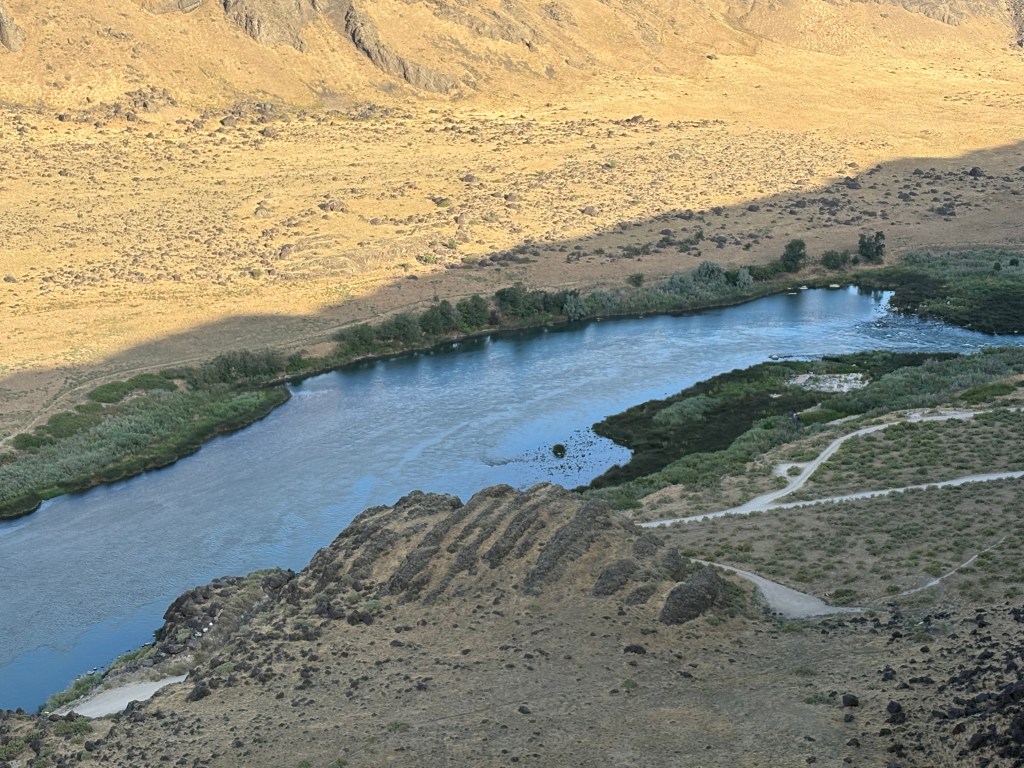
This was the view looking to my left (east, where the river flows from)

Looking almost straight across to the other side

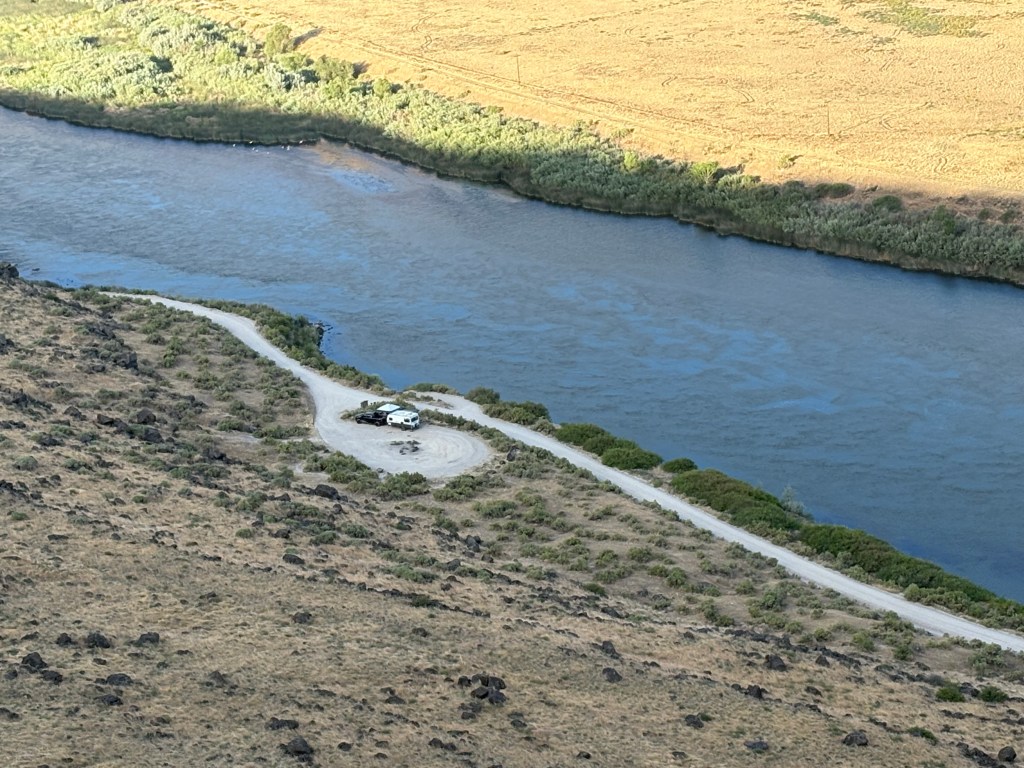
Looking down to where someone was camping next to the river

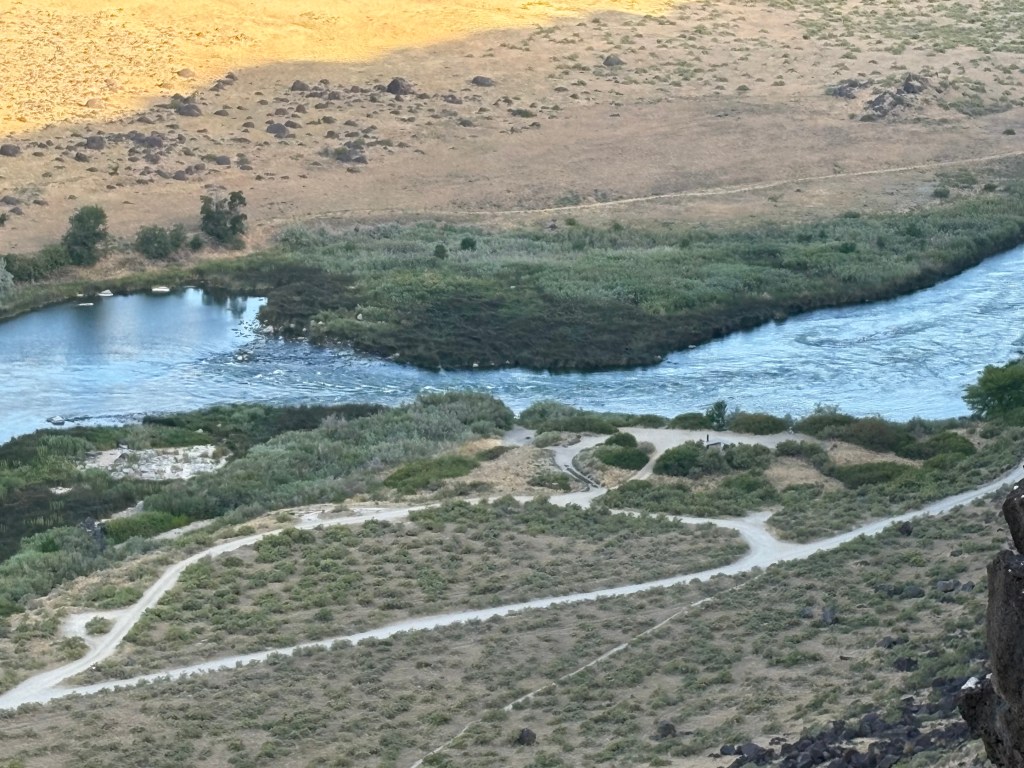
Towards the right, where there was a drop in water level (I later took a video of a small boat heading upstream and the captain know exactly which side to climb to get through without bottoming out).

And finally, looking right (west) as the river flows out of sight.

And here is a panorama of the entire scene

The sign near the parking lot showed the various big birds I might see at this location. In decreasing order by size – Golden Eagles, Turkey Vultures, Red-tailed Hawks, Swanson’s Hawks, Northern Harriers, Prairie Falcons and American Kestrels. This is a National Conservation Area and claims to have the highest density of nesting raptors in North America, and possibly the world.

Because I was up so high I saw nothing. Well, I did see some movement but they could have been pigeons for all I knew. Look back at the photo of the camper (which I had zoomed in on to the maximum extent my iPhone could). Tell me you could identify what bird a person standing next to it was holding on their arm…

Nevertheless it was a beautiful morning in a beautiful place and after I took the pictures I put my cameras away and just stood and enjoyed the moment for quite a while.