Real time post – A week ago today I crossed the border from the Yukon Territory into the United States near Beaver Creek, YT. It was around 6pm PDT, which then became 5pm AKDT when I crossed the line. As big as Alaska is, most of it is in one time zone – except the extreme southern Aleutian Islands which are on Hawaii Time. And Alaska only has one Area Code – 907.
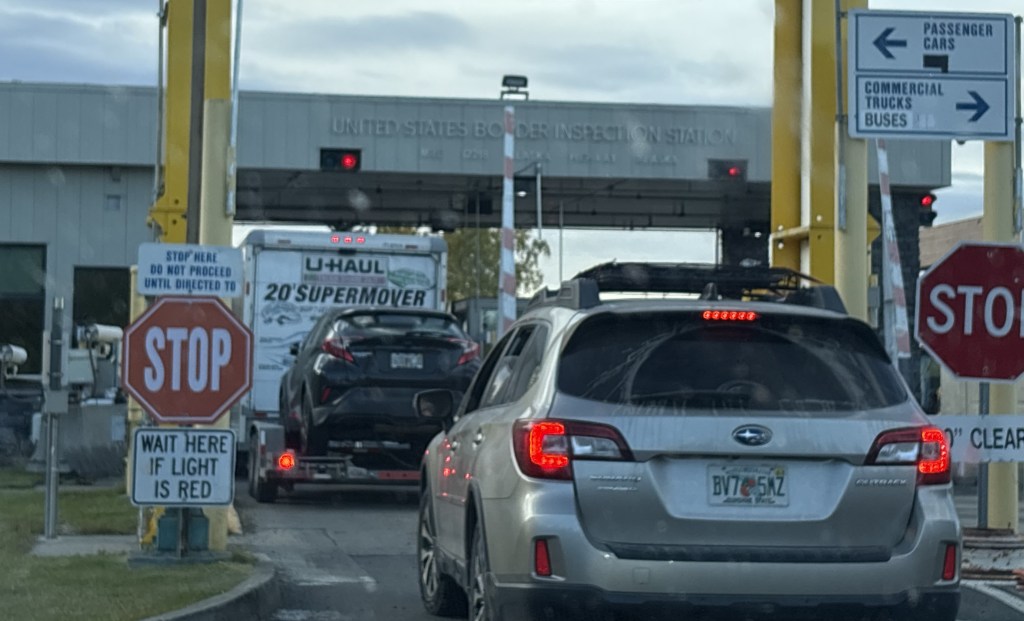
Actually, I was already in the US – I had crossed the line about 30 miles earlier but the Customs Inspection Station wasn’t until later. I guess they really want to nab you before you can slink back into Canada.
When it got to be my turn it was pretty straightforward until we got to the subject of fruit. The agent was only interested in my 1 1/3 bags of mandarin oranges which I had purchased at a Walmart in Prince George, BC. He didn’t seem to care about the one banana I had left, or the two partial bags of apples I was packing.
He confiscated them. (He took two large potted plants from the woman in the car ahead of me. Lord knows what was in the U-Haul her traveling companion was driving).
Maybe he was hungry and was outfitting his apartment.
Anyway – I was cleared to go shortly thereafter and on my way to Tok (pronounced toke), AK.
And I just talked about road conditions in my last post. The first 10 miles or so of the highway in the US were pristine. Newly paved and without blemishes. (Take THAT, Canada… we know how to do roads over here!)
Then things started to go south. Same issues as in Canada except little or no warning at offending spots, and POTHOLES! Lots of POTHOLES! I honestly don’t think I saw a single pothole on the Alaska Highway in the Yukon. I swear they must go out every morning and patch them before they get worse. Not so on the US side.
Guess AKDOT needs to tuck it’s tail between it’s legs….
In their defense, I will give AKDOT kudos for repairing the road near Anchorage after a major earthquake many years ago. I remember seeing news stories about how they removed and replaced entire sections of the badly damaged roadway in record time. They apparently had all the materials ready to go, and moved in as soon as it was safe to do the rebuild.
I should have posted this earlier after I had driven across the southern edge of British Columbia the second week I was in Canada. During that leg of my trip I had to drive across a few small mountains (fortunately I drive around most of the big ones) and in lots of places the speed limit would drop as I approached turns, not uncommon on mountain roads. Now I will admit I sometimes channel my inner Shane van Gisbergen (* see footnote at end of post) and take some of these turns at speed, going wide on entry, hitting the apex, and going wide on exit. I am an experienced driver (though not on the proverbial closed course, so don’t start emulating me – I will plead the fifth) and only do this when I am well aware of the lack of traffic around me. In fact, when I was on Vancouver Island and drove north to Port Hardy my Airbnb host told me – “You will enjoy the road going up there. It is in good shape and you may not even need to slow down, just hold onto the wheel with both hands”. He was right!
I have learned, however, that when you see this sign:
that you need to SLOW DOWN. In Canada, when they say slow down they mean it! This also rang true in the Canadian Rockies. In the Canadian National Parks their roads are wide, sometimes multi-lane affairs (with passing lanes in some areas) and with a 90/kph speed limit in most places, but on tight turns you still need to slow down.
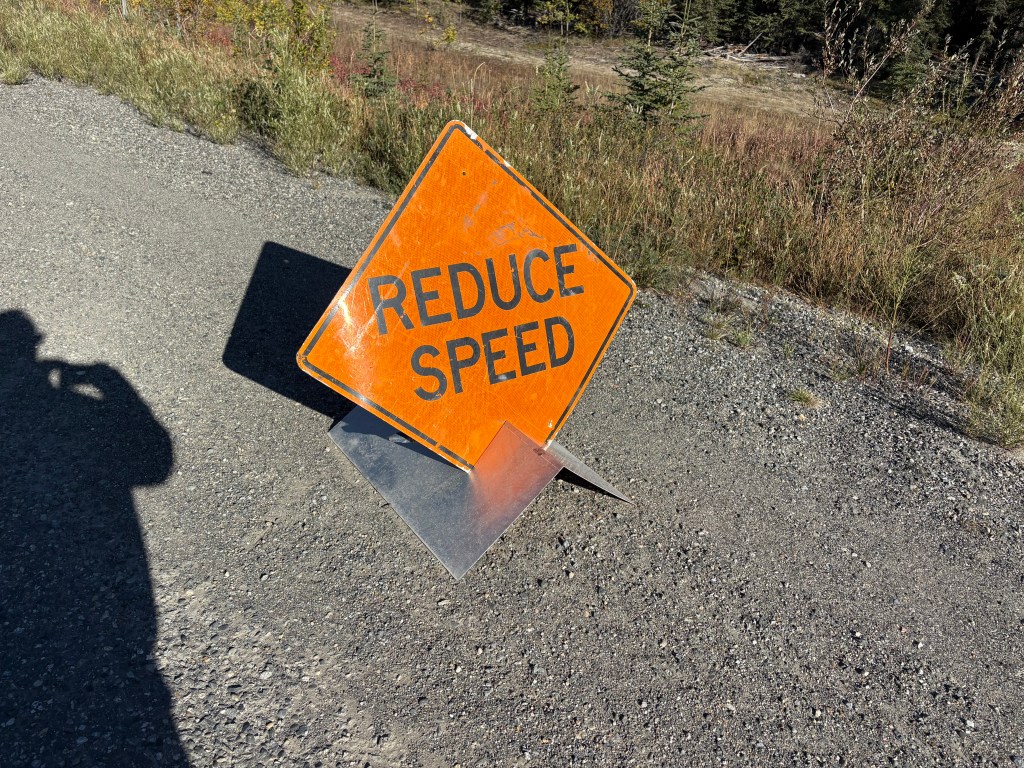
Even further evidence of this is when I crossed the southern edge of the Yukon Territory on my way west to Alaska. I was traveling on the Alaska Highway, what would be known as the Trans Canada Highway in other parts of Canada, is still referred to by its former name once one gets close to the US state. Because of the extreme cold this far north, parts of the Alaska Highway deteriorate rather quickly as potholes develop and/or the roadway “heaves,” creating undulations which, if repeated over a short distance, cause your vehicle to “porpoise” as if you were a dolphin swimming in front of a cruise ship. At full speed the result of these, usually unexpected, undulations can become catastrophic, hence the need to SLOW DOWN. These conditions can develop very quickly and randomly so instead of permanent signs, as was shown above, the Canadian Department of Transportation (probably called Transportation Canada) puts out temporary signs at each bad spot in the road.
And there are many.
Sometimes you only get the second sign, indicating a bump or dip in the road (which you can also see in the photo above. This one didn’t require any patches but can still catch the driver off guard), but the two signs generally travel in pairs. And God forbid you see an orange flag next to the Slow Down sign, as it means a severe undulation or road heave, which is sometimes like driving over a speed bump (or as Peter Sellers called it in the Inspector Clouseau movies, a “bimp”). Remember it – Orange Flag means SLOW DOWN, and big yellow sign saying SLOW means SLOW DOWN.
Now in addition to the signs, during the day the driver can often see major patches made on the road in advance, as they are all black of an otherwise gray roadway, and with black tire marks from the heavy equipment used to make the repairs. And often, if the repairs were major, they result in a very uneven surface, again necessitating a reduction in speed. I wouldn’t want to drive these roads at night – not only because of the risk of animals in the road, but also the inability to see the defects before arriving at them.
When I got in the extreme western part of the Yukon, “Transportation Canada” evidently ran out of small signs as there were NUMEROUS, major patches which were not marked (except an occasional orange flag). So in addition to worrying about animals in the road I also had to be on my toes for road conditions. I would sometimes cross to the opposite lane if the damage was confined to my side, again, well aware of other traffic around me.
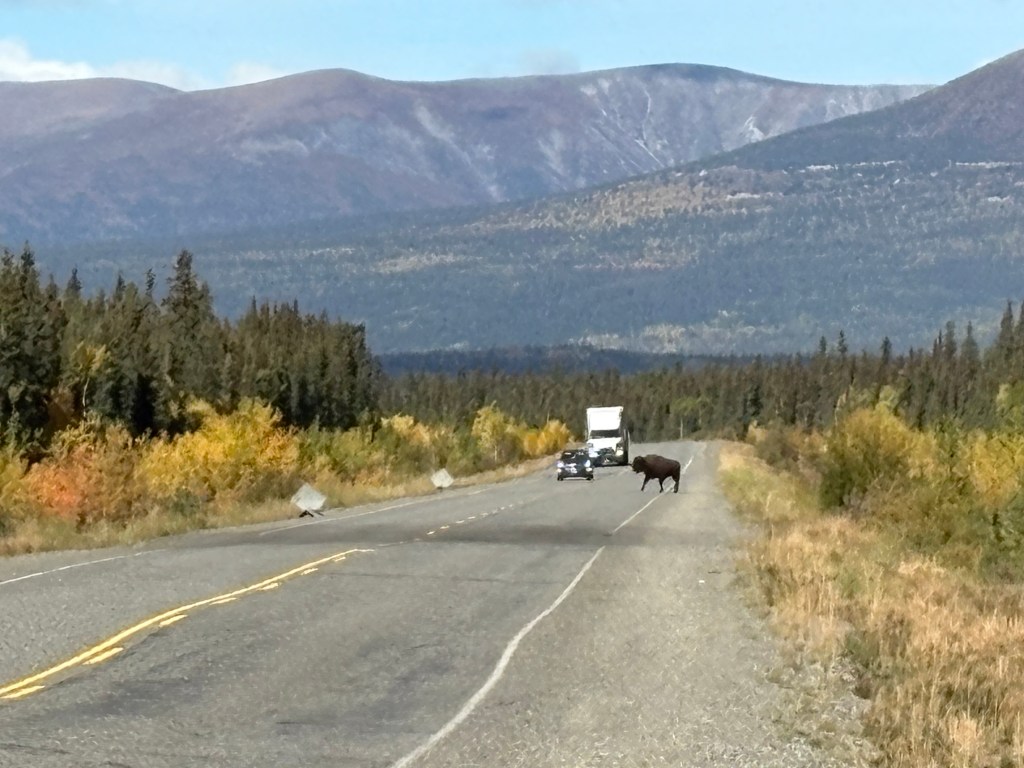
And speaking of animals in the road – as I was taking the two orange sign photos above I saw two bison casually cross the road well ahead of me:
If I hadn’t stopped to take my pictures I would have missed it. One of the FEW wildlife sightings I have had during this entire trip.
And I will also note that the car which had stopped to let the bison cross the road also stopped when she got up to my car to ask if I had broken down. I assured her, no, I was just out of the car taking pictures but thanked her for her concern and for stopping to inquire. Before she drove off, she observed “They’re not tame” and I said “No ma’am, they’re not.”
Shane van Gisbergen is race car driver from New Zealand. He used to race in the Australian “Supercar” series but came to America to compete in the inaugural NASCAR Cup Series street race in Chicago three years ago. He won. His first ever race in a Cup car, which some full time NASCAR drivers can’t even drive, AND he is used to steering from the right side of the car! Trackhouse Racing team owner Justin Marks, himself a very successful road course driver, had provided a car for him to use in the race and immediately signed him to a full-time contract. He now competes full time in the Cup Series and wins most of the road course and street races he participates in, including the Xfinity “minor league” Series. Experienced NASCAR drivers openly marvel at his ability. He still struggles on the ovals, but he’s a damn good driver and loves his NASCAR!




 johnboystravelblog