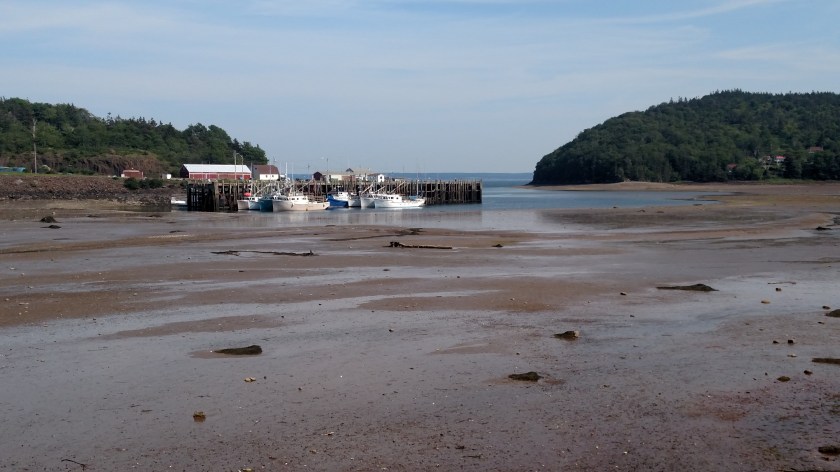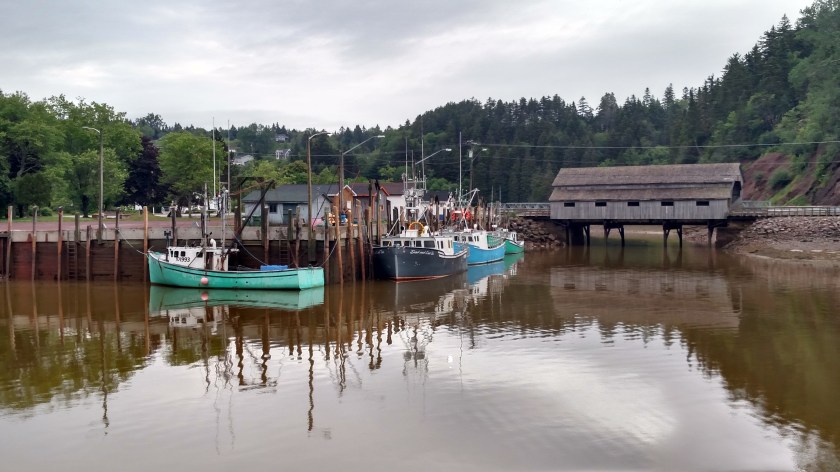
Lunenburg to Halifax, Nova Scotia

July 18, 2019

IMG_20190718_170355567

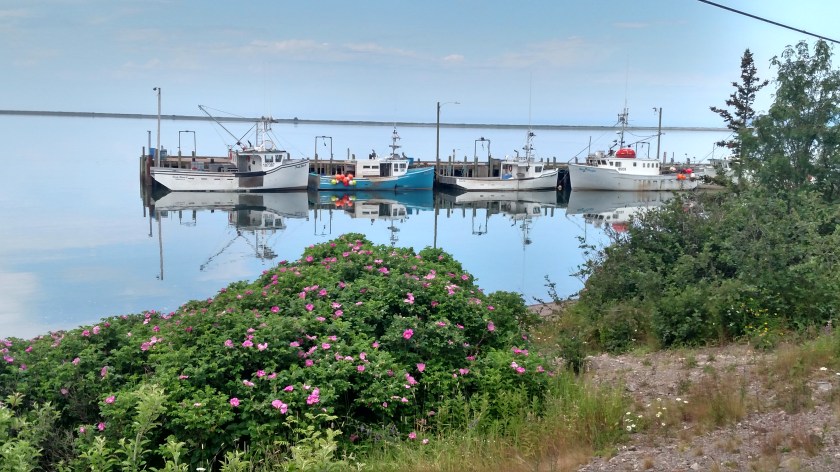
Thursday morning I awoke in Lunenburg and had this view of some of the small boats in the harbor from my window:

IMG_20190718_063757104_HDR

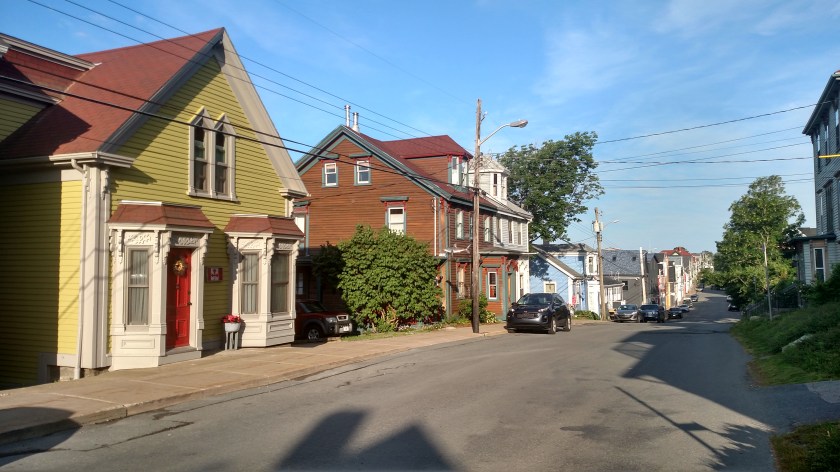
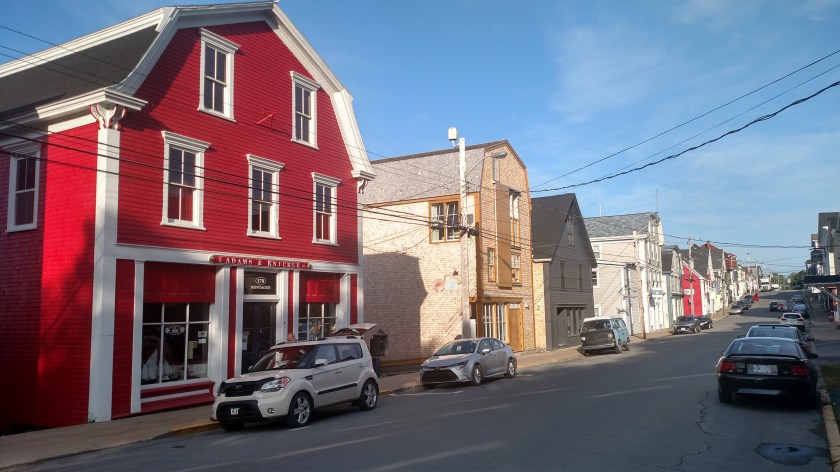
I walked around downtown and the harbor area for about 2 hours.  Lunenburg is a very colorful town, with many brightly colored houses and businesses, trendy restaurants, antique shops and art galleries.
IMG_20190718_074313676_HDR

IMG_20190718_074519035_HDR

IMG_20190718_080012188_HDR

Near the harbor I found this aerial view of the town:

IMG_20190718_074810061

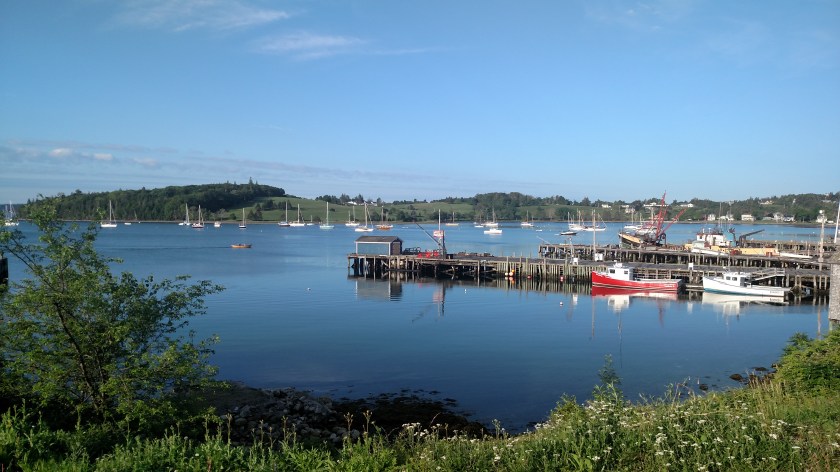
I also walked along the harbor, though most docks were private and off limits.

Here is a better picture of the smaller boats:
IMG_20190718_074137726

And there were some big ones here, too:

IMG_20190718_075206545

IMG_20190718_073854700

There is a cruise ship, the Bluenose II, which is supposed to be based here but I couldn’t find it.

After completing an errand in town for a friend, I headed south to the tiny town of Blue Rocks.  Evidently this town and view is popular with artists.

IMG_20190718_103543052

I then began my scenic drive which meandered along the coastline.  I made my next  stop in the town of Mahone Bay.  The popular photo op there is of these three church steeples:

DSCN7850

It took me a while to find the ideal spot to take the photo but there it is.  Paintings often have them closer together but this is how they appear in real life.

Next I came across a memorial near the little town of Baywater.  Swissair Flight 111 crashed into the ocean about 5 miles offshore around midnight on September 2, 1998 killing all 229 people aboard.
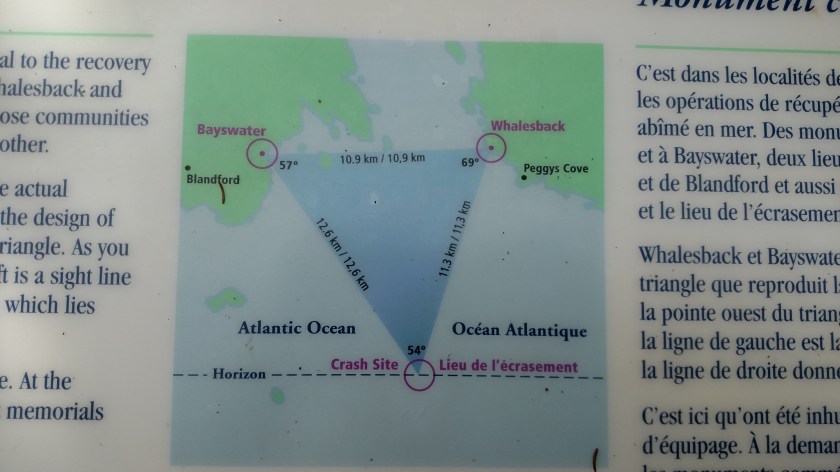
IMG_20190718_122051163

The memorial is in the shape of a triangle because the crash site triangulates to land locations here in Baywater and over in Whalesback (there is a similar memorial there).
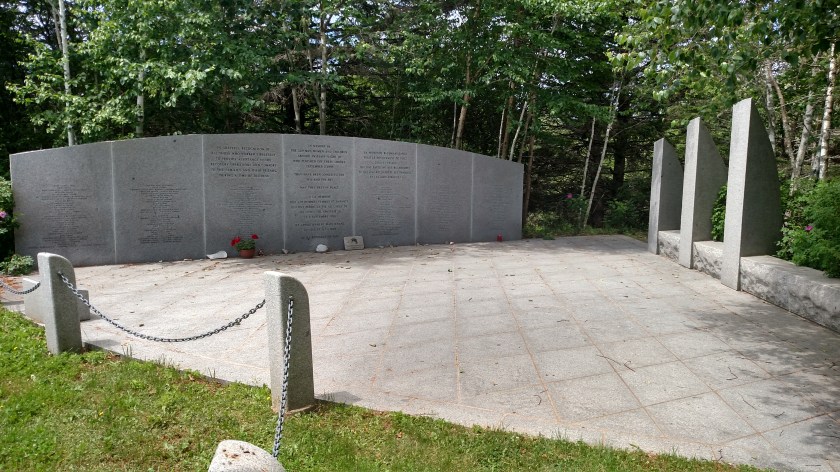
IMG_20190718_122006711_HDR

IMG_20190718_121932287

The flight had taken off from New York bound for Geneva, Switzerland.  Shortly after takeoff a fire developed onboard and the captain requested rerouting to Logan airport in Boston.  He was advised that Halifax airport was closer but the fire had gotten out of control resulting in loss of flight control and knocking out the data to the flight recorders about 5 minutes before impact.  It is believed to have plunged into the ocean at high speed.

A moment of silence before moving on please….

Next I had lunch at a colorful little deli in Tantallon:
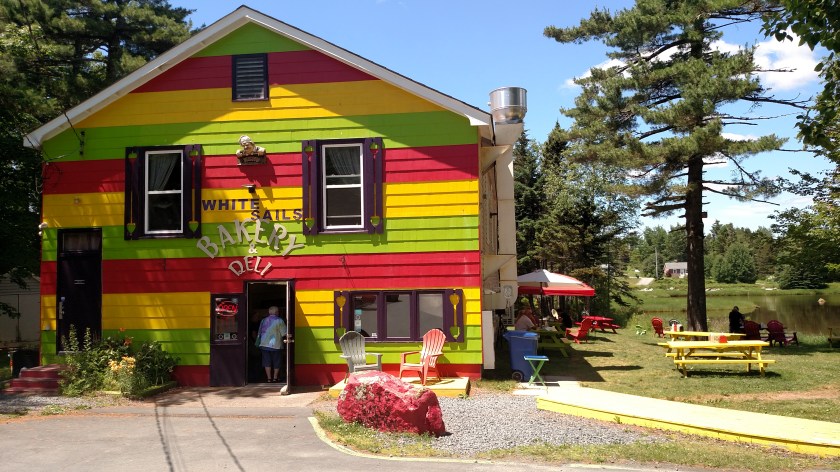
IMG_20190718_133744628

I tried something new – a Montreal Smoked Meat sandwich, and a small bowl of split pea soup.  The sandwich was very much like corned beef.  It wasn’t really a soup day but I order pea soup just about every time I see it offered and it was very good.  I resisted buying any sweet treats.  I did stop at a bakery in LaHave for treats a few days ago while waiting for a ferry on the way to Lunenburg (I forgot to tell about it in that post). In addition to an awesome cranberry muffin I had a raspberry coconut bar which was to die for.  I will have to look up the recipe and try making them at home.   For some reason the ferry there is called a “cable ferry” and I had visions of my car being attached to cables, like a zipline, to be thrust across the river but it ended up just being a regular ferry like the ones I have been on already.  Ho-hum.  Someone really needs to think about the zipline idea – it would be much more memorable.

Next I drove past Whalesback and stopped at Peggy’s Cove, a popular (almost too popular) tourist spot which had so many people wandering around along the narrow road that it was a very slow drive in.  For me the big attraction here was the lighthouse.

IMG_20190718_140625985

DSCN7858

Nova Scotia means “New Scotland” and there are supposed to be lots of people from Scotland and Ireland living in the province.  I was expecting to see lots of plaid, family crests and experience Scottish strathspeys, Acadian jigs, Celtic rock and Ceilidh (pronounced KAY-lee) but the first sign of anything Scottish was this guy playing bagpipes near the lighthouse.
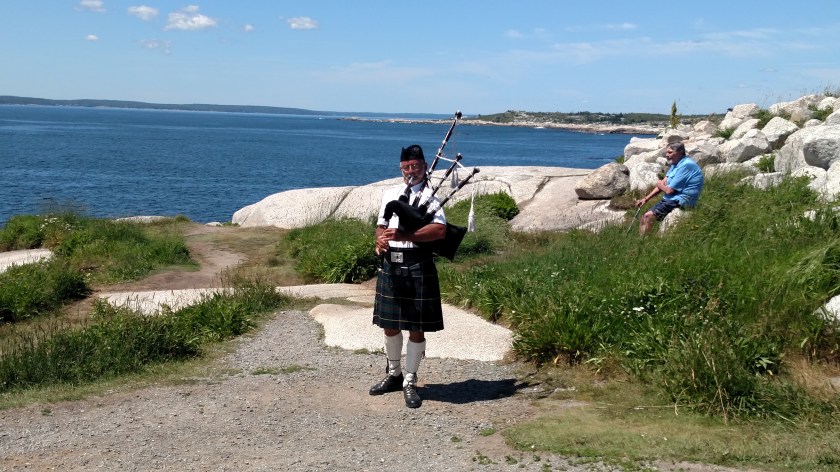
IMG_20190718_140953496

I suspect that as I get further north, especially towards Cape Breton Island in northeast Nova Scotia, that my wishes will be fulfilled.  The kid at the Tidal Bore visitor center in Truro already told me that I might experience a Ceilidh at a place he recommended for lunch up there.

I actually breezed right past another memorial on my way in to Halifax but I backtracked to see in on Friday and I will post information about it separately.

Halifax is a much bigger city than I was expecting and I was somewhat unprepared and intimidated so I scooted down to my Airbnb south of town in order to avoid rush hour and checked in early, washed a load of laundry and got caught up on some blog posts.

Digby to Lunenburg, Nova Scotia

July 17, 2019

IMG_20190718_170340025

Wednesday I drove from the Bay of Fundy side of Nova Scotia down to the Atlantic Ocean side. I went southeast on Route 8, past Kejimkujik National Park (stopping again at the big lake briefly to study my notes in solitude) to the town of Liverpool. From there I drove west to Keji’s Seaside location (see separate post), then went back northeast and took one of my trusty scenic routes from Liverpool back and forth out along the water, ending the day in beautiful little Lunenburg.

I had intended to drive out around the extreme southwest end of Nova Scotia on a series of coastal scenic roads (indicated on their map, not mine) but my Airbnb hostess talked me out of it. She said there really wasn’t much to see and that many of the coastal areas around Yarmouth are private property and people don’t want visitors stomping around taking pictures. She also said it would take an inordinate amount of time and in hindsight I think she was right. The only big thing I know I missed by taking the Route 8 shortcut over to Liverpool was seeing this unusually shaped lighthouse at Cape Fouchu, near Yarmouth:

CapeForchupic

(Photo credit: novascotia.cioc.ca)

Several times today I saw little village signs as I drove which were different from ordinary signs I generally see. Here are two of the more interesting ones:

IMG_20190717_084025792_HDR

IMG_20190717_123702282_HDR

When I arrived in Liverpool I enjoyed my first dose of “timbits” during this trip. For those of you who don’t know what I’m talking about – in the United States we have Dunkin’ (Donuts), a chain of shops which have doughnuts, coffee and other breakfast fare. Well in Canada, and lucky portions of the upper Midwest and northeast US, there is a Canadian chain called Tim Hortons. Dunkin has “Munchkins,” tiny round doughnut-holes you can pop in your mouth and eat in one bite. Tim Hortons has “timbits”. If I do say so myself, I have shown incredible discipline in not going to Tim Hortons every day I have been in Canada but today I was weak and stopped in for a box of 20 assorted timbits. They were fresh and yummy!
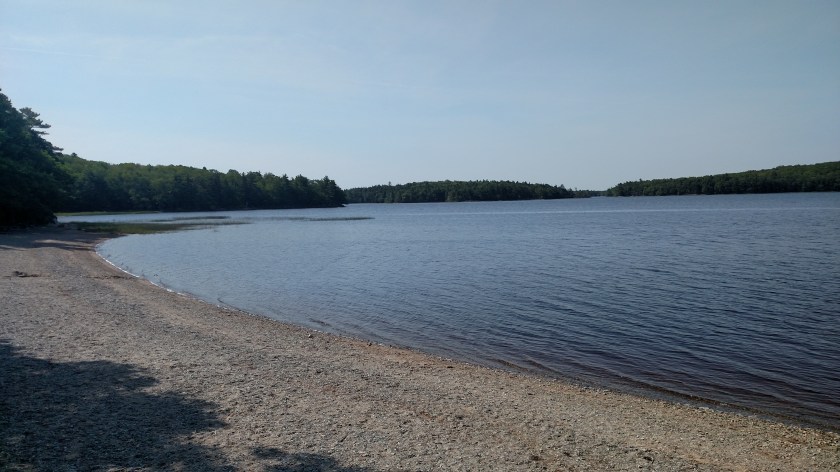
My current Airbnb host just told me that Krispy Kreme, which we swear by in North Carolina, tried to make a go of it in New Glasgow but couldn’t compete with Tim Hortons.  I also meant to mention that as I was leaving Tim Hortons the other day with my “tidbits” bounty I noticed a sign in the inside of the exit door saying “See you tomorrow”.  Ah, the power of suggestion…
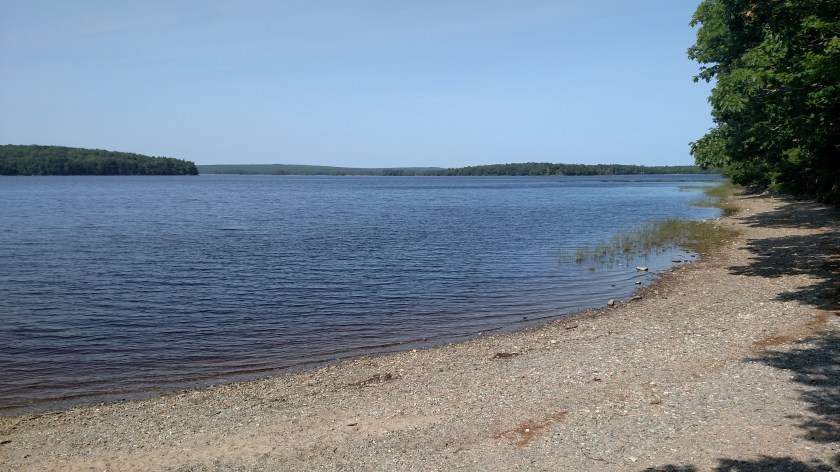
Moving on – just before driving through West Berlin I saw this this amazing tree in someone’s yard. I turned around and went back to take this photo (which doesn’t accurately reflect how stunning it was, especially in bright sunlight against a green background looking at it from the road in the other direction). I donned my Safety Sam best for the first time this trip and proceeded to take pictures.

IMG_20190717_122054225_HDR

The gentleman who lives in the house came out when he heard my car door shut and asked if I was having difficulty. I said no, I was just taking pictures of his tree. I asked if he knew what kind it is and he said it’s a dogwood. That kind of surprises me because we had dogwood trees in Pennsylvania and I never remember seeing trees that were this prolific with flowers. He said the mayor of his town encouraged people to plant them many years ago, and even provided the plants. Here is a closeup of the blooms:

IMG_20190717_125013843

It is from a different, but equally beautiful tree (I did see a lot more further up the road). Thinking back to when I was growing up in PA I think the dogwoods there were white, not pink.

Further up the road my little scenic road took me to Port Medway and I followed the signs out to see their lighthouse.

IMG_20190717_134612379_HDR

IMG_20190717_134706911_HDR

I spent a long time speaking with one of the co-owners. He and a group of friends bought the lighthouse several years ago and it was moved to this location. They are renovating it and it looks great. They’ve already spent more than $ 30,000 in removing and replacing 2 of the exterior walls which had fallen into serious disrepair. There were two artists set up on the property painting.

I ultimately made it up to Lunenburg where I would be spending the night before continuing on to Halifax. I arrived at my Airbnb earlier than usual (in light rain which had just moved in) because I wanted to try and get caught up posting the blog after delays in Granville Ferry. While I was working the house cat snuck in my room and took a nap on my bed, behind me as I was sitting at a table working.

IMG_20190717_185322931

I looked again about an hour and a half later and she was still racked out.

IMG_20190717_203233231

Kejimkujik Oceanside

July 17, 2019

Wednesday I left Granville Ferry and headed southeast past Kejimkujik National Park (stopping there for a while to study my scenic road book for the day’s activities).  Continuing southeast on Route 8 I reached the town of Liverpool, along the Atlantic coast, about an hour later.  I then drove southwest on 2-lane, controlled access NS-103 and exited near the town of Port Joli.  A short drive out to the water and I arrived at Keji’s coastal location.

To complement the main Park which is way inland, a location next to the ocean to help reflect Nova Scotia’s 4,600 miles of coastline was established.  An adjunct was recently added adjacent to the original seaside Park to help protect two estuaries.

There are two walking trails from the parking area out to the ocean (and this is a good opportunity to mention that since leaving Maine earlier this trip, photos of large, non-lake bodies of water were the Bay of Fundy, or it’s sudsidiaries.  From this point forward, at least until I reach Quebec province, they will now be the Atlantic Ocean).  I opted for the shorter walk (still a hike) out to Harbour Rocks.  A lengthier route which went out and around Port Joli Head was longer than I wanted to walk, and was rated as “Difficult”.

This was a view as I drove in towards the parking lot.

IMG_20190717_095637038_HDR

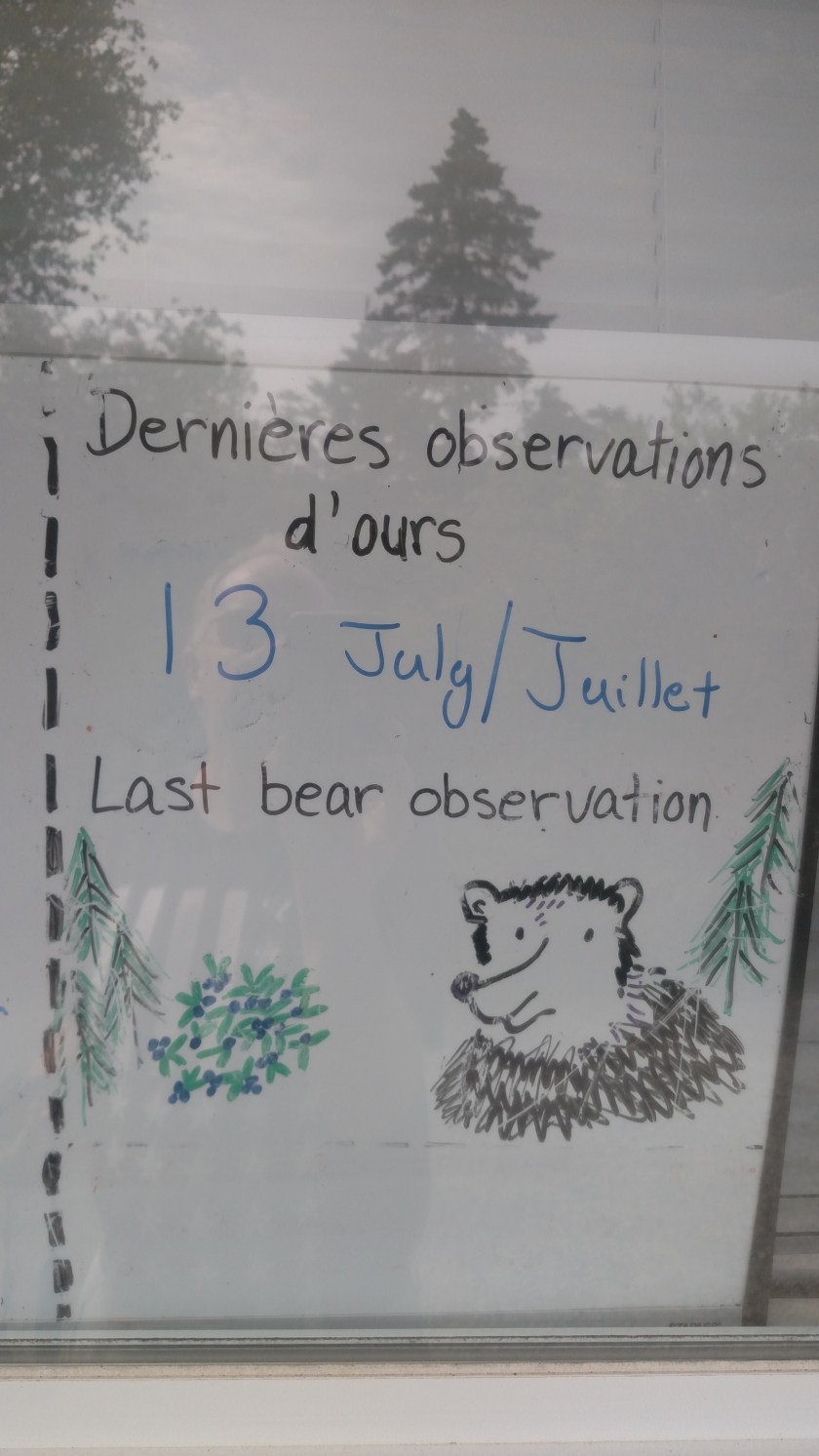
When I got to the unattended entry kiosk there were several warning signs, among them:

IMG_20190717_100733819

I was there on July 17.  About halfway out to the water a family overtook me on the walking path (I had stopped to photograph some flowers).  A boy about 12 years old asked me what his chances were of encountering a bear.  I told him it was possible but probably unlikely.  I also relayed the tips I read at the entrance:  Make yourself big (waving your arms and making noise), always look the bear in the eyes (backing away if you need to), and NEVER turn and run.  I didn’t tell him that if he did run he shouldn’t run any faster than me!

Someone later told me (and I subsequently read online) that this oceanside location was recently closed for a period of time due to increased bear activity.

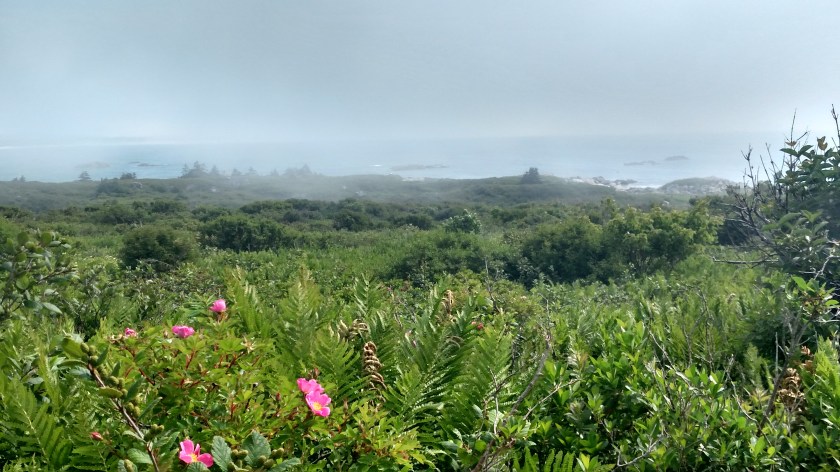
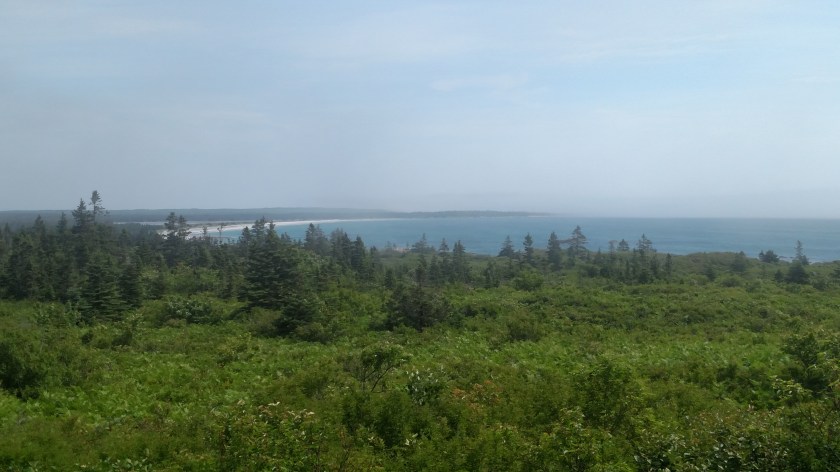
I finally made it to within sight of the water – trust me, it’s out there:

IMG_20190717_104428707_HDR

There was just a hint of coastal fog that literally burned off within a few minutes of my taking that photo.  It had been generally overcast but now the sun was shining brightly.

IMG_20190717_104959659_HDR

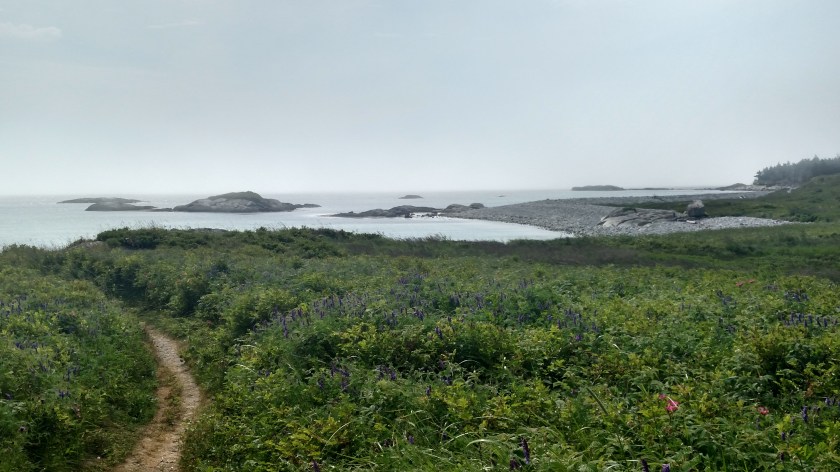
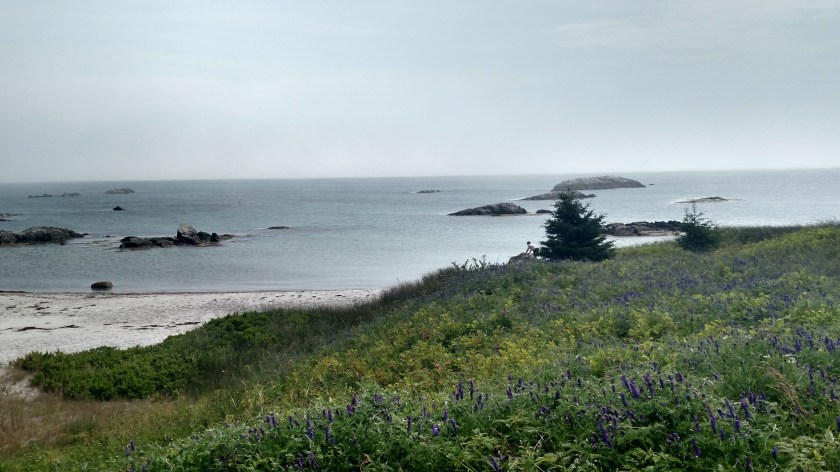
There was a small beach area open to the public:

IMG_20190717_105011550_HDR

IMG_20190717_105006405_HDR

You can just make out the kid that asked me about the bear to the left of the bigger pine tree, up on a large rock.

Further north there appeared to be a much larger beach area but signs indicated it was off limits to visitors.  Protected Piping Plovers (say that 3 times fast…) are nesting, and I think sea turtles are too.

IMG_20190717_110802187

Because of on-site research, visitors are not allowed off the trails unescorted so there wasn’t anything else here to see or do and I headed back to my car.

Bear River & Digby Neck

July 16, 2019

DigbyMap

(Photo credit: shinealightblog.wordpress.com)

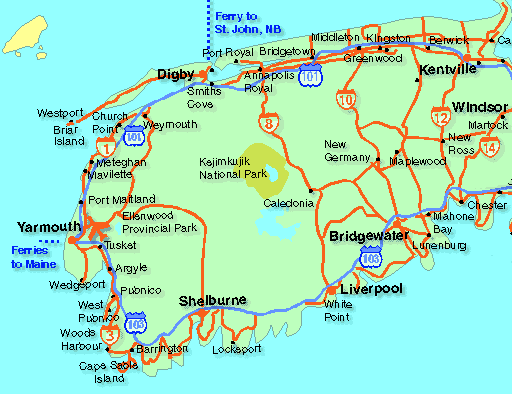
Tuesday morning I set out from Granville Ferry (east of Digby and north of Annapolis Royal on the map above) to drive to Kejimkujik National Park, about a half hour south.  This was the view looking east near the bridge I had to drive over to get to Annapolis Ferry:

DSCN7822

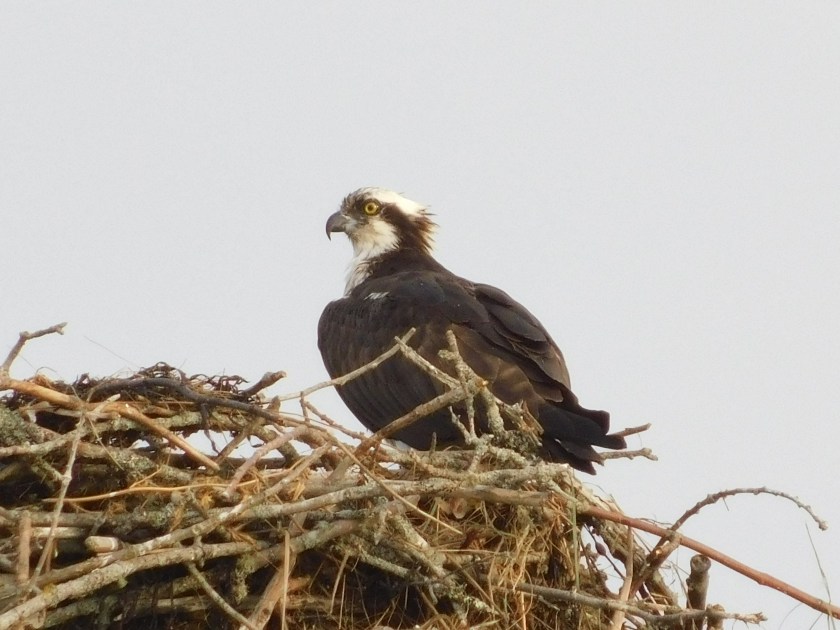
This is an osprey, guarding her nest on a utility pole right next to the parking lot where I took that photo.  I had heard her up there squawking the night before when I had stopped to view the river.

DSCN7818

Once I was done at the Park (see separate post below), and at the suggestion of my Airbnb hostess, I took a series of small roads to the little town of Bear River (not shown on the map but located diagonally between the 8 above the Park, denoting the highway number, and the town of Smiths Cove, just south of Digby).

IMG_20190716_120918379

IMG_20190716_120951282_HDR

IMG_20190716_121127742

The buildings on the right in the photo above are all built on stilts, as seen from this view from the other side of the river:

IMG_20190716_122323419

Bear River is hosting their annual Cherry Carnival this weekend.  In addition to pie eating and pit spitting contests the highlight of the carnival is the Greased Log competition, where a telephone pole is liberally coated with grease, placed in the river and contestants are given a prize if they can successfully walk all the way across it.  Evidently it is quite a hoot.  My Airbnb hostess very enthusiastically told me about it, as did a gentleman who I met while taking these photos who has lived here all his life.

After seeing Bear River I drove up through Digby and out onto Digby Neck, a long, thin peninsula which juts out into the Bay of Fundy, parallel to the mainland.  I stopped at Lake Midway Provincial Park where I saw this guy kayaking back to where his wife and daughters were picnicking nearby:

IMG_20190716_134900823

Next stop was Sandy Cove on the inland side of the peninsula.  This photo was taken at 205 pm, on my way west:

IMG_20190716_140518318

And this is the same scene at 455 pm as I was returning to Digby.  You can see how much the receding tide had dropped in the meantime:

IMG_20190716_165534434

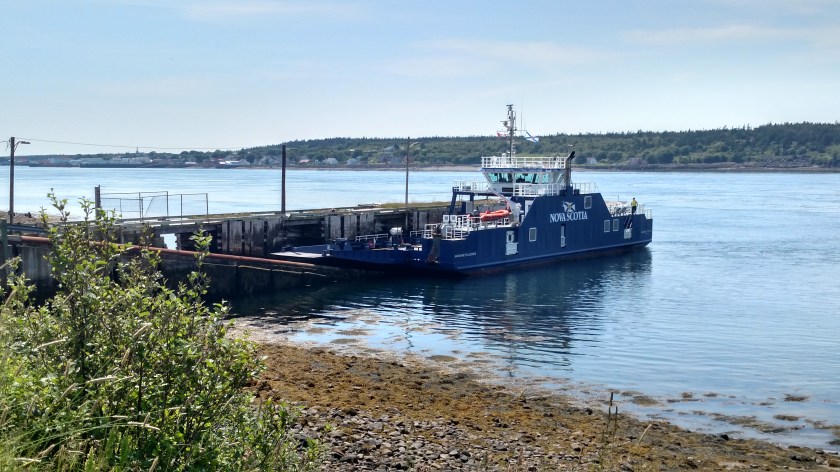
Next stop as I drove west was the ferry which would take me across the “Petite Passage” over to Long Island.

IMG_20190716_145457387_HDR

IMG_20190716_143726820

I drove all the way across Long Island to the town of Freeport.  I could have taken another ferry across the “Grand Passage” to Brier Island but decided not to.  One thing I missed by not going was a chance to see this lighthouse in person:

Brier_Island_Lighthouse_(1)

(Photo credit: en.wikipedia.org)

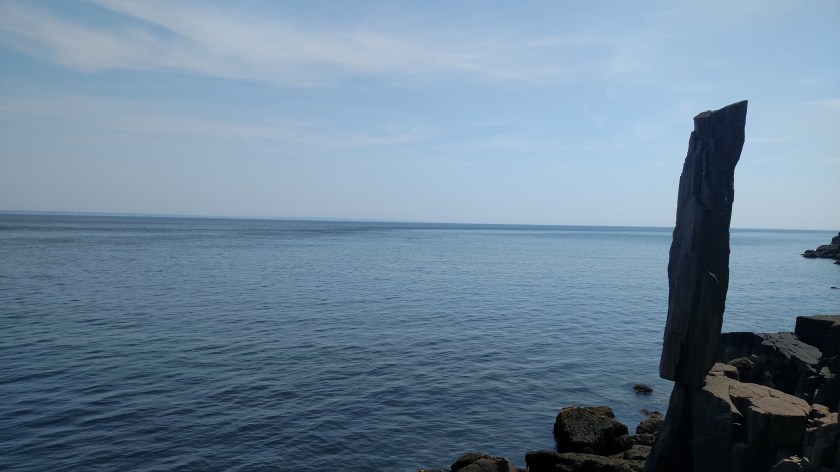
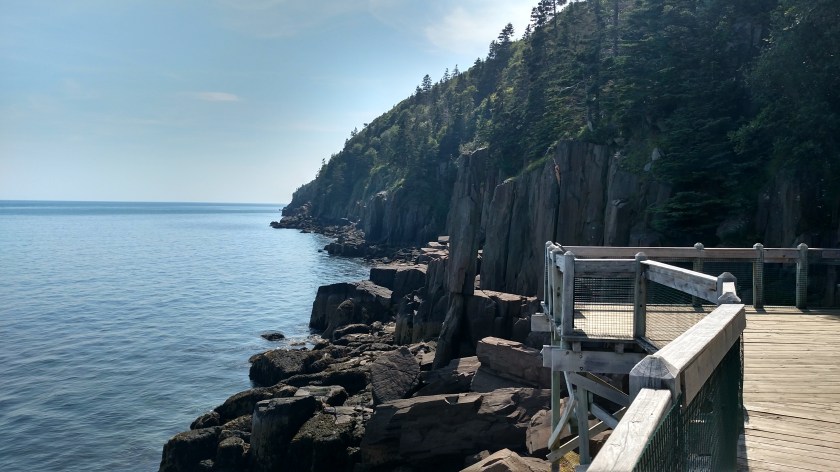
I drove back east on Long Island and stopped to see Balancing Rock.  This involved a long walk out a dirt path and wooden walkway to a long set of stairs (235 of them) which would take me down to the water’s edge.

IMG_20190716_152421201

Here is the reward:

IMG_20190716_152617631

What you are seeing is a columnar basalt sea stack, about 30 feet tall, which is perched precariously on the rock below.

IMG_20190716_152624926

IMG_20190716_153123496_HDR

The signage on-site teases the viewer about the weight of the column but I can’t find the exact number online.  Legend has it that a fisherman once tied a rope to it and tried to topple it without success.  According to the sign a cubic meter weighs 3 tonnes (slightly more in US tons).  Evidently the column weighs several tons.

Feeling exhilarated, the climb back up those 235 stairs wasn’t as bad as I was expecting.

Kejimkujik National Park

July 16, 2019

Don’t be intimidated by all those k’s and j’s.  Just stick an ‘a’ right in the middle of it and it is pronounced pretty much just how it looks.  keji-ma-COO-jik.  I will explain the origin of the name later in this post.

“Keji,” as it is called by the locals, is about a half hour southeast from where I was staying in Granville Ferry.  It is an inland, heavily wooded park with a huge lake on the eastern side of it, featuring many islands of all sizes.  There are also lots of smaller lakes in the Park.

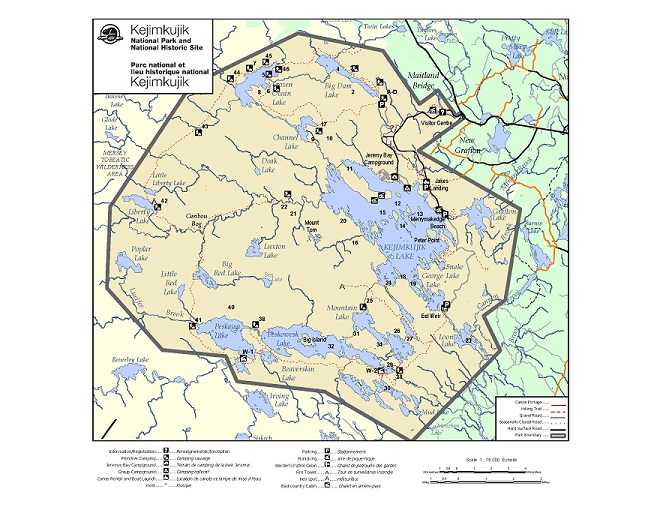
Keji map

(Photo credit: pc.gc.ca)

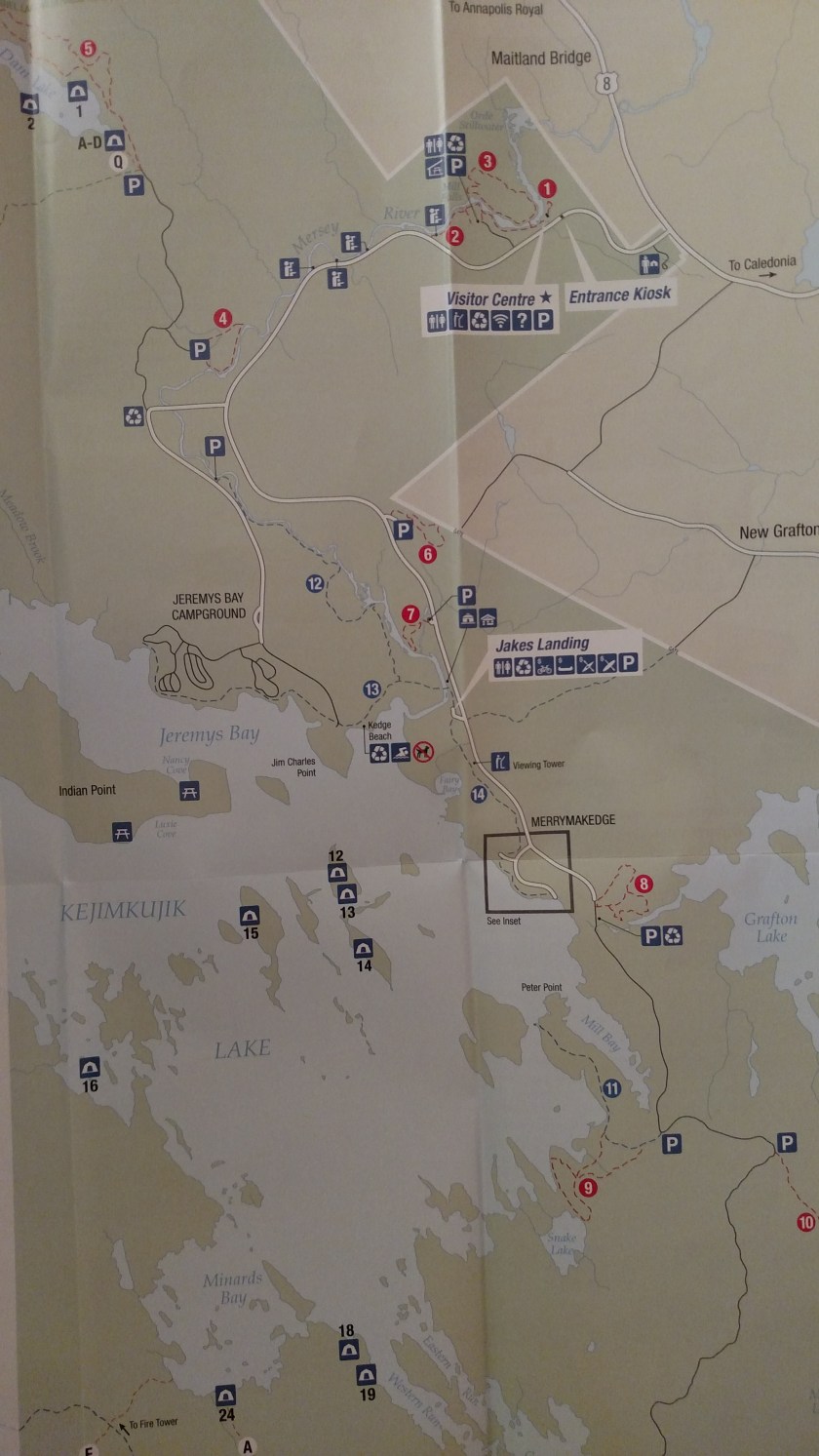
Here is a photo of the map I was given at the Visitor Center:IMG_20190718_202448914

The map doesn’t show the entire lake or park, only the main road which goes down the eastern side of the lake.  I drove to the last parking area inside the “box” in the photo.  There were only two vehicles in the parking area when I arrived and there wasn’t a soul in sight.

IMG_20190716_101701889

IMG_20190716_101706436

IMG_20190716_101714308

From pre-trip research I knew there wouldn’t be much for me to do here but I sat for a long time just enjoying the solitude.  There are lots of hiking trails and camping areas.  But they say the best way to see Keji is from the water.  This is paradise for canoers and kayakers.  It is also a great place for stargazing as it is in the remote southwest end of Nova Scotia and is well protected from light pollution.

Later in the morning some other folks arrived – a young family with two kids who frolicked in the water, another couple with two dogs who thoroughly enjoyed playing fetch in the water at the far end of the beach, reserved specifically for pets, and four ladies who arrived with their canoe who were about to embark out to one of the islands to spend the day.  One of the ladies knew my Airbnb hostess.

IMG_20190716_110920400

IMG_20190716_110323845

The name of the park is derived from the Mi’kmaq phrase for “little fairies”.  Fairies, or gnomes and elves, are featured prominently in petroglyphs found in the Park.  Mi’kmaq (pronounced mick-maw) are the indigenous people who inhabited the area and they lived in all of the Maritime provinces except the Labrador part of Newfoundland and Labrador, which was inhabited by the Inuit people.

The names and numbers in the photo below denote regions where the Mi’kmaq lived. Keji is located near number 7 is the lower left corner.

IMG_20190716_101020486

There are still many proud Mi’kmaq descendants living in the area today.

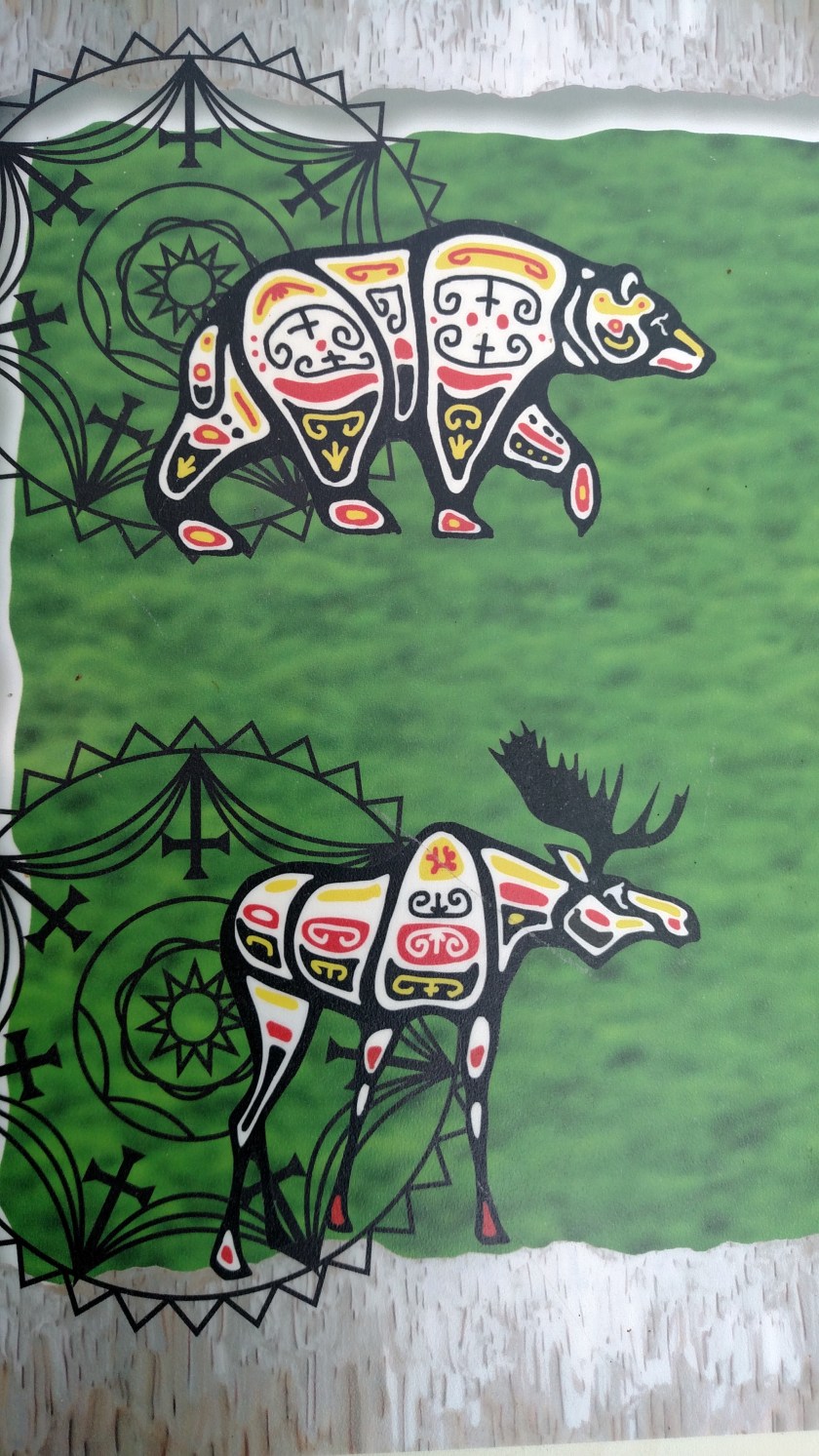
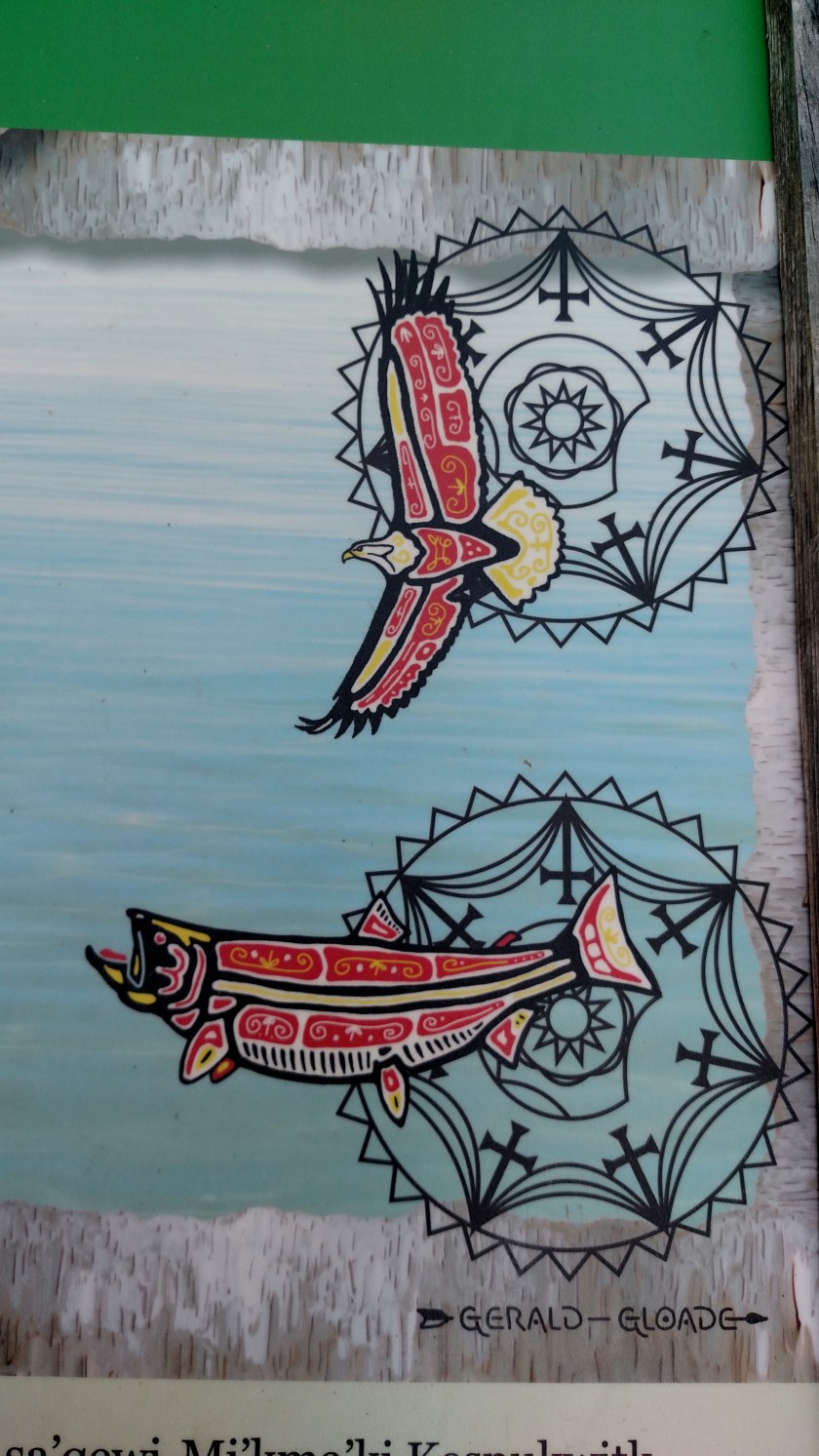
Here is some interesting artwork from the sign which had the map showing the provinces with Mi’kmaq settlements.

IMG_20190716_101132985

IMG_20190716_101140614

Truro to Digby, Nova Scotia

July 15, 2019

Sunday morning I left Truro to head southwest along the coast on some scenic roads.  It took me about 6 hours with stops, and after checking in to my Airbnb in Granville Ferry (east of Digby) I went back out to explore some more before the sun went down.

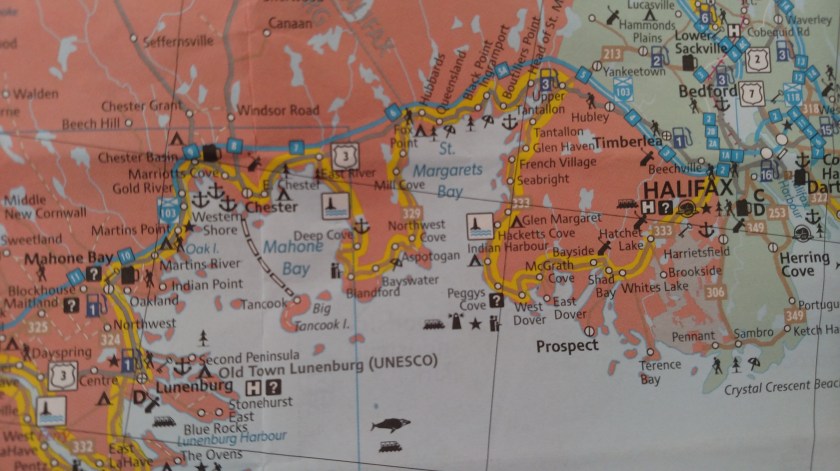
I took a picture of the section of the Nova Scotia map I was given upon entering the province which shows this part of my adventure.  The roads marked in yellow are scenic roads (in the province’s opinion) and mostly coincide with my “bible,” a book my friends Eric and Shawn gave me listing scenic drives in the Maritime provinces – the basis for this trip.

IMG_20190718_170228878

The map also shows (in yellow) the route I took yesterday – at the top right corner of the photo.  Today’s trip goes right to left along the lower yellow line.

First stop – the Shubenacadie River near Green Oaks:

IMG_20190715_081655958

People were arriving at a little after 8 AM to gear up at a rafting outfitter on the river.  Later today they will be going out in these zodiac boats.

IMG_20190715_081829861

You can see one raft already in the water in the photo above, with a man standing in the water near it.

IMG_20190715_081846644_HDR

It doesn’t look like much now but high tide will occur here a little before 1 PM so business, and the river, will be picking up.

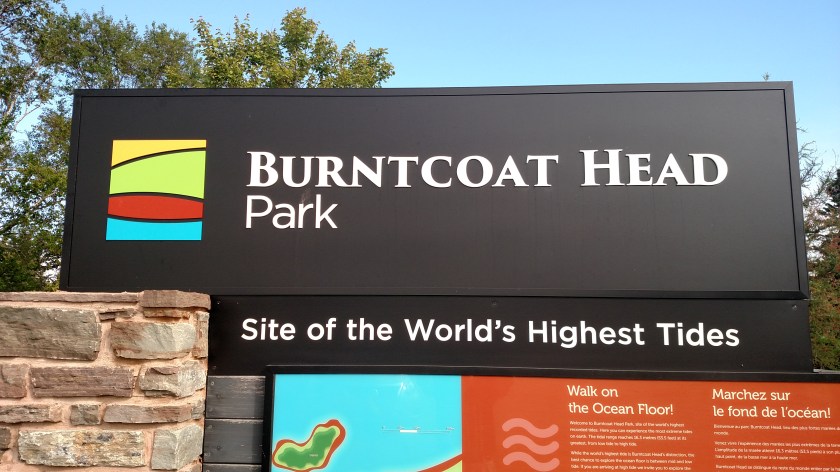
Further up the road I stopped at Burntcoat Head:

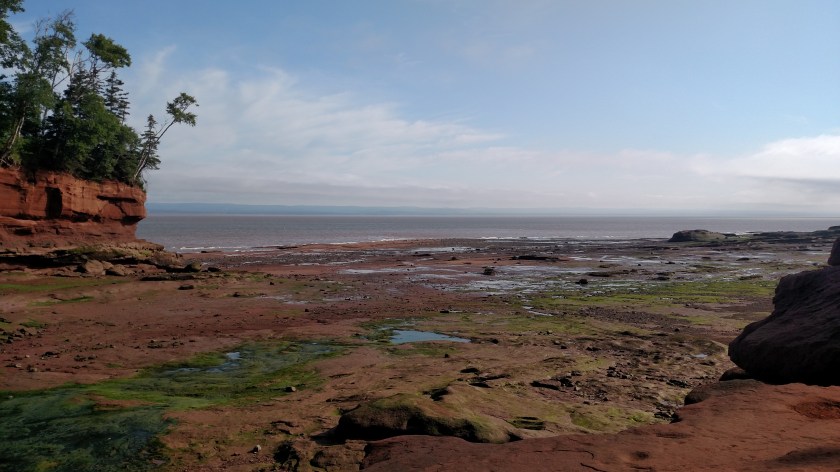
IMG_20190715_085613615

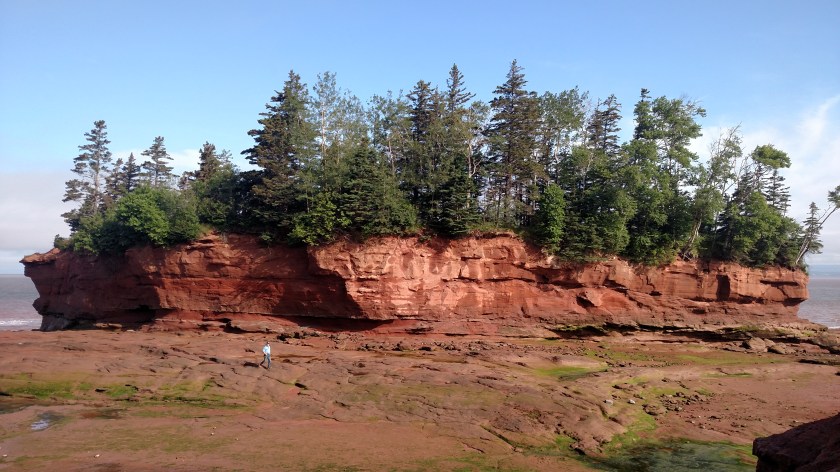
If you thought the 46 foot rise at Hopewell Rocks was impressive, this is the world record holder at a whopping 53.5 feet!

IMG_20190715_090049019

If you look closely at the left side of the photo you will see a man walking.  At high tide the water will come up to just below where I was standing as I took this photo.

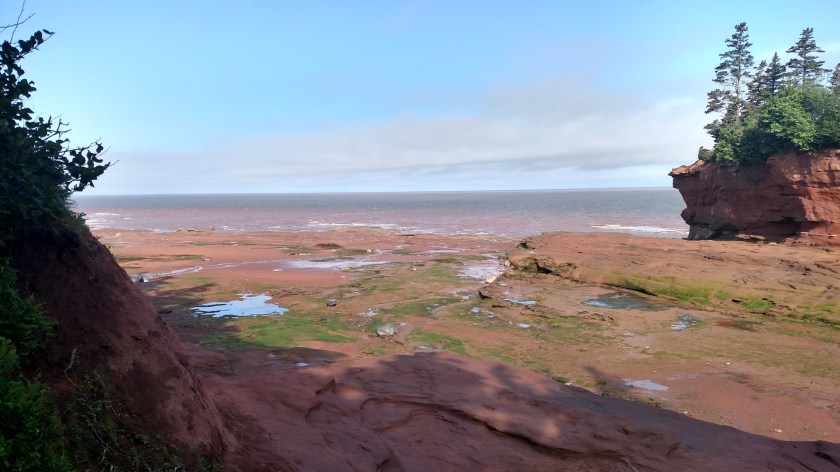
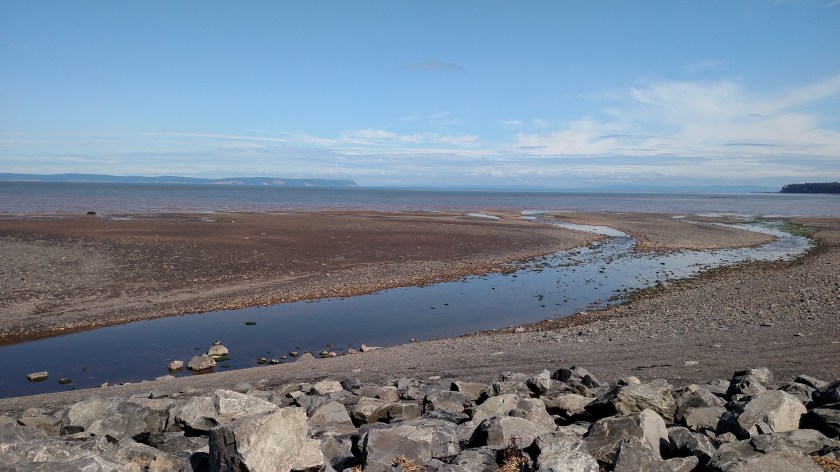
Here is the view looking left, towards Minas Basin (and ultimately the Bay of Fundy):

IMG_20190715_090124518_HDR

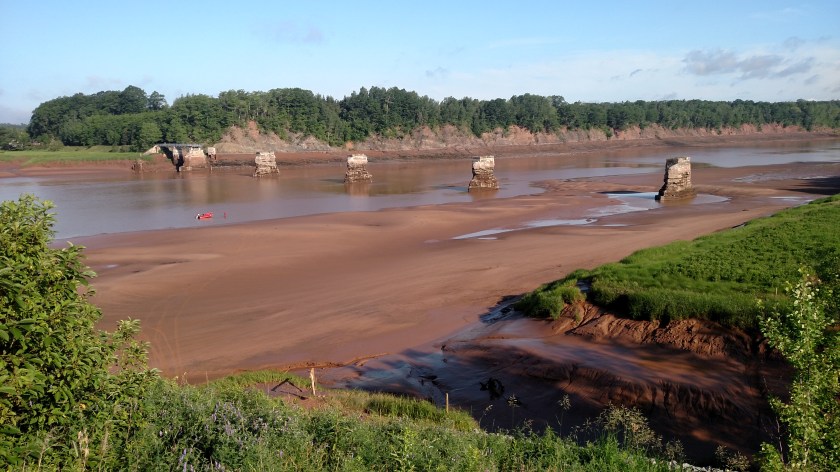
And looking right, towards Cobequid Bay while ultimately becomes the Shubenacadie River shown above.

IMG_20190715_090146634

All that open area will be filling with water over the next 4 hours or so and the formation will become a giant “flowerpot planter!”.

Further up the road I stopped near Cheverie, where schooners used to be built.

IMG_20190715_095514833

The road then took me south to an intersection with Route 1 which would ultimately take me to Digby.  I am driving on this older, original road.  There is a newer, controlled access highway – NS-101 which runs parallel and is much faster, but I prefer the slower, scenic road.

After I got on Route 1 I drove through the town of Windsor, which is arguably the “Birthplace of Ice Hockey”.  My “bible” tells the story of Thomas Chandler Haliburton who wrote about students at nearby King’s College playing “hurley”.  I have seen lots of outdoor hockey rinks which are flooded with water in the winter for people to play hockey.  It is strictly BYOZ (Bring your own Zamboni).  I have also seen lots of Curling clubs (the Olympic sport where a large puck-like object is slid over the ice and people with little brooms brush the ice frantically in front of it trying to control the trajectory.  At least I think that’s how it works…)

Mr. Haliburton was also a writer and is credited with coining the phrase “it’s raining cats and dogs”.

But I digress…

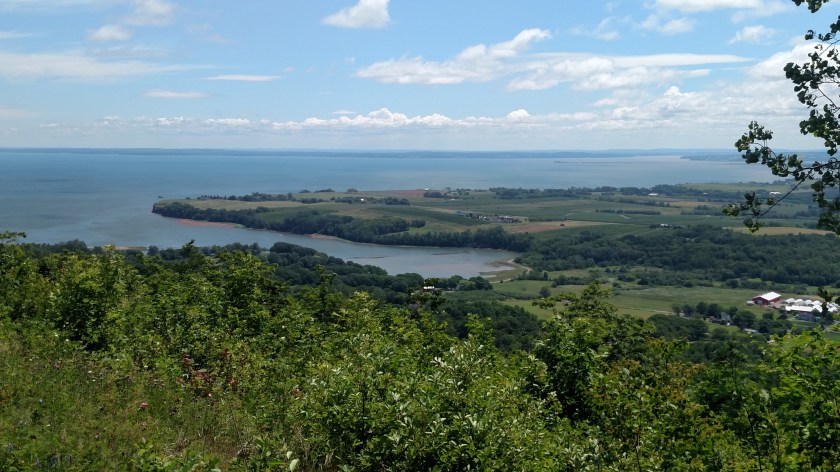
Moving on up the road I took a side road (on MY list from the “bible,” not shown in yellow on the state map) to The Lookout.  The road took me up to almost 1,000 feet and provided this fantastic view of Minas Basin and the farm valley below:

IMG_20190715_123153167

IMG_20190715_113338613

IMG_20190715_113350984

I then took a side road off the side road and drove out to Halls Harbor (another book suggestion):

IMG_20190715_125209991_HDR

IMG_20190715_125323740

I saw this sign with photos showing the harbor at high and low tide.

IMG_20190715_125609473_HDR

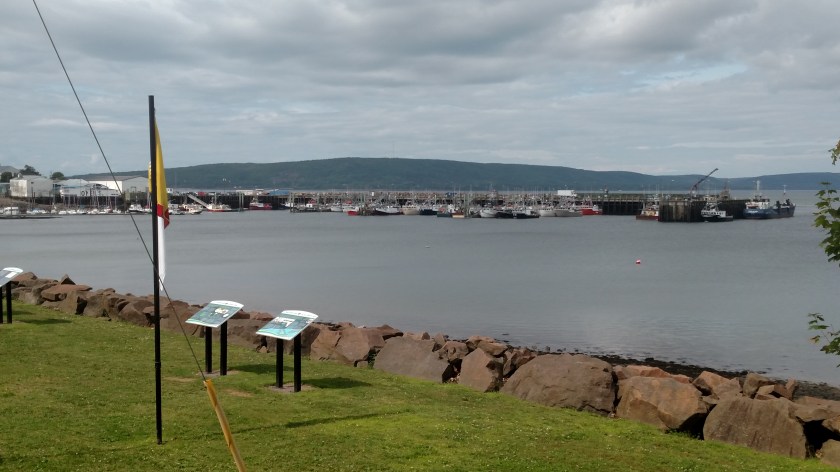
I then drove back down to Route 1 and continued west to Granville Ferry where I checked in to my Airbnb, then drove over to Digby for dinner and to pickup maps and info at the Visitor Center there.  Digby is known for harvesting scallops and clams.  Here is a photo of their harbor as seen from a gazebo next to the Visitor Center.

IMG_20190715_161653495

Welcome to Nova Scotia

July 14, 2019

IMG_20190714_085757719

After visiting Hopewell Rocks on Saturday I spent the night in the town of Moncton, New Brunswick.  Sunday morning I headed southeast to cross into Nova Scotia.


Looking at my maps I always thought all of Nova Scotia province was an island but in fact the majority of it is a peninsula – attached to the southeast tip of New Brunswick.  The northeast end of Nova Scotia is an island.  I will address that issue further when I get there later in this trip.

five-islands-nova-scotia-10

(Photo credit: somethingbiggeroutthere.wordpress.com)

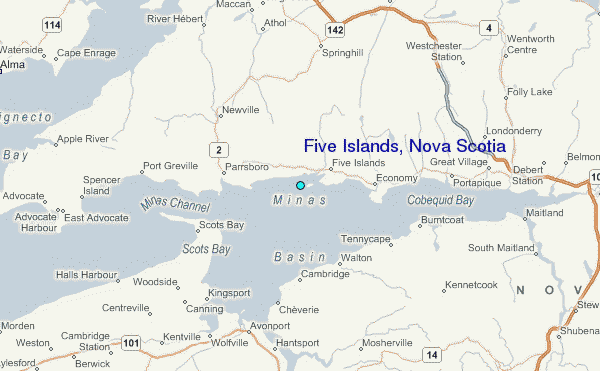
The map above covers most of what I will address in this post.  Moncton, NB is off the map in the upper left corner and I crossed in to Nova Scotia just above Maccan in the upper left part of this map.  I took scenic roads (not shown) through River Hebert, southwest to Apple River then south to Advocate.  I then proceeded east through Parrsboro, Five Islands, Economy and then reached a bigger highway near Debert Station which would take me to Truro (due east of Belmont and just off this map) where I would spend the night.

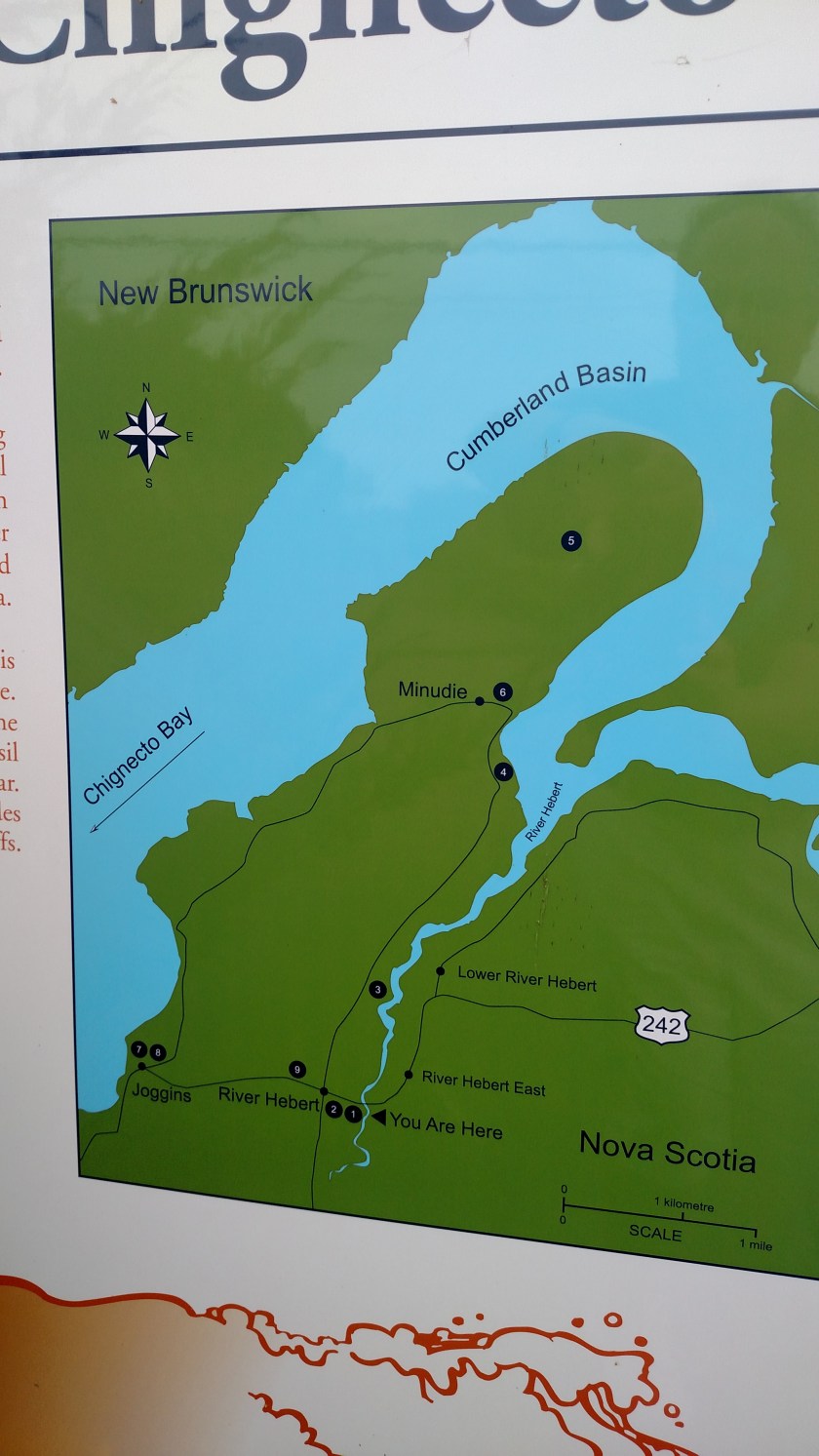
When I got to River Hebert I learned something new about tides: that they can create a tidal bore.

IMG_20190714_100846904

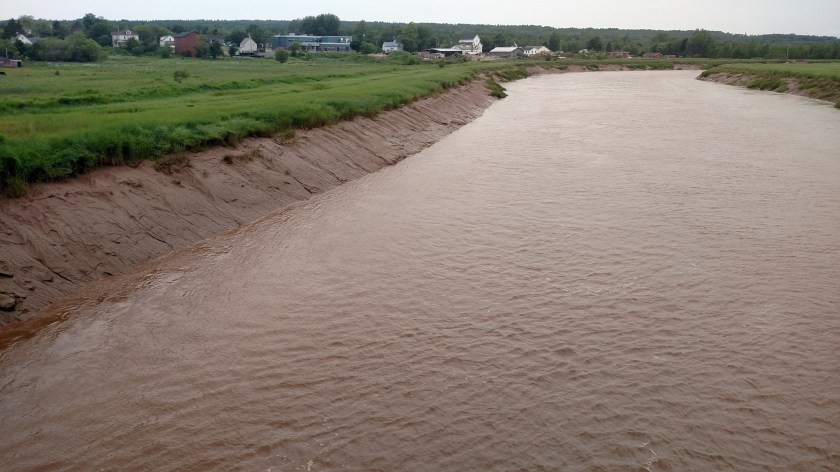
River Hebert (the town) is at the bottom of the map above – almost the end of the line for this part of the water coming in from the Bay of Fundy.  The photos below are of the water from a bridge over the Hebert River.  The water, as it was at Hopewell Rocks, is milk-chocolate brown.  This is because of the constant churning of water and mud at this, the shallow northeastern part of the Bay which almost completely drains at low tide.

IMG_20190714_100512970

IMG_20190714_100521159

A tidal bore is something that occurs at many locations due to the force of the incoming tide pushing large amounts of water forward quickly.  In narrow areas, such as the river at this point, that “push” creates kind of a teeny tiny tsunami – a wave of water as much at 3 feet high which surges forward.  I’m sure you can find videos on YouTube.

The water here was moving rapidly towards me but I didn’t see any tidal bores – they occur about 2 hours before high tide.

Further down the road near the town of Apple River I drove over that river coming in from the Bay.  The water is clearer here because it is from a deeper part of the Bay.  The water was obviously moving rapidly inland, away from the Bay, as the tide was coming in.


IMG_20190714_104727771

IMG_20190714_104744804

And while the water in the photo above was moving “up” from this vantage point (the other side of the bridge), the marsh grass on the right was clearly matted towards the Bay (“down”) as it had moved back during the transition to low tide a few hours earlier.

The photos below are looking south from Advocate Harbour.

IMG_20190714_111722835

IMG_20190714_111702798

The water is especially calm here because there is a rock barrier separating most of this harbor from the Bay.

IMG_20190714_111920343_HDR

IMG_20190714_112123856_HDR

This is further east in the town of Parrsboro.  I am posting this photo because of something which happened shortly after I took it.  Although I was driving east this was when things started going south.

IMG_20190714_130044111

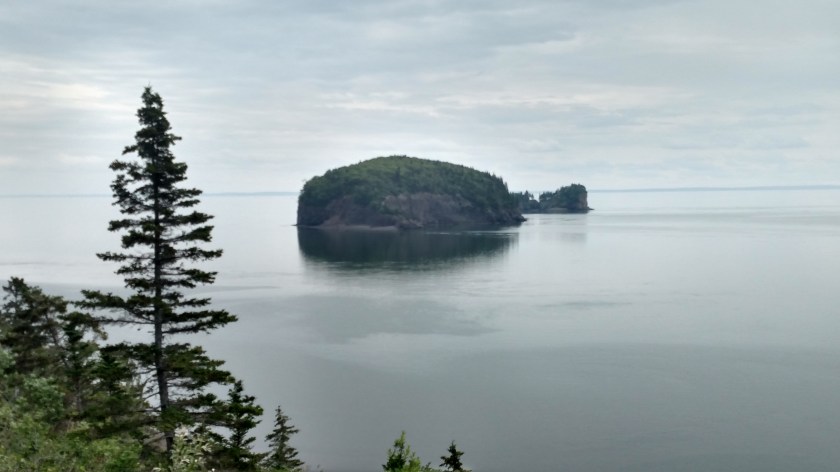
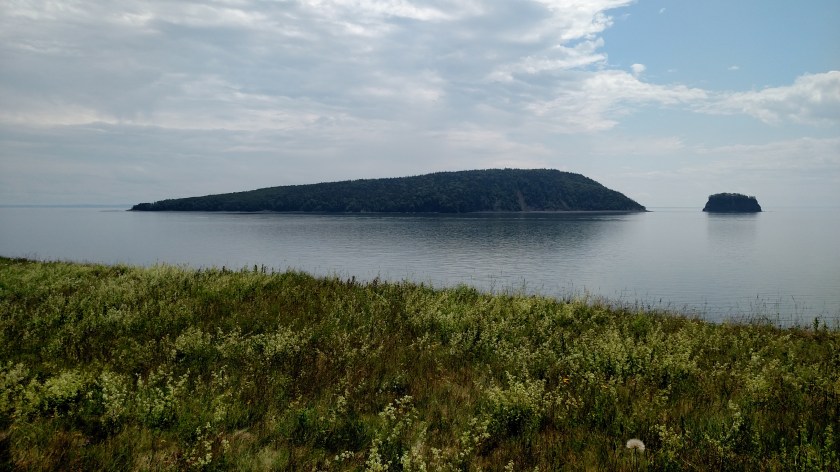
The first sign of trouble was when the road I was on turned to gravel.  Shortly after that I stopped to take these two photos – of Two Islands (aka The Brothers)…

IMG_20190714_131456222_HDR

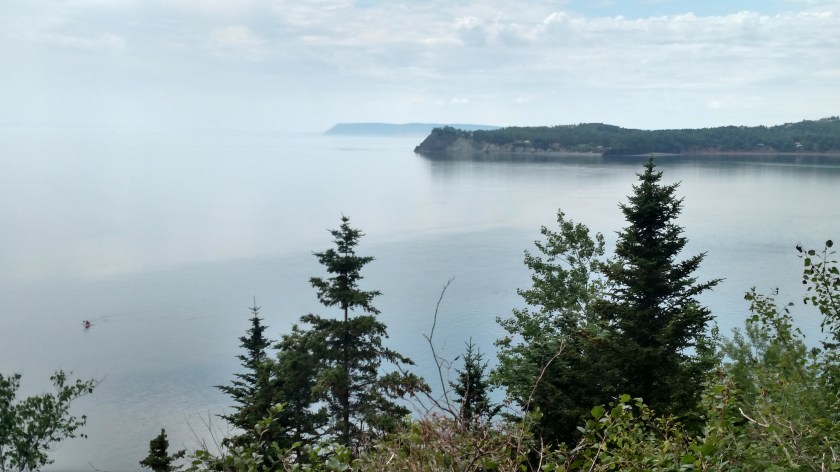
… and of the view looking southwest (towards Clarke Head in the foreground and Cape d’Or in the distance.  If you look closely you’ll see a guy in a kayak in the lower right hand corner of the photo below.

IMG_20190714_131503897_HDR

Shortly after I resumed driving the road went from gravel to two tire tracks in the grass (and became very rocky) and I surmised I was not on the right road.  I plugged in my trusty GPS which quickly confirmed that I had gone astray.

I drove the 7 miles back to Parrsboro (no harm, no foul) and my GPS put me on a much nicer paved road to take me where I had intended to be.

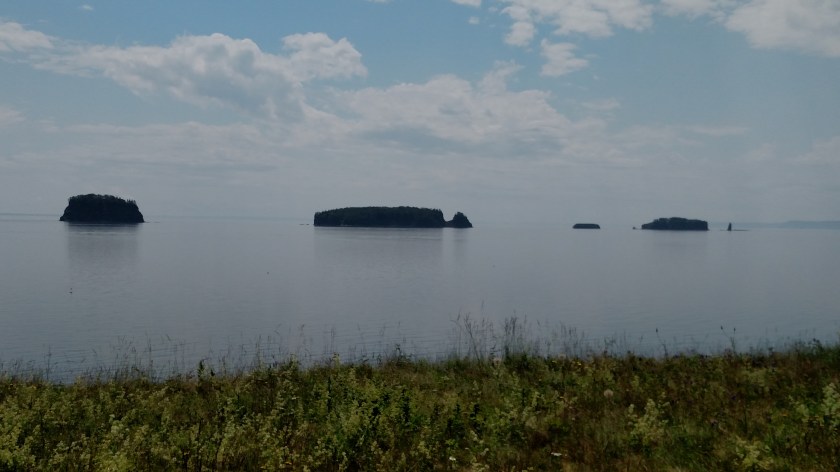
East of Two Islands is Five Islands:

IMG_20190714_135543593

IMG_20190714_135604722

I overlapped one of the islands if you want to create a panorama.  The tiny “finger” sticking up on the far right of the second photo evidently doesn’t qualify as an island.

I proceeded without further delay to Truro where I found another Tidal Bore observation area (where I saw a video of a tidal bore.  It looked kind of like the water coming ashore after a wave breaks but before it reverses direction).  I was running ahead of schedule – despite the detour – and the young man I spoke with there suggested a good restaurant in town for dinner and also suggested I visit a large city park to help pass the time.  He told me there was a nice waterfall but that I’d have to climb “Jacob’s Ladder” to get there:

IMG_20190714_173150557

I was going to play my “Go ahead, count ’em – I’ll wait” game but it isn’t a fair fight.  You can’t see all the stairs from this vantage point because they slope away from the field of view as they approach the top.

187 stairs, which helped boost my Fitbit stair count for the week.

I ended up NOT going to the waterfall.  After climbing all the way up I had to go DOWN another bunch of stairs and then go right back up to get out.  I could see the waterfall and it wasn’t anything remarkable so I just marched back down the “ladder” and went to my Airbnb for the night.


Hopewell Rocks, New Brunswick

July 13, 2019

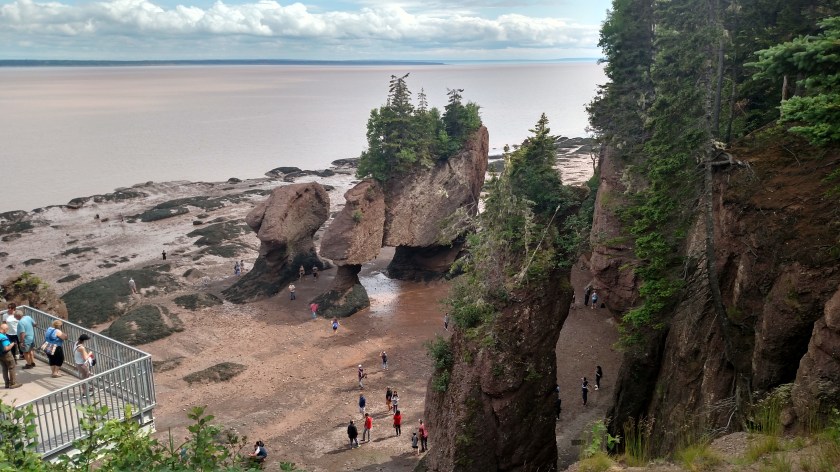
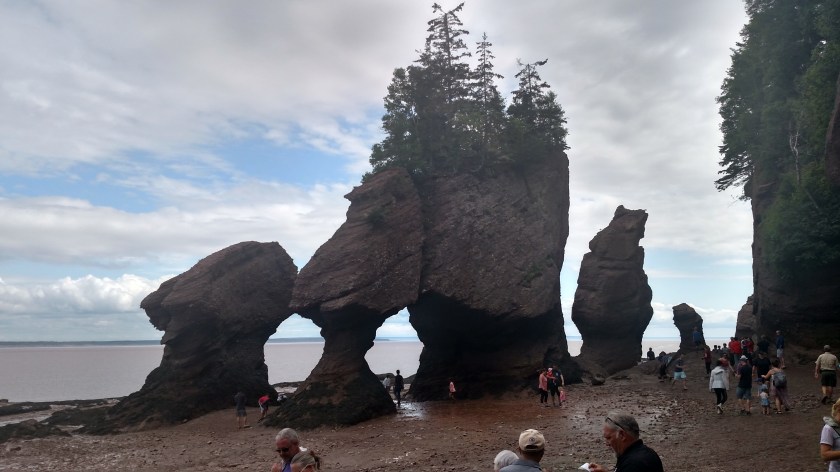
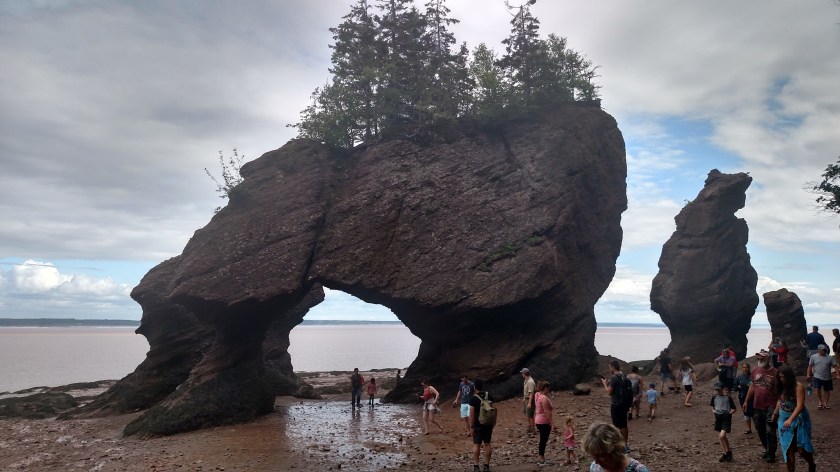
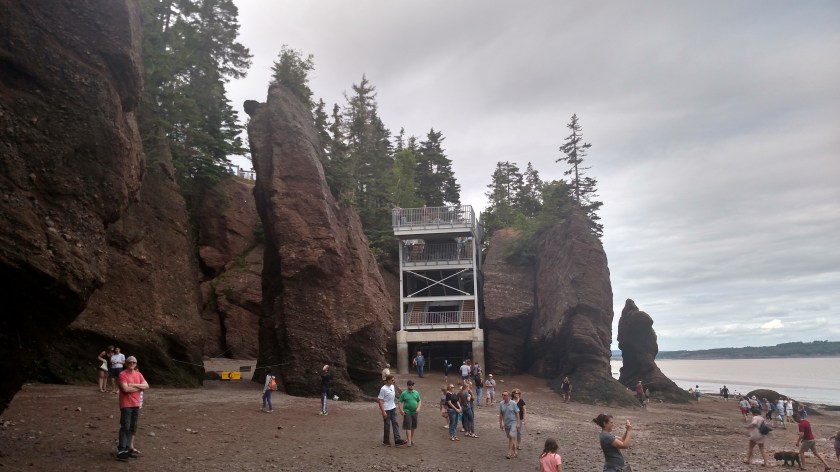
Further north up the coast from Fundy National Park is Hopewell Cape, home of the famous Hopewell Rocks.  These are flowerpot rocks on steroids:

IMG_20190713_160140474_HDR

IMG_20190713_160147448_HDR

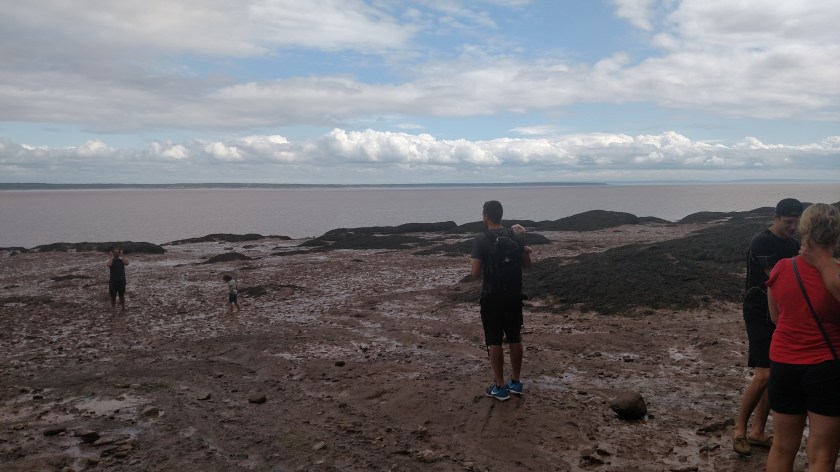
Before I go any further let me give you a quick explanation of how this works.  The body of water in these photos is the Bay of Fundy which separates New Brunswick province from Nova Scotia.  The Bay covers 6,177 square miles – about 4 times the size of the state of Rhode Island.  Give it a minute to let that fact soak in.  Every day massive amounts of water flow in and out of the Bay creating huge tides. I will explain more details at the end of this post but I’m sure you want to see more photos.

But first, an example of the difference between low and high tide at this specific location.

Low tide:

IMG_20190713_160314107

High tide:

IMG_20190713_160303073

Those are actual photos posted at the Visitor Center.  The tide here rises 46 feet.  Now I know what you’re thinking – JohnBoy, if those were adults standing out there that isn’t any 46 feet…

Well, what you may not be able to tell from those photos is that the shoreline slopes downward from the formations to where the water is currently (my last few photos were taken within a few minutes of low tide, which occurred at 426 PM the day I was there).  From low tide the water had to rise 28 feet just to get to the base of the formations you are seeing.

OK – enough talk.

IMG_20190713_160713833_HDR

IMG_20190713_160915701_HDR

IMG_20190713_160811119_HDR

IMG_20190713_160926463_HDR

The photo above shows the metal stairs leading down from the walking path to the area where everyone is milling about.  A ranger told me that at high tide the lowest two or three flights of stairs are underwater.

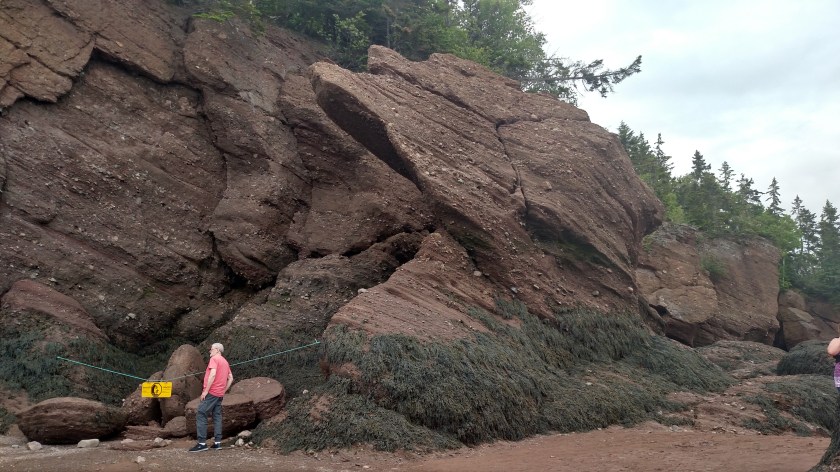
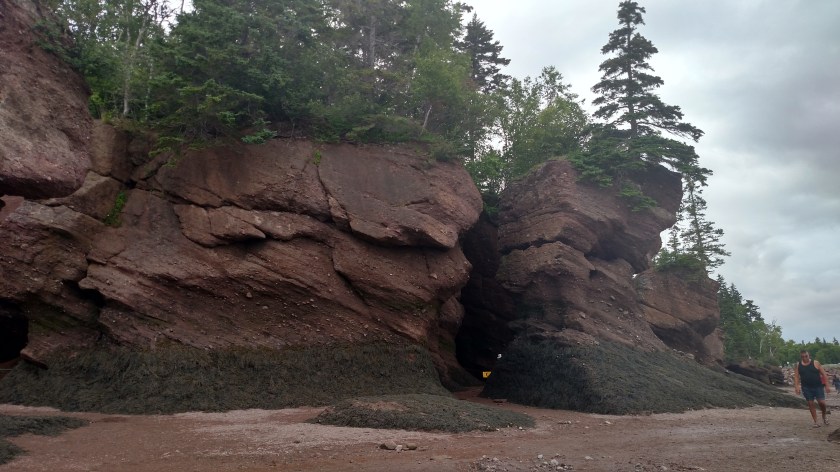
This is what one of the formations looks like up close:

IMG_20190713_160953214

IMG_20190713_161049032

The photo above illustrates my point about the current water level at low tide.  The guy with the blue shoes is standing closer to the water than the formations.  His buddy on the left who is taking his picture is clearly lower in elevation and the water behind him is even lower yet.  Just imagine how much water it takes just in the area you can see in that photo to raise the water level 46 feet…

IMG_20190713_161509774_HDR

IMG_20190713_162036309_HDR

IMG_20190713_162246046_HDR

IMG_20190713_162210669_HDR

IMG_20190713_162251637_HDR

Every day 116 billion (that’s with a B) tonnes (which equates to 127 billion US tons) of water flow in and out of the Bay of Fundy.  Now I know water is very heavy, but 127 BILLION TONS of it.  That is the equivalent of the daily discharge of ALL the rivers in the world combined.

127 billion tons in and out, twice a day, every day.   Just a massive amount of water.

Full disclosure – there are not exactly two in and out cycles every single day.  A full cycle takes a little over 12 hours.  Each day the “same” high or low time is about 35-40 minutes later than it was the day before so 2 full cycles take more than 24 hours.  For example, over the next 5 days the “evening” low tide at Fundy National Park occurs at 932 pm, then 1007pm, 1042 pm, 1119pm and midnight.

The Bay of Fundy is wide and deep at the mouth and narrow and shallow at the northeast end so that is why all that water coming in raises the tide by such large amounts.  In places the tide can rise 14 feet in an hour.

Fundy National Park

July 13, 2019

After leaving St. Martins I drove northeast back to NB-1 at Sussex and went a few miles east before exiting and driving southeast again to get to the Park.

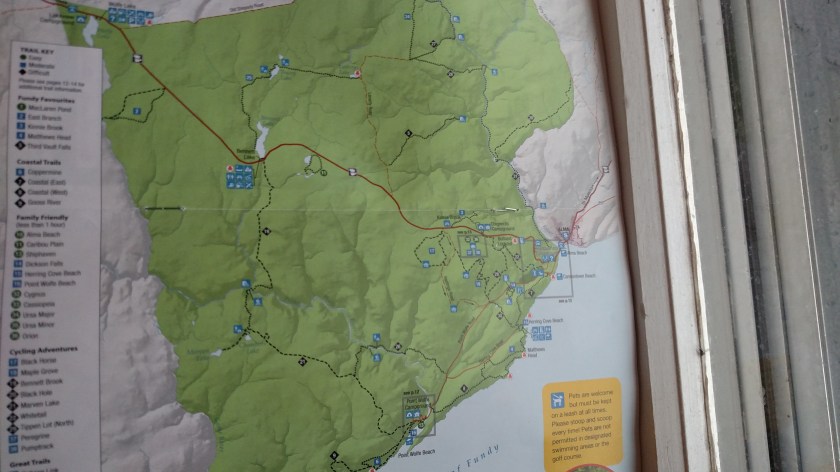
FundyMap

(Photo credit: hlanderz.blogspot.com)

IMG_20190717_201704423


I purchased a Senior Discovery Pass when I entered the Park (at the upper left hand corner on the map).  It is good for one year and will get me in to all the National Parks I will be visiting during this trip.  Unlike US National Parks, where a higher admission is generally good for 7-consecutive days from date-of-entry, Canadian Parks charge a smaller entrance fee every day.

As I surmised from my research, there wasn’t much for me to do here other than drive on the three roads in the Park.  Fundy is heavily wooded but with lots of hiking trails and campgrounds.  There is one small lake, a golf course and beach access.  The major attraction that draws most people here is actually further up the road, outside the Park.

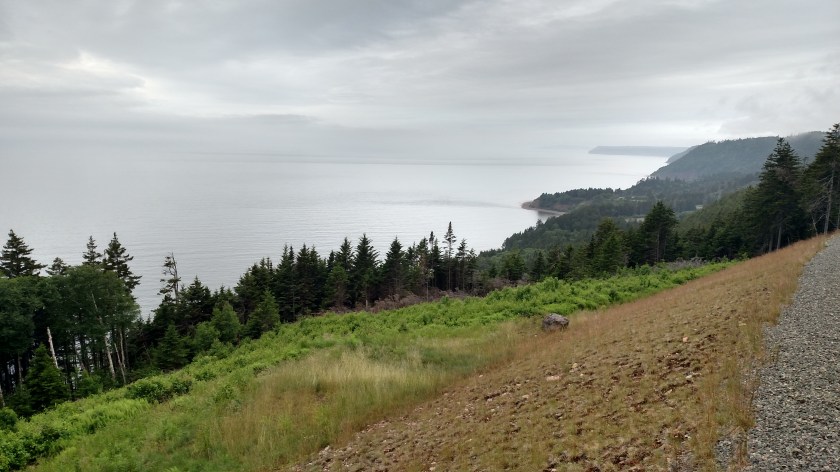
Here is a photo I took about 4/5 of the way down the main road just before reaching the Visitor Center.  As you can tell, much of the Park is on a hill which descends to the water.

IMG_20190713_121939761_HDR

Because of the cloud cover it is hard to distinguish the clouds from the water in the photo.  You can see a thin peninsula sticking out from the top of the large mountain on the left.  That appears to be part of the land mass on the opposite side of the Bay.

Probably the highlight of the Park was the covered bridge near the end of Point Wolfe Road (lower center of map):

DSCN7752

IMG_20190713_130616511

This is the view from inside the bridge. looking through an opening towards the Bay of Fundy:

IMG_20190713_130810588_HDR

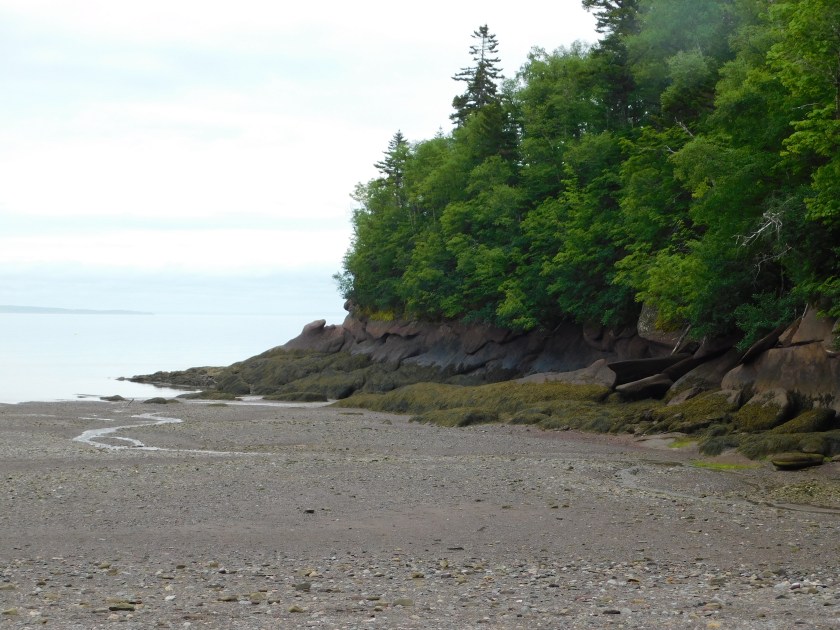
As I was heading back towards the Visitor Center I drove down Herring Cove Road, parked my car and walked down to the beach:

IMG_20190713_133320743

DSCN7766

Not that much variety to see in this Park but it was still very nice and worth the visit.

After exiting the Park and stopping to eat in Alma I drove past this beach on my way further up the coast to my next stop.

IMG_20190713_150214024

That photo was taken less than an hour and half before low tide so the water is way out.


Fundy Trail Parkway

July 13, 2019

FundyMap

(Photo credit: hlanderz.blogspot.com)

Saturday morning I set out from Rothesay (just northeast of Saint John) to drive down to the coast and check out the Fundy Trail Parkway (aka Fundy Coastal Drive). First I had to take a secondary highway southeast to the little town of St. Martins.

This was taken before I crossed NB-1, which I arrived on the day before.

IMG_20190713_070019917_HDR

And these were taken in St. Martins:

IMG_20190713_075032284_HDR

DSCN7736

The second photo is actually a different covered bridge, behind and to the left of the first one.  I didn’t even know it was there until I was on my way back to the highway after driving the Parkway.

This is the waterfront in St. Martins:

IMG_20190713_075505782


IMG_20190713_075515585

The big circle you see in the first photo above is one of several Sea Caves:

IMG_20190713_080219788_HDR

DSCN7707

The tide was going down so I still couldn’t have walked out to them without getting my tootsies wet, but at low tide people can walk out and explore them.

Shortly after taking those photos I continued up the road a short distance and arrived at the entrance to the Parkway.  The road getting there wasn’t too great (very rough) but the roadway once you get in is great – not paved exactly, but fairly new crushed gravel (compacted, not loose) which was in excellent shape.  Admission was $8 (for me, now a Senior!) and it was worth every Canadian nickel (they don’t use pennies – they round cash purchases up to the nearest nickel).  A gorgeous 17-mile drive with lots and lots of scenic overlooks.  No billboards or human residents – just you and Mother Nature.  On the way in I didn’t even see another vehicle except in parking areas and I saw very few people coming in as I was on the way out.  The road currently ends before reaching Fundy National Park but it will hopefully get all the way there in the next year or two.

IMG_20190713_082624455_HDR

This is the view of the Big Salmon River as it drains into the Bay of Fundy near the Visitor Center for the Parkway.

IMG_20190713_084509241_HDR

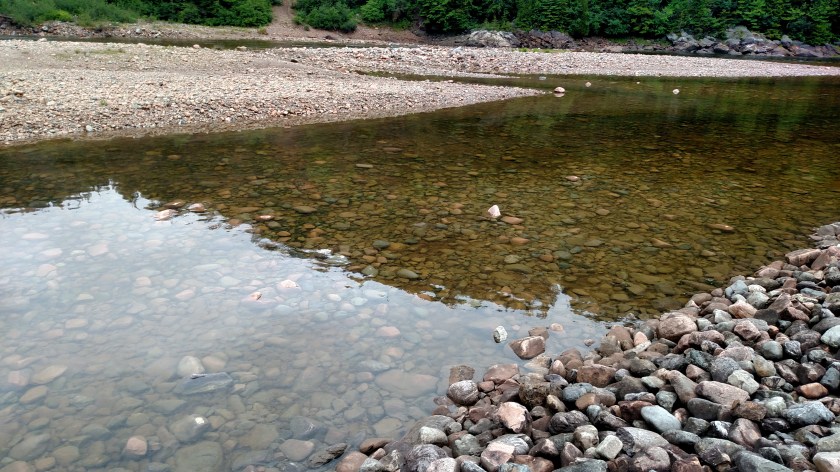
Since this is river water it is crystal clear:

IMG_20190713_085110294

I saw these Red-Breasted Mersangers swimming in the river – Mother with one young’un hitching a ride on her back and two others swimming behind.

DSCN7726

IMG_20190713_094257012_HDR

IMG_20190713_094606778_HDR

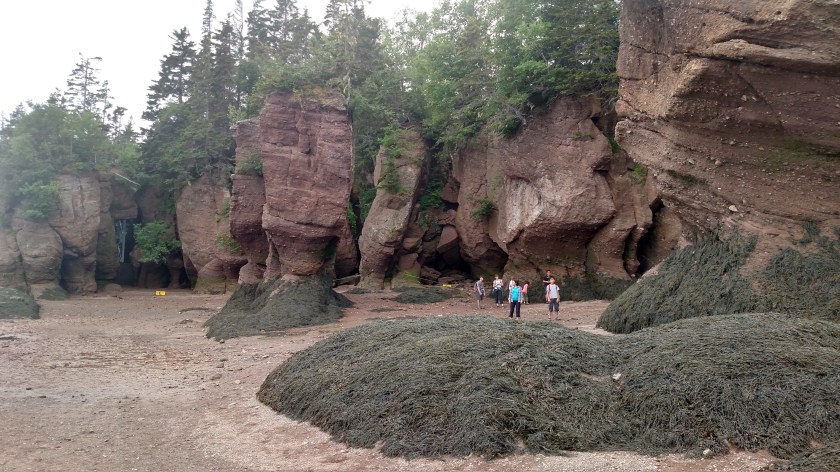
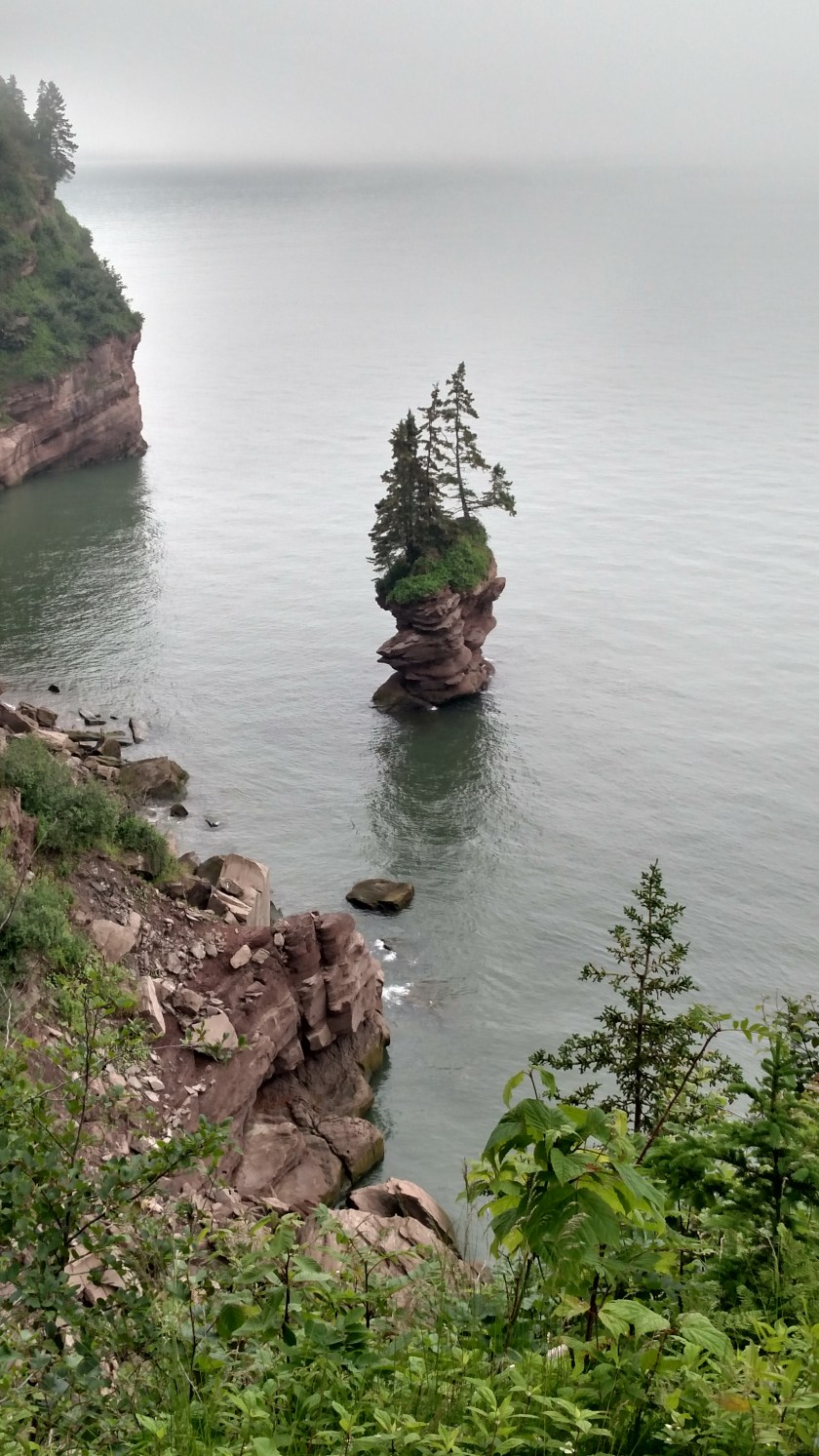
This is a “flowerpot rock,” so named because when the tide is low you can see it is attached to the ground but when the tide is high it looks like a freestanding flowerpot with trees growing out of it:

IMG_20190713_100810658_HDR

And as seen from the other side (from further up the trail):

IMG_20190713_101237867

Pretty cool, eh?