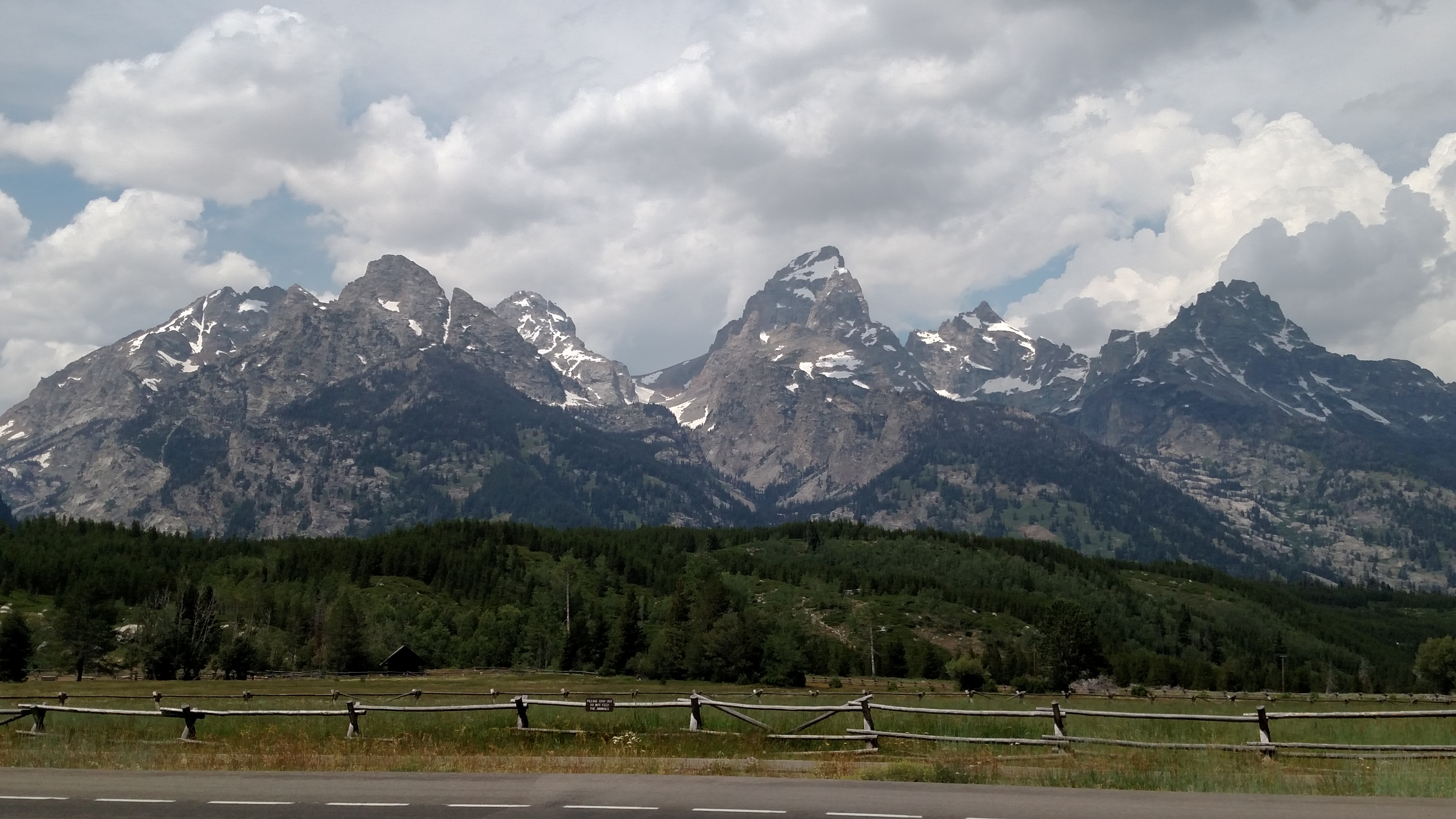
Grand Teton National Park


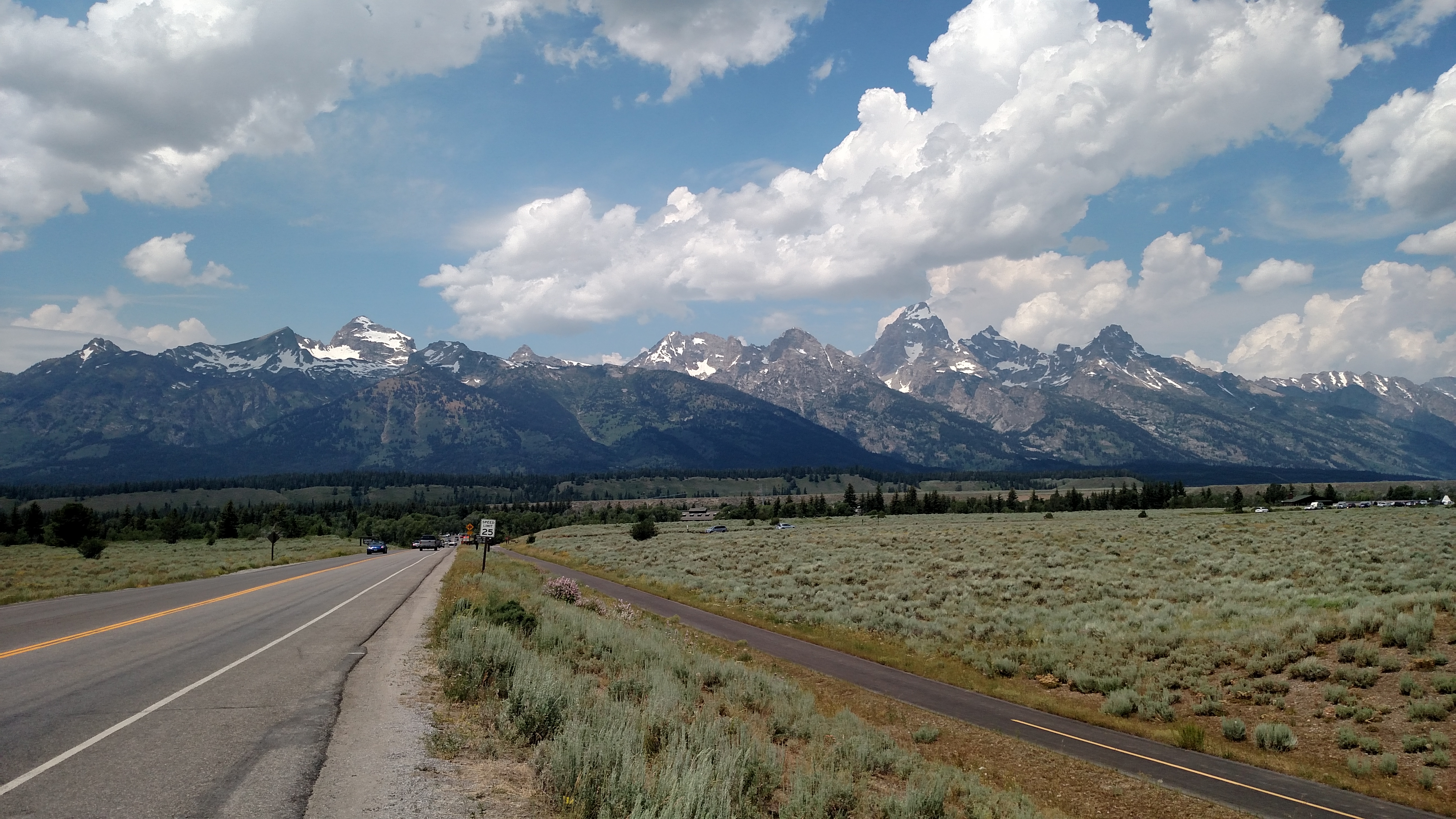
You get a twofer on this one.  Sunday I drove down west of Yellowstone and through a portion of southeast Idaho before crossing over to Jackson, Wyoming.  The town itself is named Jackson.  The valley between the Teton and Gros Ventre mountain ranges is what is known as Jackson Hole.  Just north of Jackson is Grand Teton National Park.  The mountains stretch for 40 miles.  I posted the top picture to try and capture the length of the range (and you are only seeing a portion).  The bottom picture shows how rugged these mountains are.

In the middle of the bottom picture is Grand Teton, which tops out at a whopping 13,770 feet.  To the left is Middle Teton and to the right is Mount Owen.  Even at 13,770 feet Grand Teton is not the highest point in Wyoming.  That honor goes to Gannett Peak at 13,809 feet.  It is located a little bit southeast of the Teton range.

The accessible part of the National Park lies to the east of the mountains.  The main road through the park runs pretty much parallel to them until reaching a series of lakes, at which point it starts getting further away.  There are no roads in the mountains themselves.  So visitors basically travel the main road and see the mountains from varying perspectives.  There is a bicycle path which runs parallel to Teton Park Road and I saw many, many bikers (it is fairly level, unlike the roads in most National Parks).  There are lots of trails which branch out between the road and the mountains.

There are two small lakes, Jenny Lake and Leigh Lake, which are south of the largest lake, Jackson Lake up near the north end of the range.  There are also two small lakes located east of Jackson Lake, Two Ocean Lake and Emma Matilda Lake.  There are several lodges at various points in the Park, as well as several campsites.

Missoula, Montana

You are looking at the home of the Missoula Smokejumpers.  It is part of the US Forest Service (which is very different from the US Park Service).  This is where people train to be dropped into areas where forest fires are burning which are too remote to be accessed by conventional means.

There are 7 smokejumper bases run by the Forest Service in the western United States, two in Montana (here and in West Yellowstone), two in Idaho, and one each in Washington, Oregon and California.  The Bureau of Land Management also operates two smokejumper bases, one in Idaho and one in Alaska.

Obviously this type of work is physically and mentally demanding and requires a substantial amount of training.  Jumpers must be in excellent condition and be able to carry a 110 lb. pack on mountainous terrain.

There is a small visitor center here.  Unfortunately I didn’t have time to stick around for a tour of the facility.


Helena, Montana

I visited Yellowstone on Thursday and Friday and thought I’d leave it to the tourists over the weekend.  Saturday I decided I’d like to see more of Montana so I took a long drive north and west of Bozeman, where I am staying.  I drove north to Helena (the state capital), then west to Missoula, then south to the Idaho state line, then east and back to Bozeman.

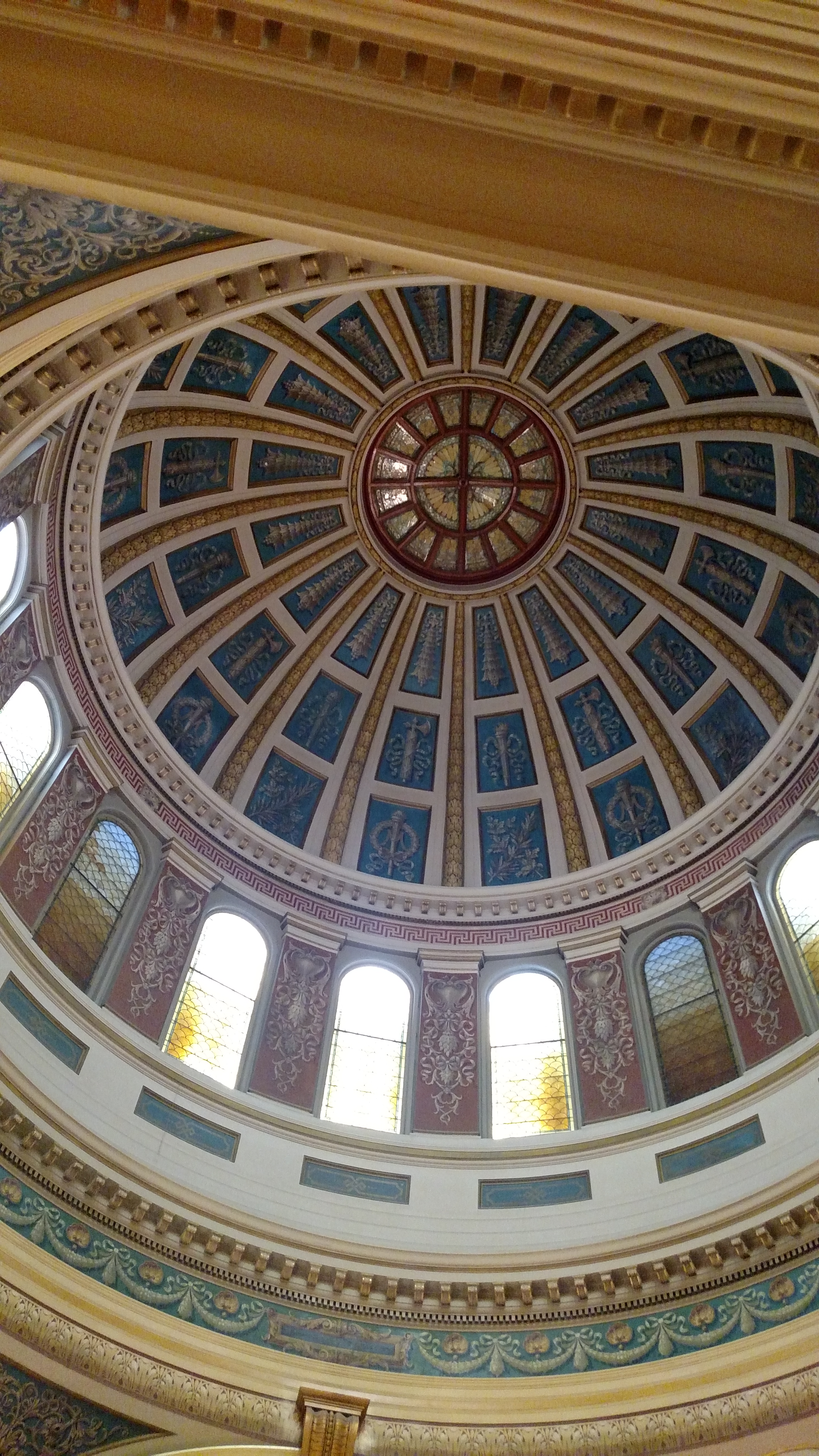
You are looking at the rotunda inside the Montana state capitol.  I was told this building recently underwent a major renovation and believe me, it shows.  It is absolutely gorgeous.  The main lobby is breathtaking and even the tilework on the floors (I was on three different levels) was amazing. I was hoping to take a photo looking straight up into the dome but there was a tour group congregated in the lobby so I couldn’t get there.  I do have a picture looking straight up in the rotunda of the Texas state capitol but that will have to wait until we get to that part of our program.

While in Helena I also visited the Cathedral of St. Helena which is a huge church not far from the capitol.  It is a very impressive building (inside and out) and I was told by someone there that it might not even exist but for a $1 million donation by a wealthy miner.

Next I drove over to Missoula to see a carousel featuring hand-carved animals made by a local cabinetmaker (it may warrant it’s own blogpost), the Elk Country Visitor Center, and Smokejumpers Base (shown in the post above).  I then drove south on a very nice scenic road until I got to the Idaho state line where I turned east.  More nice scenic back roads until I got back to an interstate, which I took to Butte (stopping to take pictures of the homes of a wealthy copper-baron and his son) then back to Bozeman.

********

When I left the dreaded interstate and started driving north towards Helena I saw what appeared to be about 20 horses grazing on a small hill left of the road.  As I was getting ready to go past them I looked again and discovered, much to my amusement, that they were fake!  Kind of like cardboard cutouts (but undoubtedly made of wood or metal) these were life-size, or many even a little bigger, images of horses.  It really cracked me up.

Yellowstone Inn

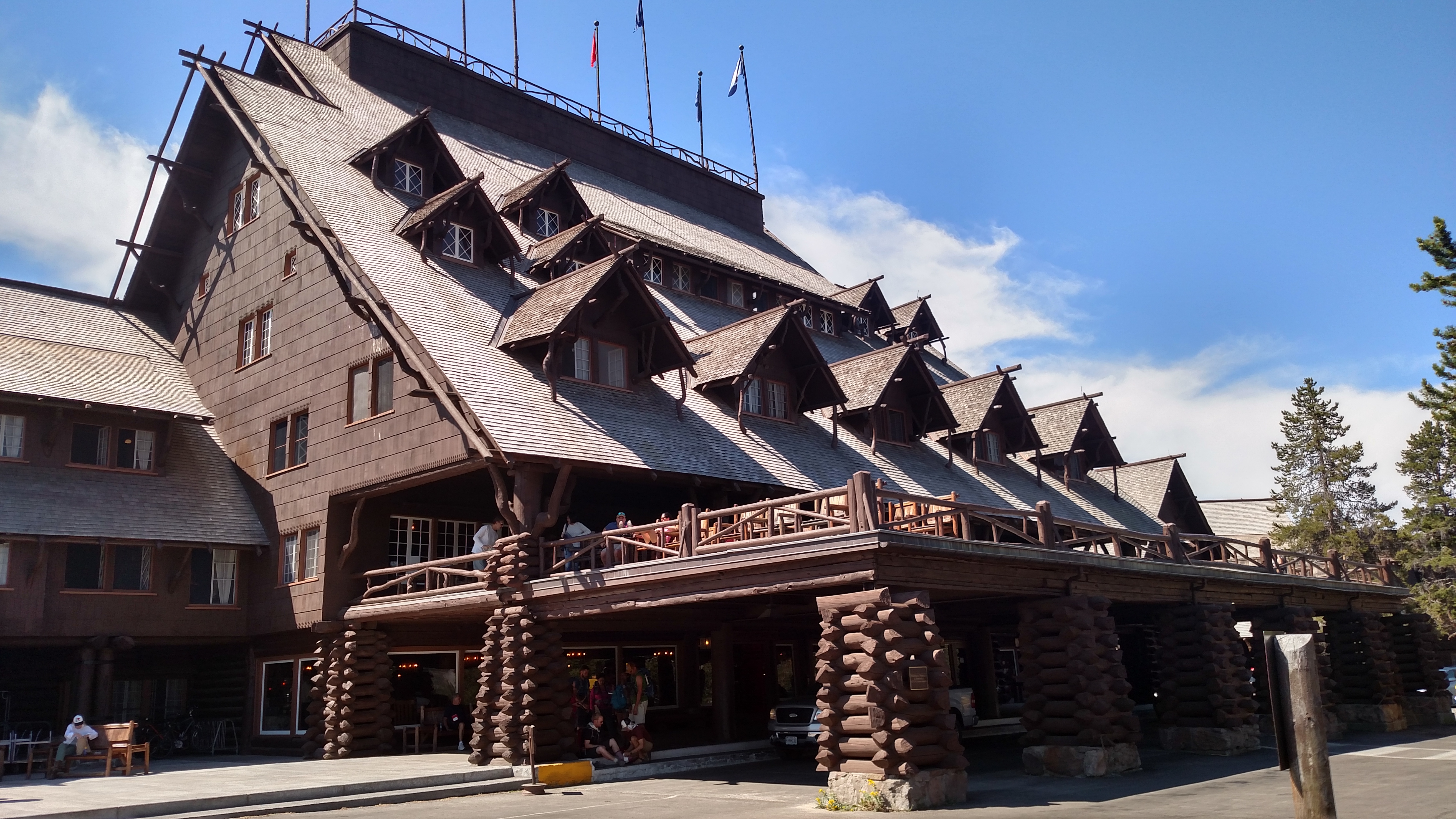
This is the majestic Yellowstone Inn, located a short walk from the Old Faithful geyser in Yellowstone National Park.  It is sometimes referred to as the Old Faithful Inn.  It was completed in 1904 and is one of the largest log structures in the world.  It has over 300 rooms.  The lobby is huge and is open to see all the way up to the roof!

45th Parallel (North)

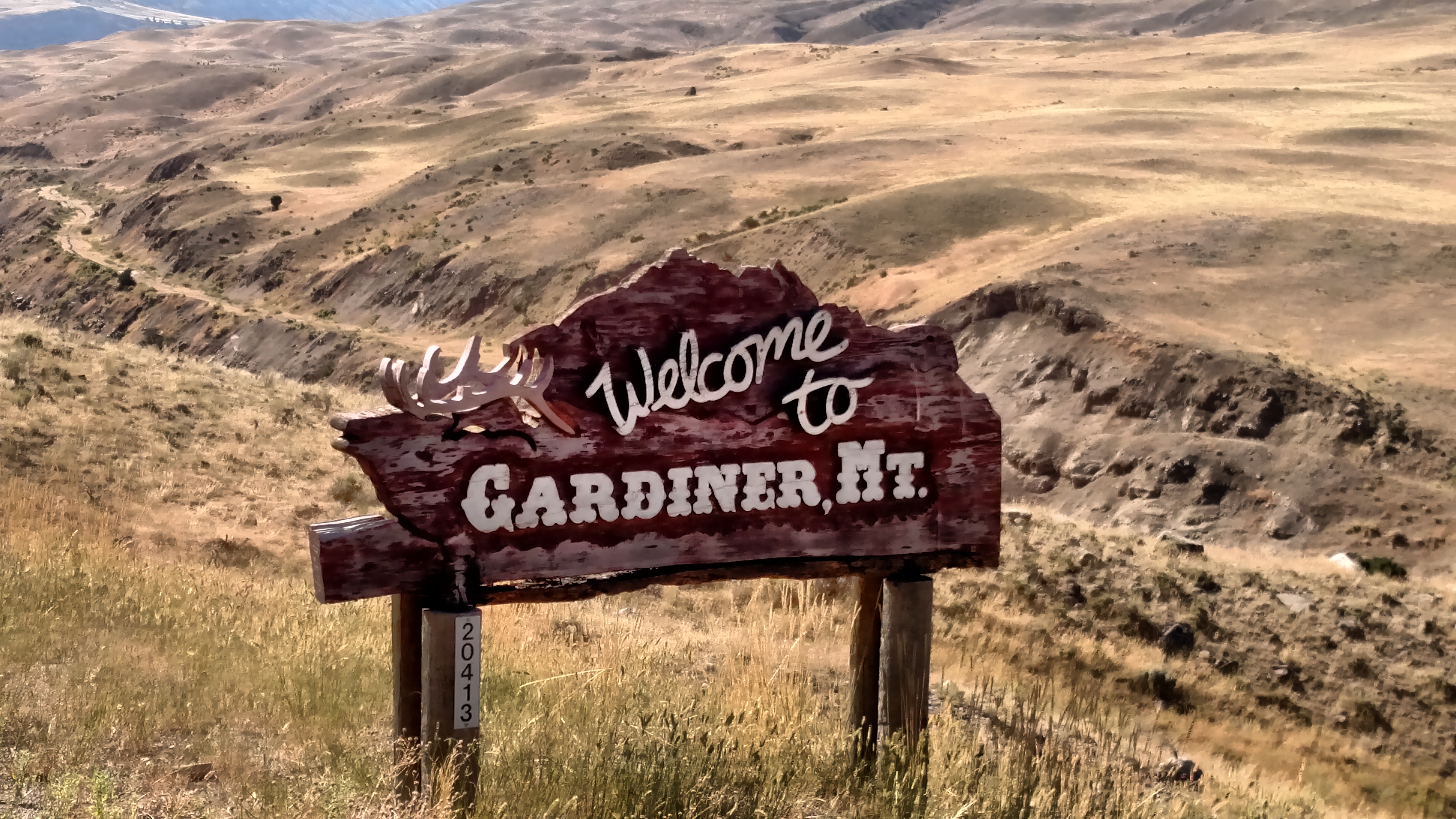
I originally took this picture to send to friends of mine whose last name is Gardiner.  This little town (pop. 875) is located just outside the north entrance to Yellowstone National Park.  Coincidentally, the Gardiners visited Yellowstone just a few weeks ago with their kids and came out to have lunch here.  But there is another reason why I’m telling you all this….

Gardiner is located near the 45th Parallel, the point halfway between the equator and the North Pole (the sign marking the exact point is just inside the Park entrance).  I first saw a sign denoting this distinction when I passed through Stewartstown, NH (VERY close to the Canadian border) two years ago while touring New England.  Other US towns located near the 45th are Minneapolis, MN and Wausau, WI.  This gives you some idea how far north I am right now.

In a few days I’ll be heading up to Kalispell, MT, just outside Glacier National Park.  Kalispell is a little north of the 48th Parallel (or 48 degrees north of the equator).  For those of you in the east, this will put me the equivalent of being north of Quebec City (or at the very tippy-top of Maine).

FUN FACT

If you lived in Provo, Utah (approx. 40 degrees north) and Kevin Bacon lives in Los Angeles (34 degrees north) then you could say there is six degrees of separation between you and Kevin Bacon!   Thank you, and goodnight…. I’ll be here all week.  Remember to tip your waitresses……

A bison amongst the geysers

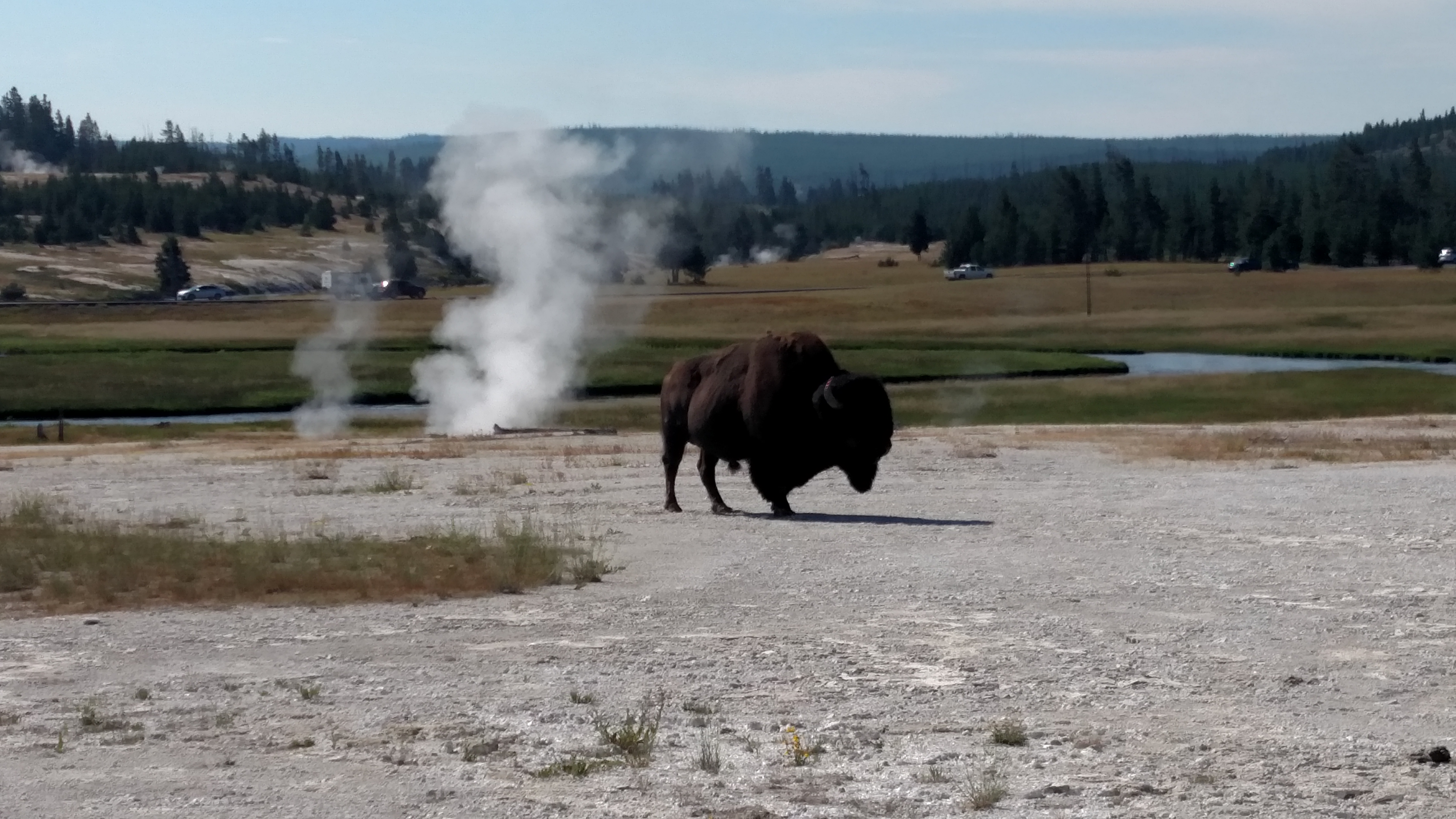
This guy was hanging out in one of the geyser basins.  He stayed right where he was the whole time I was there.

FUN FACTS

Both male and female bison have horns.  So how do you tell a male from a female?  (Really??  Do we need to have “the talk”….)

In addition to the obvious plumbing differences, male bison have a more pronounced hump on their back, have more hair on their heads and forelegs, and weigh about twice as much as a female.  There are also subtle differences in the shape of their head and the relationship between their shoulder width and hips.

If you see a bison raise its tail you have probably done something to piss him off and you should start paying closer attention to him than you already are.  This action means they are angry (or maybe they’re pooping).  If they aren’t pooping than be advised of this:

Q:  How fast can a bison run?

A:  Faster than you.

An average human can run about 10-15 mph.  Usain Bolt has been clocked at 28 mph.  A 2,000 pound adult male bison can get up to 35 mph.  So if you see that tail go up you’d better start heading for the exit.

Moose Day in Yellowstone

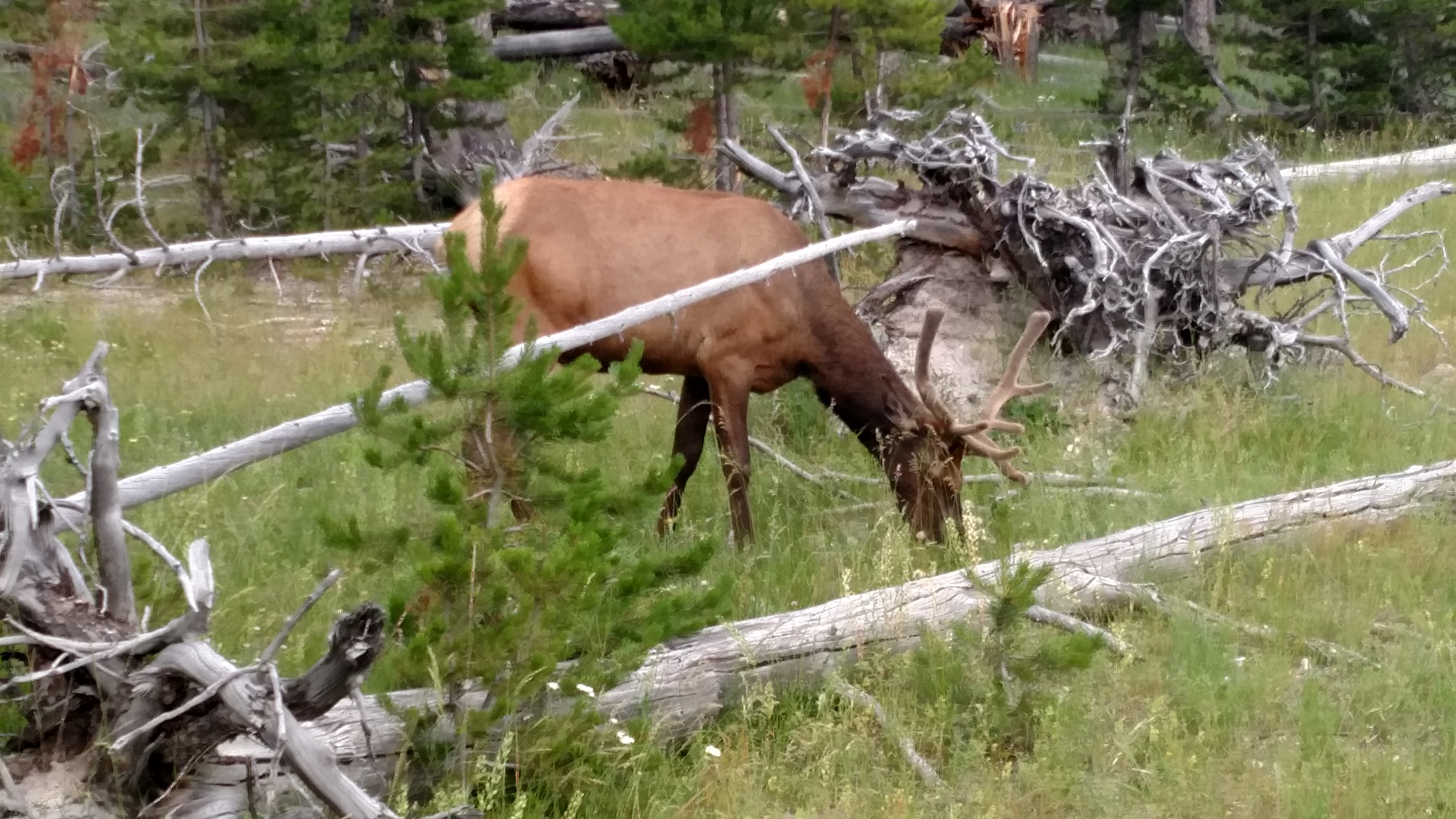
In addition to seeing many more bison I saw lots of moose today.  This was the only male, and was grazing right next to the road late in the afternoon.  I was hoping he’d raise his head a little more but then a ranger yelled at me for being too close (“but it’s for my blog peeps, ma’am….”) so I had to back away.

Earlier in the day a large female moose (called a cow, but it was definitely a moose) crossed the road right in front of me.  I had just come around a turn and there she was.  By the time I got my camera unlocked and ready, poof, she was gone.  There was a steep embankment next to the road and she had already gone down it.

Later I saw several females with some young’uns laying in tall grass near the road.  All I could see were their heads and their ears twitching.  When I got out of the car several of them stood up and moved a short distance before laying back down in the grass.

And as I was leaving the Park for the day I saw several more females both next to and in the road.  They were mainly showing me their backsides so the pictures aren’t very flattering.

********

I also saw a black bear today, although by the time I got up to where it was it had gotten  so far up the hill I could not get a good picture.  Funny thing when you are driving in the Park –  If a car is stopped by the road then 6 more will stop.  If a car is stopped and someone is pointing, 12 more will stop.  I talked to a guy who used to work in the Park and he said when tourists would pull up behind him and start tailgating, all he had to do was point off to the side of the road and they’d all pull over and stop.

I also saw two brown bears today (most likely grizzly’s in these parts).  They were both outside the park (I had to drive about 90 miles down from Bozeman to get to the closest entrance). I saw one this the morning on the way down and one in the evening on the way home.  Both times they were pretty far off the road but you could tell they were VERY big.

********

This post is dedicated to my brother Stephen who, despite spending many summers vacationing in Maine, has yet to see a moose in the wild.

And I did resolve an earlier question.  The naming rules for Cows (I’ll have to start calling them Moo Cows), Moose and Bison are all the same:  Bull/Cow/Calf/Herd.

Yellowstone Lake

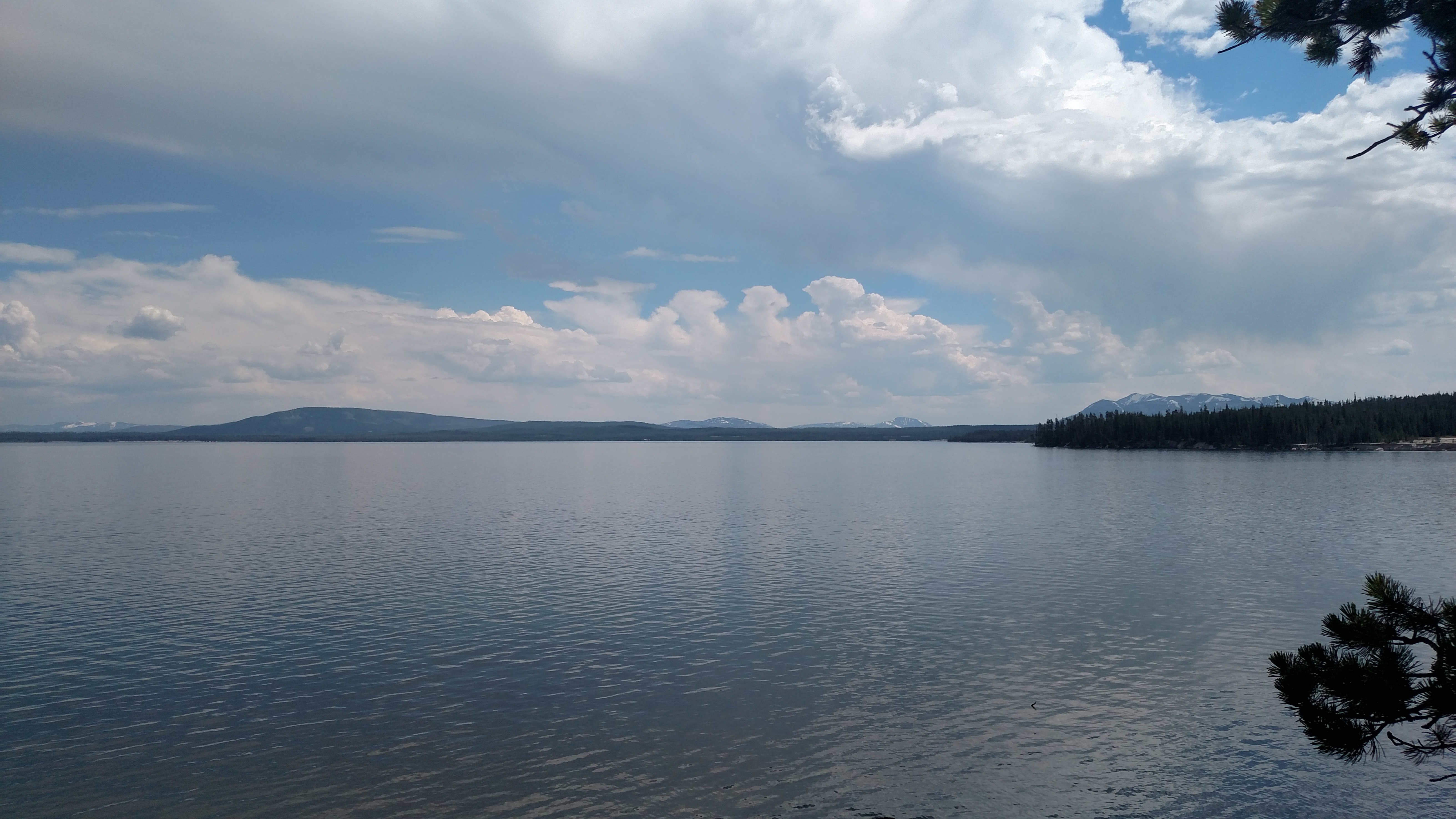
After driving around the park for much of the day I decided to take a break by Yellowstone Lake.  It is in the southern park of the Park and is huge. I got my chair out of the car, grabbed my binoculars and found a nice spot in the shade.  There were no boats or jet-skis (they launch in the northernmost part of the lake) so it was very serene (well, except for the vehicles zipping by behind me).  There were short breaks when there was no traffic, though, and then it really was quite tranquil.

You are only seeing about 1/3 of a very small portion of the lake called the West Thumb.  Yellowstone Lake is at an elevation of 7,733 feet (I got that from the official map of the park.  I didn’t drive out there to verify it with my GPS!). It alone is 136 square miles in size.  For you folks back in North Cackalacky, that makes it seven times larger than Falls Lake.  For those of you not familiar with that reference, it is larger than Durham (City) and Chapel Hill combined.  Despite it’s size, the lake completely freezes over in the winter.

The area north and east of the lake suffered a big fire back in 1988 (really big) and all the trees are dead.  New growth is starting to show, though, and while it will take a while it should eventually regain its majesty.  The 1988 fire was so big that the entire Park closed for the only time in it’s history.  The fire ultimately affected 36% of the park in one way or another.

After about 30 minutes I hopped back in the car and resumed my adventure.  Lots more to see and do!

Bubble bubble, toil and trouble

This is one of the small, but entertaining, hot springs.  There is often a gurgling sound which, on the larger springs, sounded like a washing machine running with the lid open.  There was one spot where you could hear the water gurgling in a tunnel and the whooshing sound of the steam coming out made it seem like the snout of a fire breathing dragon (but without the flame).  I have video of that and hopefully you’ll be able to hear it as well.

Given that this is Mother Nature at work, geysers and hot springs are unpredictable.  They may appear dormant but then will suddenly break out in a flurry of activity.   I tried taking still pictures of one of the geysers which went through a whole range of eruption levels in the course of just a few minutes.  Again, the still pictures really don’t capture the fun of watching them in action.  After watching that geyser erupt for a few minutes I turned around (literally just shifted my body by about 75 degrees) to take this picture.  Of course then the geyser (now behind me) went nuts, shooting water so high it I could feel the mist from it on my back.  I turned around and started shooting video again and it sat and did nothing….

Sapphire Pool, Yellowstone

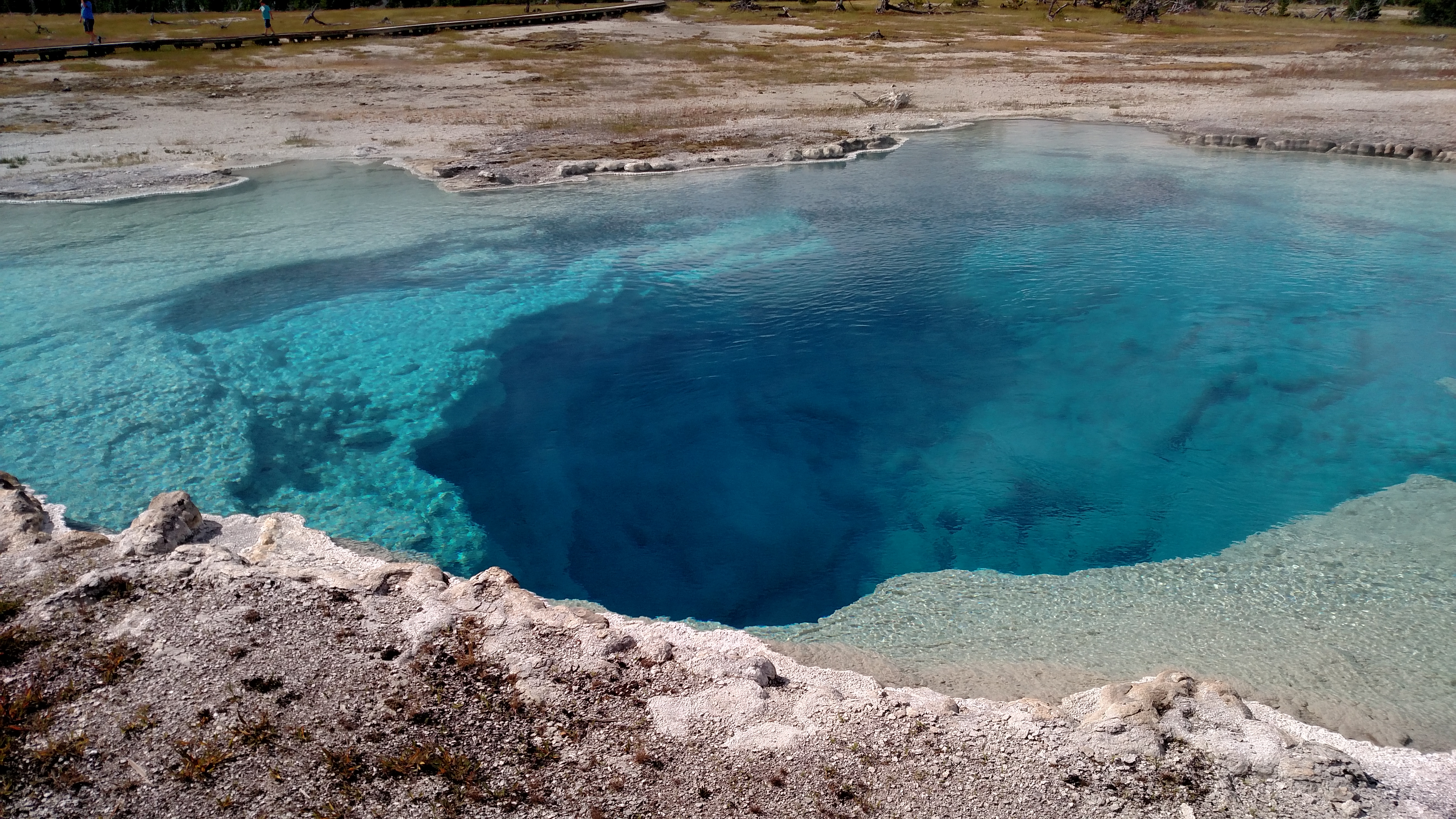
I replaced the picture I originally posted here with one that more accurately represents the true color.  It is crystal clear and simply gorgeous.
There is an area of the Park where there are several “basins” holding a variety of geysers, mud pots, fumaroles, hot springs and other interesting hydrothermal features.  There is a very strong sulphur (rotten egg) odor present when you are near these basins.

It is hard to capture the beauty and character of these various things with still pictures.  I did take short video clips of many of them and will share them when I get home.  I waited almost an hour and a half to watch Old Faithful erupt and have video of it.  It erupts every 35 to 120 minutes and evidently I got there shortly after it had just done so, so had to wait what turned out to be more towards the longer end of the range.